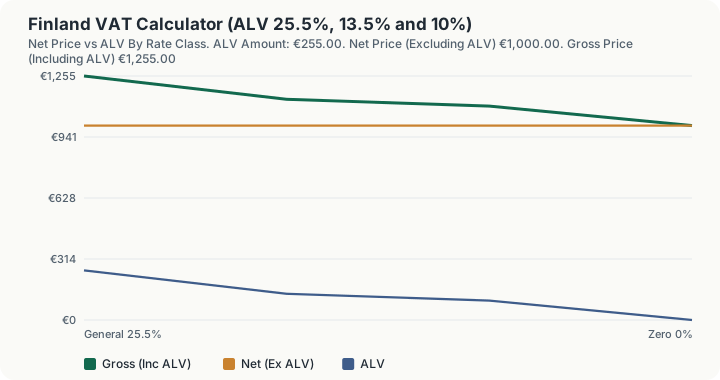
Quick Answer: Adding the general rate to a €1,000 net price gives €255.00 of ALV and a €1,255.00 gross price. Going the other way matters more: removing ALV from a €1,000 gross price gives €203.19, not €255, because the VAT fraction is 25.5/125.5 = 20.32% of the gross, not 25.5% of it.
What does this calculator do?
Finland's value added tax (arvonlisävero, ALV) runs on four rate classes in 2026: the general rate of 25.5%, a reduced rate of 13.5%, a second reduced rate of 10%, and a zero rate. Two things changed on 1 January 2026 and both invalidate templates written for 2025.
First, the entire 14% class fell to 13.5%. Food, beverages and food ingredients, animal feed, restaurant and catering services, books in print and electronic form, pharmaceuticals, sanitary protection and baby nappies, sports and fitness services, admission to cultural and entertainment events, passenger transport, accommodation and performers' fees all moved together.
Second, public broadcasting services moved up from 10% to 13.5%. That leaves the 10% class in 2026 containing newspapers and magazines, printed and electronic, and nothing else. Any Finnish invoicing template still carrying a 14% line, or still putting broadcasting at 10%, is wrong for 2026.
Finland's general rate is also the awkward one arithmetically. At 20%, backing VAT out of a gross price is exactly one sixth. At 25%, exactly one fifth. At 25.5%, it is 25.5/125.5, which is 20.3187% of the gross, close enough to a fifth to be mistaken for one and far enough away to fail a reconciliation by around €3 per €1,000.
How is this calculated?
Adding ALV to a net price:
Gross = Net × (1 + r); ALV = Net × r
Removing ALV from a gross price uses the VAT fraction:
ALV = Gross × r/(1 + r); Net = Gross − ALV
Step 1: Select the rate from the rate class. General 25.5%, reduced 13.5%, second reduced 10%, or zero 0%. The calculator does not decide which class your supply falls in; you tell it.
Step 2: If adding, multiply the net amount by the rate. That product, rounded to the cent, is the ALV.
Step 3: If adding, add the ALV to the net to get the gross.
Step 4: If removing, multiply the gross amount by the VAT fraction r/(1+r). That product, rounded to the cent, is the ALV.
Step 5: If removing, subtract the ALV from the gross to get the net.
Step 6: Report the VAT fraction as a share of gross. The rate divided by one plus the rate, shown as a percentage of the gross price.
Step 7: Build the comparison table on the net amount. The four rate-class rows are all generated by applying each rate to the net amount from Steps 2 to 5. So when you remove ALV from a gross price, the table shows what that recovered net price would cost under every rate class.
Step 8: Show the same net amount at the pre-2026 reduced rate. The net amount multiplied by 1.14, alongside the difference between 14% and 13.5% of that net amount, to size the 2026 rate cut.
Step 9: Check the registration threshold, if a turnover figure was entered. Compare calendar-year turnover against €20,000. Strictly above the threshold means registration applies. At or below it, the small-business exemption is available. Entering zero leaves the check unassessed.
Worked Example
A Finnish consultancy quotes €1,000 net for a piece of work at the general rate.
Step 1: The rate. General class, so r = 25.5%
Step 2: The ALV. €1,000 x 25.5% = €255.00
Step 3: The gross invoice total. €1,000.00 + €255.00 = €1,255.00
Step 4: The VAT fraction. 0.255 / 1.255 = 20.3187%, displayed as 20.32% of gross
Now run it in reverse, which is where estimates go wrong. A retailer has a €1,000 shelf price including ALV and needs the net figure for their books.
Step 5: ALV in the gross price. €1,000 x (0.255 / 1.255) = €1,000 x 0.203187 = €203.19
Step 6: The net price. €1,000.00 - €203.19 = €796.81
Step 7: The error from using the rate instead of the fraction. €255.00 - €203.19 = €51.81 overstated on a €1,000 gross price
And the 2026 reduced-rate cut, sized on the €1,000 net amount:
Step 8: Gross at the old 14% rate. €1,000 x 1.14 = €1,140.00
Step 9: Gross at the new 13.5% rate. €1,000 x 1.135 = €1,135.00
Step 10: The fall in the gross price. €1,140.00 - €1,135.00 = €5.00 per €1,000 of net price
That last figure assumes the retailer passes the cut through to the shelf price in full, which is a commercial decision rather than a tax rule.
What does this calculator not account for?
- It does not tell you which rate class a supply belongs to. That is the substantive VAT question and it is not modelled. You choose the class; the arithmetic follows.
- VAT-exempt activities are not modelled and are structurally different from the zero rate. Healthcare, medical and social services are exempt: no output VAT is charged and no input VAT is deductible. Under the 0% rate, input VAT is deductible. Treating an exempt supply as a 0% supply will produce the wrong recoverable-input position.
- The graduated small-business relief (alarajahuojennus) is deliberately not implemented, because it no longer exists. It was available until 31 December 2024 and is not available for accounting periods starting on or after 1 January 2025. A Finnish business in 2026 is either under the €20,000 limit and outside the system, or over it and paying full VAT from the first euro. There is no taper to model, and modelling one would overstate relief that has been abolished.
- Input VAT recovery is out of scope. This computes output VAT on a single amount. It is not a VAT return: it nets nothing off for purchases.
- Cross-border rules are absent. Reverse charge, intra-EU acquisitions, the One Stop Shop, distance selling and imports all change who accounts for the VAT and are not covered.
- The "old 14% rate" comparison always applies 14% to the net amount, whatever rate class you selected. It is a sizing tool for the reduced-class cut. If you have selected the general rate, that comparison row is not describing your supply.
- The rate comparison table is always built from the net amount. In remove mode, that is the net recovered in Step 5, not the gross you typed in.
- Registration is assessed on the figure you enter, on the calendar year. The threshold has been measured on the calendar year rather than the accounting period since 1 January 2025. The calculator does not know your accounting period, prior-year turnover, or whether you have registered voluntarily.
What mistakes do people make with this?
- Using 25.5% to strip VAT out of a gross price. The single most common Finnish VAT error. The correct divisor is 1.255, or equivalently the fraction 25.5/125.5. On a €1,000 gross price the two methods differ by €51.81.
- Rounding the VAT fraction to one fifth. 20.3187% is not 20%. On €100,000 of gross turnover the shortcut is out by roughly €3,187.
- Still invoicing at 14%. That class ceased to exist on 31 December 2025. A 14% line on a 2026 invoice is a wrong rate, not a rounding difference.
- Leaving public broadcasting at 10%. It moved up to 13.5% on 1 January 2026. In 2026 the only things at 10% are newspapers and magazines.
- Expecting relief just above the threshold. Crossing €20,000 of calendar-year turnover means full VAT, not tapered VAT. The relief that used to soften the transition was abolished.
- Measuring the threshold on the accounting period. Since 2025 it is the calendar year. A business with a non-calendar accounting period can be over the line on a calendar-year measure while looking safe on its own year-end.
- Confusing exempt with zero-rated. Both charge nothing to the customer; only one lets you reclaim input VAT.
Frequently Asked Questions
What is the VAT fraction for Finland's 25.5% rate?
What changed in Finnish VAT on 1 January 2026?
Do I have to register for Finnish VAT?
Is there still small-business VAT relief in Finland?
What is at 13.5% in 2026?
Does the rate cut mean prices fell?
Sources
- Verohallinto (vero.fi), "Rates of VAT", vero.fi/en/businesses-and-corporations/taxes-and-charges/vat/rates-of-vat: the 25.5% / 13.5% / 10% / 0% rate table, the statement that "Up to 31 December 2025, the reduced rate was 14%", and the move of public broadcasting from 10% to 13.5%. Read 2026-08-31.
- Verohallinto (vero.fi), "Changes to taxation in 2025", vero.fi/en/About-us/newsroom/changes-in-taxation/changes-to-taxation-in-2025: the €20,000 calendar-year registration threshold, raised from €15,000 with effect from 1 January 2025, and the abolition of the alarajahuojennus for accounting periods starting on or after that date. Read 2026-08-31.
Full citation block, including the scope exclusions, is in engine/primitives/finland-vat.ts.