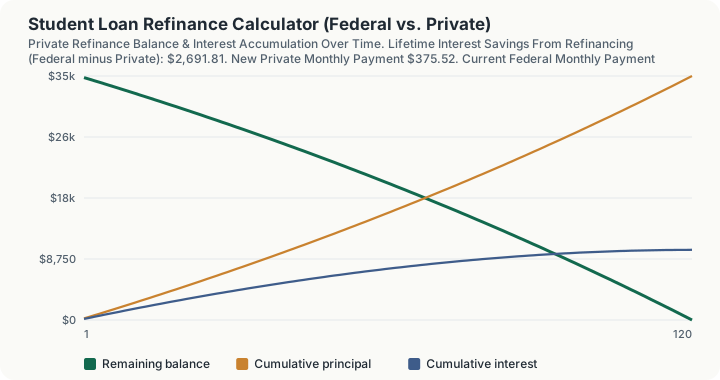
Quick Answer: Refinancing a $35,000 federal loan balance at 6.53% into a 10-year private loan at 5.25% lowers the monthly payment by $22.43 and saves $2,691.81 in lifetime interest, but that comparison covers only the math; refinancing to private also permanently forfeits federal protections like income-driven repayment, Public Service Loan Forgiveness eligibility, and federal deferment and forbearance, none of which this dollar figure accounts for.
Overview
Refinancing federal student loans into a private loan is often pitched as a simple rate-improvement decision, and the monthly payment and interest math genuinely can look better with a private lender, especially for borrowers with strong credit and stable income. But the comparison most refinance calculators run, and the one this calculator runs in its headline number, is incomplete on its own, because federal student loans carry a set of protections and programs that private lenders do not offer and that cannot be added back once you refinance. This calculator computes the payment and interest comparison plainly, then spends real space explaining what that comparison does not, and cannot, put a dollar figure on.
As of this writing (verified August 2026), the federal student loan program landscape has changed meaningfully in the past two years. The SAVE Plan, an income-driven repayment plan introduced in 2023, was blocked by a federal court in June 2024, ruled unlawful by the Eighth Circuit Court of Appeals in February 2025, and a further March 2026 court order ended the Department of Education's ability to implement it. It has been replaced, effective July 1, 2026, by the Repayment Assistance Plan (RAP), created by the FY2025 reconciliation law, which now stands alongside the older Income-Based Repayment (IBR) plan as one of two income-driven repayment options for federal borrowers going forward. Public Service Loan Forgiveness (PSLF) remains active; separately proposed employer-eligibility rule changes that were set to take effect July 1, 2026 were blocked by federal courts. Every one of these programs, RAP, IBR, and PSLF, is available only on federal loans, and every one of them disappears permanently the moment a federal loan is refinanced into a private loan.
How This Is Calculated
- Federal loan payment (status quo). Your federal balance amortized at your current federal rate over your remaining federal term:
federalPayment = amortize(balance, federalRate, federalMonths). - Private loan payment (proposed refinance). The same starting balance amortized at the private lender's quoted rate over the new private term:
privatePayment = amortize(balance, privateRate, privateMonths). - Monthly payment difference.
federalPayment − privatePayment. Positive means the private loan's payment is lower. - Lifetime interest difference. Total interest paid under the federal schedule minus total interest paid under the private schedule, over each loan's own term. Positive means refinancing to private saves interest over the life of the loan; negative means it costs more, which can happen if the private term is shorter or the rate improvement is small.
This math is identical in structure to any other rate-and-term loan comparison on this platform. What makes a student loan refinance decision different is not the arithmetic, it's everything the arithmetic cannot see, covered in detail below.
Worked Example
Scenario 1: Standard comparison, same 10-year term on both sides. A $35,000 federal balance at 6.53%, compared against a private refinance offer at 5.25% over the same 120-month term:
- Federal monthly payment: $397.95
- Private monthly payment: $375.52
- Monthly payment savings: $22.43
- Federal total interest: $12,754.28
- Private total interest: $10,062.53
- Lifetime interest savings: $2,691.81
Scenario 2: Refinancing into a shorter 7-year private term instead. Same balance and rates, but the private lender's term is 84 months instead of 120:
- Private monthly payment: $498.81, an increase of $100.86 over the federal payment, not a decrease
- Private total interest: $6,899.93
- Lifetime interest savings: $5,854.35, more than double Scenario 1's savings
Shortening the private term raises the monthly payment above the federal payment but more than doubles the lifetime interest savings, the same term-length tradeoff that shows up in every amortizing loan comparison on this platform. Neither scenario changes the fact that both are private-refinance outcomes: once federal loans are refinanced, RAP, IBR, PSLF, and every other federal protection are gone in both cases, regardless of which private term is chosen.
What This Does Not Account For (Read This Before Refinancing)
This section is not a formality. Refinancing federal loans into a private loan is irreversible, and the following federal-only protections are permanently forfeited the moment it happens, regardless of how favorable the rate comparison above looks:
- Income-driven repayment (RAP and IBR). Federal loans can be repaid on RAP or IBR, which cap your payment as a function of income rather than balance, and can reduce your payment to a flat minimum or even to $0 in the case of IBR during periods of low or no income. Private loans have no equivalent; your private payment is fixed by contract regardless of what happens to your income.
- Public Service Loan Forgiveness (PSLF) eligibility. PSLF remains active for federal loans and can forgive remaining balances after 120 qualifying payments while working for a qualifying public service employer. Refinancing to private permanently ends PSLF eligibility for the refinanced balance, even if you later take a qualifying public service job.
- Federal deferment and forbearance. Federal loans offer deferment and forbearance options for situations like unemployment, economic hardship, or further education, during which required payments can be paused. Some private lenders offer their own hardship programs, but none are required to, and none carry the statutory protections federal deferment and forbearance provide.
- Death and disability discharge. Federal loans are discharged upon the borrower's death or total and permanent disability. Private loans are not guaranteed this treatment; terms vary by lender and some historically have pursued co-signers or estates.
- Any future federal forgiveness action. Federal loan forgiveness programs and their terms have changed multiple times in recent years and may change again. A refinanced private loan cannot benefit from any future federal forgiveness program, by definition, because it is no longer a federal loan.
- This calculator's dollar comparison. The interest savings figure above is a real, calculable number. The value of keeping access to income-driven repayment, PSLF, or federal forbearance is not a number this or any calculator can honestly produce, because it depends on your individual risk of job loss, career path, and income volatility over the entire repayment period. Do not treat the interest savings figure as the full financial picture.
Common Pitfalls
- Refinancing federal loans to private for a small monthly savings while relying on unstable income. A $20 to $30 monthly savings, as in Scenario 1, is a real number, but it is small compared to the value of retaining an income-driven repayment safety net for a borrower whose income could drop.
- Assuming you can "refinance back" to federal terms later if circumstances change. You cannot. Once a federal loan is refinanced into a private loan, it is a private loan permanently; there is no path to restore federal loan status or federal protections on that balance.
- Not checking PSLF or IDR progress before refinancing. If you have any qualifying payments toward PSLF or a federal forgiveness track already accrued, refinancing forfeits that progress on the refinanced balance entirely.
- Confusing "refinancing" with "consolidating" federal loans. A federal Direct Consolidation Loan combines federal loans into a new federal loan and can preserve federal protections and PSLF eligibility (subject to program rules); refinancing into a private loan does not, and the two terms are not interchangeable despite sounding similar.
- Refinancing without shopping multiple private lenders. If refinancing is still the right decision after weighing the tradeoffs above, rates and terms vary meaningfully across private lenders; comparing several offers, not just the first one, materially affects the actual savings realized.
Frequently Asked Questions
Is the SAVE Plan still available if I stay federal?
Does refinancing federal loans to private always forfeit PSLF eligibility?
If my income is stable and I don't work in public service, is refinancing safer?
Can I refinance only some of my federal loans and keep others federal?
What credit profile does private refinancing typically require?
Sources
- U.S. Department of Education / studentaid.gov: guidance on federal student loan repayment plans, Public Service Loan Forgiveness (PSLF), and the risks of refinancing federal loans into private loans. studentaid.gov
- Consumer Financial Protection Bureau: consumer guidance on student loan refinancing and the permanent loss of federal borrower protections upon refinancing to a private lender. consumerfinance.gov
Also consulted: Congress.gov, Congressional Research Service: "The Repayment Assistance Plan (RAP) in P.L. 119-21, the FY2025 Reconciliation Law" (CRS product IF13075); The Institute for College Access & Success (TICAS): "Explainer: Student Loan Repayment Changes Starting July 1, 2026.".