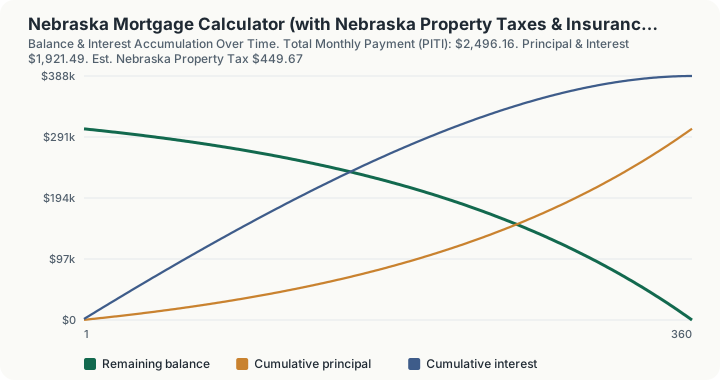
Quick Answer: A $380,000 Nebraska home with 20% down and a 6.5% fixed rate carries a total monthly payment (principal, interest, property tax, and insurance) of roughly $2,496, combining $1,921.49 in principal and interest with $449.67 in estimated Nebraska property tax and a $125 insurance placeholder.
Overview
Nebraska carries one of the highest effective residential property tax rates in the country, averaging close to 1.42% of home value statewide, roughly 60% above the national average of about 0.89%. That single fact changes the shape of a Nebraska mortgage payment more than in almost any other state on this platform: property tax is not a minor add-on to principal and interest, it is often the second-largest line item in the monthly bill. This calculator treats that reality seriously, applying Nebraska's statewide effective rate directly rather than a token placeholder.
Nebraska's high property tax burden partly reflects the state's reliance on local property taxes to fund schools and local government, since Nebraska does not have some of the alternative revenue mechanisms other states use. Buyers relocating to Nebraska from a lower-property-tax state should expect their escrowed monthly payment to be noticeably higher relative to their loan size than they may be used to.
How This Is Calculated
The calculator runs through four stages.
- Loan principal. Home price minus the down payment (home price multiplied by your down payment percentage) determines the financed amount.
- Principal and interest. The loan principal is amortized over a standard 360-month (30-year) term at your entered interest rate.
- Property tax estimate. Nebraska's statewide effective property tax rate of 1.42% is applied to the home price and divided by 12 for a monthly escrow contribution.
- Insurance estimate. A flat $125 monthly placeholder represents typical homeowners insurance; actual premiums vary by insurer, coverage, and regional risk factors including hail and severe storm exposure.
The standard amortization formula for monthly principal and interest $M$ is:
where $P$ is the loan principal, $r$ is the monthly interest rate, and $n$ is the number of monthly periods.
Worked Example
Using the calculator's baseline inputs:
- Home price: $380,000
- Down payment: 20% ($76,000)
- Interest rate: 6.5% APR
- Term: 30 years (360 months)
The financed loan principal is $380,000 - $76,000 = $304,000. Amortized over 360 months at 6.5%, principal and interest comes to approximately $1,921.49 per month, matching the calculator's verified test vectors. Nebraska's 1.42% effective property tax rate applied to the $380,000 home price gives $380,000 × 1.42% ÷ 12 = $449.67 per month in escrowed property tax, well above what a buyer in a low-tax state such as Hawaii or Alabama would pay on the same home. Adding the $125 insurance placeholder, total monthly PITI comes to $1,921.49 + $449.67 + $125.00 = approximately $2,496.16 per month.
Moving the Three Inputs, One at a Time
The amortization table below walks the months. This section keeps the 30-year term fixed and sweeps the inputs instead.
A quarter-point of rate. Moving from 6.5% to 6.625% lifts principal and interest from $1,921.49 to $1,946.55, $25.06 a month, and lifts total 30-year interest from $387,732.82 to $396,756.31, a difference of $9,021.08 on the same $304,000 loan.
Two full points of rate. At 5.5% the payment is $1,726.08 and lifetime interest is $317,388.26; at 7.5% they are $2,125.61 and $461,220.45. Two points is $399.53 a month and $143,832.19 across the life of the loan.
Cutting the down payment from 20% to 5%. Financed principal rises from $304,000 to $361,000, total monthly PITI rises from $2,496.16 to $2,856.44, an increase of $360.28 a month, and lifetime interest rises by $72,700.34. Nothing in that increase is mortgage insurance: the calculator adds no PMI at any down payment, so a 5% Nebraska buyer's real monthly cost is higher than this figure by the whole premium.
Zero down. The loan becomes the full $380,000, PITI reaches $2,976.53 and lifetime interest $484,667.97, which is $480.37 a month above the 20% baseline and still carries no mortgage insurance.
Raising the price 25%. A $475,000 Nebraska home at 20% down finances $380,000, the same principal a $380,000 home finances at 0% down, so principal and interest are identical at $2,401.86 in both cases. The whole difference sits in the tax line: $562.08 a month against $449.67, because the 1.42% rate is applied to the purchase price. Total PITI is $3,088.94.
Why the tax line dominates here. At the baseline, Nebraska's 1.42% produces $449.67 a month of escrowed property tax against Montana's $218.50 on an identical $380,000 home. That $231.17 monthly gap is larger than a quarter-point of interest rate nine times over, and it is the single biggest reason two identical loans produce different Nebraska and Montana payments.
Two fixed assumptions worth naming. Insurance is a flat $125.00 a month at every price, so the model charges the same premium on a $200,000 house as on a $2,000,000 one. And the tax line is 1.42% of the purchase price held constant for all 360 months, with no reappraisal, valuation growth or levy change ever applied.
What This Does Not Account For
- No private mortgage insurance is added at any down payment. Setting the down payment to 5% or 0% raises the payment by principal and interest alone, understating the real monthly cost of a low-equity loan.
- Insurance is a flat $125.00 a month regardless of home price, and the property tax line is a fixed percentage of the purchase price held constant across all 360 months.
- County and school district variation. Nebraska's 1.42% figure is a statewide average; actual mill levies vary significantly by county, school district, and municipality, with some Nebraska counties assessing considerably above or below the state average.
- Homestead exemption programs. Nebraska offers property tax relief programs, including a homestead exemption for qualifying senior, disabled, and veteran homeowners, which can materially lower the effective tax bill for eligible buyers but is not modeled in this calculator's baseline.
- Nebraska Property Tax Credit. The state has run refundable income tax credit programs tied to property taxes paid, which effectively offset some of the property tax burden outside of the mortgage escrow itself; this calculator does not net that credit against the monthly figure.
- Private mortgage insurance (PMI). This calculator's default assumes 20% down, which typically avoids PMI; a smaller down payment adds an unmodeled cost.
- Severe weather insurance loading. Nebraska's exposure to hail and severe thunderstorms can push homeowners insurance premiums above the flat $125 placeholder in some counties.
Common Pitfalls
- Underestimating the property tax share of the payment. Because Nebraska's rate is so much higher than the national average, buyers who mentally budget using a lower-tax state's rule of thumb will significantly underestimate their true Nebraska payment.
- Missing homestead exemption eligibility. Qualifying seniors, disabled homeowners, and veterans in Nebraska can reduce their taxable value substantially through the state's homestead exemption program, an opportunity this calculator's baseline does not reflect.
- Ignoring county-level mill levy differences. Douglas County (Omaha) and Lancaster County (Lincoln) carry different effective rates than smaller rural Nebraska counties, so the statewide average is a starting point, not a final figure.
- Forgetting PMI below 20% down. Since the baseline assumes 20% down, buyers financing with a smaller down payment should add an estimated PMI cost to the PITI figure this tool produces.
- Not accounting for the state income tax credit tied to property taxes paid. Some of Nebraska's property tax burden is offset annually through state tax filings rather than at the monthly escrow level, which can make the effective net cost lower than the raw monthly figure suggests.
Frequently Asked Questions
Why is Nebraska's property tax rate so much higher than other states?
Are there ways to lower my Nebraska property tax bill?
Does this calculator include the Nebraska Property Tax Credit?
Which Nebraska counties have the highest and lowest effective property tax rates?
Does this calculator assume a 20% down payment?
Sources
- Nebraska Department of Revenue, Property Assessment Division: Statewide effective property tax rate data. revenue.nebraska.gov
- Consumer Financial Protection Bureau: Regulation Z (Truth in Lending Act) and mortgage disclosure standards. ecfr.gov/current/title-12/chapter-X/part-1026
Also consulted: Nebraska Department of Revenue: Homestead exemption and property tax credit program guidance.