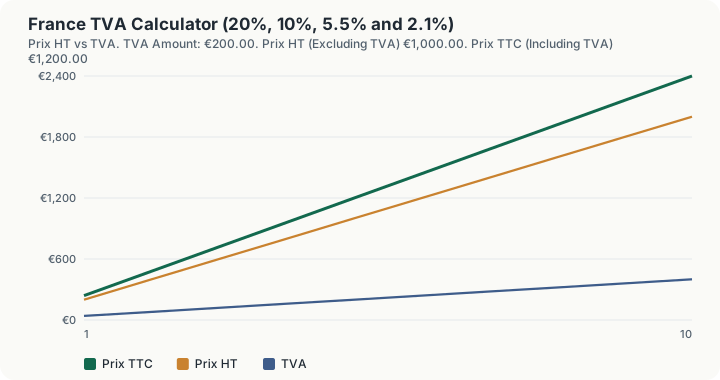
Quick Answer: Adding the normal 20% rate to a €1,000 price HT adds €200.00, giving €1,200 TTC. Going the other way, from €1,000 TTC back to HT, gives €166.67 of TVA, exactly one sixth of the gross, leaving €833.33. At 20%, France has the lowest normal VAT rate of the four largest eurozone economies.
What does this calculator do?
France applies four TVA rates in metropolitan territory: the normal 20%, two reduced rates of 10% and 5.5%, and a particular rate of 2.1%.
The conversion between prix HT (hors taxes) and prix TTC (toutes taxes comprises) is the calculation people actually need, and at 20% it has an unusually clean form: the TVA is exactly one sixth of the TTC price, and the HT price is exactly five sixths of it.
Which rate applies to a given supply is fixed by the Code général des impôts, not chosen by the seller. This calculator handles the arithmetic and does not attempt classification: a deliberate decision, explained below.
How is this calculated?
Adding TVA to a price HT:
TVA = HT × rate; TTC = HT × (1 + rate)
Recovering HT from TTC uses the VAT fraction:
TVA = TTC × rate/(1 + rate)
At 20% that is 20/120, which simplifies to one sixth. At 10% it is 1/11, at 5.5% it is 5.5/105.5, and at 2.1% it is 2.1/102.1.
Worked Example
The direction of travel matters more than the rate does. Adding TVA is a multiplication; recovering it from a gross price is not the same operation run backwards, and that is where most errors on a French invoice come from.
Adding TVA to a price HT
Step 1: The applicable rate. Taux normal, so r = 20%
Step 2: The TVA due on €1,000 HT. €1,000.00 x 20% = €200.00
Step 3: The prix TTC. €1,000.00 + €200.00 = €1,200.00
Recovering HT from a price TTC
Step 4: The VAT fraction at the normal rate. 0.20 / 1.20 = 20/120, which simplifies to one sixth, or 16.67% of the gross
Step 5: The TVA inside €1,000 TTC. €1,000.00 / 6 = €166.67
Step 6: The prix HT. €1,000.00 - €166.67 = €833.33
Step 7: The mistake this step exists to prevent. Taking 20% of the TTC instead gives €1,000.00 x 20% = €200.00 and an HT of €800.00 Error against step 6: €33.33 on a single €1,000 invoice
The 20% applies to the HT, never to the TTC. On a run of invoices that €33.33 becomes a reconciliation problem rather than a rounding one.
The other three rates
Step 8: Adding each rate to €1,000 HT. 10% reduit: €100.00 of TVA, €1,100.00 TTC 5.5% reduit: €55.00 of TVA, €1,055.00 TTC 2.1% particulier: €21.00 of TVA, €1,021.00 TTC
Step 9: Recovering each rate from €1,000 TTC. 10%, fraction 1/11: €90.91 of TVA, €909.09 HT 5.5%, fraction 5.5/105.5: €52.13 of TVA, €947.87 HT 2.1%, fraction 2.1/102.1: €20.57 of TVA, €979.43 HT
Compare step 8 with step 9 at the same rate and the asymmetry is plain: €100.00 of TVA added to a €1,000 net price, but only €90.91 recovered from a €1,000 gross one. Which rate applies is set by the Code general des impots and is not a choice; for context, France's 20% normal rate is the lowest of the four largest eurozone economies, against 21% in Spain and the Netherlands and 22% in Italy.
The Fraction, the Subtraction, and What Each Rate Costs
The two directions this calculator offers are not inverse subtractions, and confusing them is the single most expensive error in TVA arithmetic.
Adding at the normal rate. On €1,000 HT the engine returns €200.00 of TVA and €1,200.00 TTC.
Removing from the same figure. Switch the direction to remove and enter €1,000 TTC, and the engine returns €166.67 of TVA and €833.33 HT. The TVA fraction at 20% is one sixth of the gross, not one fifth, and the two operations differ by €33.33 on a thousand euros.
Pricing the error directly. A business that deducts 20% from a €1,000 TTC receipt records €800.00 HT and €200.00 of recoverable TVA. Run €800 through the add direction and the engine returns €960.00 TTC, not €1,000: the subtraction has invented a receipt that does not exist. The correct €833.33 HT and €166.67 of TVA is what the engine returns from the remove direction, and the €33.33 gap is over-reclaimed input tax on every single invoice treated that way. Across a hundred such invoices it is €3,333.
The four rates, on the same €1,000 HT. Normal at 20% returns €200.00 of TVA and €1,200.00 TTC. Reduced at 10%, which covers restauration and certain building works, returns €100.00 and €1,100.00. Reduced at 5.5%, covering most foodstuffs, returns €55.00 and €1,055.00. The particular rate at 2.1% returns €21.00 and €1,021.00. Getting the rate wrong on a restaurant invoice, applying 20% where 10% belongs, overstates the TVA by €100.00 per thousand euros of HT value.
And the fractions differ with the rate. From €1,000 TTC at 10% the engine returns €90.91 of TVA and €909.09 HT: the fraction is one eleventh, not one tenth. At 5.5% it returns €52.13 and €947.87. Only the extraction produces these; a subtraction would give €900.00 and €945.00 respectively, out by €9.09 and €2.13 per thousand.
Reading the ten-row table. The schedule scales the amount from one fifth to twice the figure you entered, holding the direction and the rate fixed. At the defaults row 1 is €200.00 HT with €40.00 of TVA, row 5 is the €1,000.00 baseline, and row 10 is €2,000.00 HT with €400.00 of TVA. There is no threshold in it, because TVA has no bracket: the rate is set by the nature of the supply, not by its size.
What is outside the calculation. The engine holds metropolitan France only. Corsica's intermediate rates and the distinct rates of the overseas departments are not in the table, and neither is the autoliquidation reverse charge, the franchise en base threshold below which a small business charges no TVA at all, nor any intra-Community treatment. It converts between HT and TTC at a stated rate and does nothing else.
What does this calculator not account for?
- Which rate applies to which supply. This is set by the Code général des impôts and is genuinely intricate. During verification of this page, one government-adjacent summary misattributed restauration to the 2.1% rate when it belongs at 10%, which is precisely why classification is left to the CGI rather than encoded here.
- Corsica and the overseas departments, which apply their own reduced rates differing from metropolitan France.
- The franchise en base de TVA, under which small businesses below the turnover thresholds do not charge TVA at all.
- Autoliquidation (reverse charge) in construction and cross-border business supplies.
- Exonérations, and the distinction between exempt supplies and those outside the scope, which differ in their effect on input TVA recovery.
- The One Stop Shop and EU distance selling.
- TVA sur les débits versus sur les encaissements, which affects timing rather than amount.
- TVA on property transactions, which interacts with droits de mutation.
What mistakes do people make with this?
- Deducting 20% from a TTC price. €1,000 minus 20% is €800, wrong by €33.33. The correct HT is €833.33, because the TVA is one sixth of the TTC and not one fifth of it.
- Assuming restaurant meals are 5.5%. Restauration is at 10%. Only certain foodstuffs sold for later consumption fall to 5.5%.
- Applying metropolitan rates in Corsica or the DOM. Both have their own schedules.
- Forgetting the franchise en base. A business below the threshold issues invoices with no TVA and the calculation does not apply to it.
- Treating 2.1% as a general low rate. It is a narrow category set by the CGI, not a catch-all for cheap goods.
- Confusing exonéré with hors champ. Both mean no TVA on the invoice, with different consequences for deducting input TVA.
Frequently Asked Questions
How do I convert TTC to HT?
What is France's standard VAT rate?
What falls under 5.5% rather than 10%?
What is the 2.1% rate for?
Do the same rates apply in Corsica and overseas?
What is the franchise en base de TVA?
Sources
- impots.gouv.fr: "Fiscalité des entreprises", the 20% standard VAT rate and the 10%, 5.5% and 2.1% reduced rates. impots.gouv.fr/international-professionnel/fiscalite-des-entreprises
Also consulted: economie.gouv.fr: "TVA: quels sont les taux de votre quotidien?", the normal rate of 20% and the reduced rates of 10%, 5.5% and 2.1%; All rates verified on 30 August 2026. Classification of supplies is deliberately not encoded; see What This Does Not Account For.