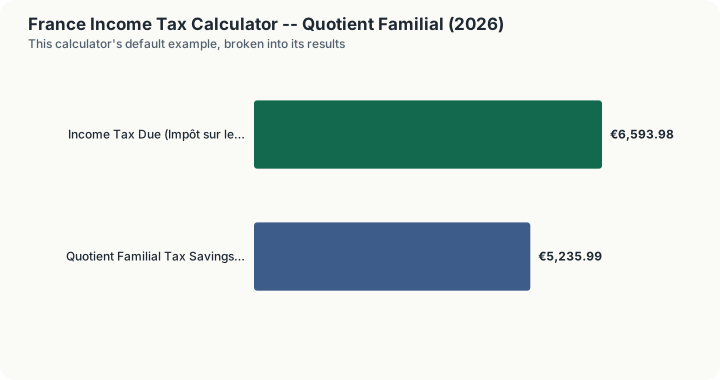
Quick Answer: A married French couple with 2 dependent children and €80,000 of net taxable household income for 2025 owes €6,593.98 in income tax (impôt sur le revenu) for 2026, an effective rate of 8.24%. Without children, that same couple's €80,000 income would owe €10,207.98 -- the quotient familial family-splitting mechanism, even after its statutory cap kicks in here, still saves this household €3,614.
Overview
France taxes household income, not individual income, and it does so through a mechanism unlike almost any other developed country's system: the quotient familial (family quotient). Instead of applying tax brackets directly to your total household income, France divides that income by a number of "parts" (parts fiscales) determined by your household composition -- 2 parts for a married or PACS couple, 1 for a single filer, plus additional parts for dependent children -- computes the tax on that smaller per-part amount, and then multiplies the result back by the same number of parts. Because France's income tax brackets are progressive (0%, 11%, 30%, 41%, 45% for 2025 income under the 2026 barème), dividing income into more parts pushes each part further down the bracket ladder, which is why larger households with the same total income pay less tax per euro than smaller ones.
This calculator computes your exact 2026 tax liability (on 2025 income) under this system: it works out your household's quotient familial parts from your marital status and number of children, applies the official progressive barème, and -- critically -- checks whether the tax benefit those extra parts produced exceeds the legal cap (plafonnement) on that benefit. Higher-income families with children routinely hit this cap, and this calculator is one of the only tools that models it explicitly rather than silently ignoring it.
How This Is Calculated
- Determine the number of quotient familial parts. A married or PACS couple filing jointly starts with 2 parts; a single, divorced, or widowed filer starts with 1. Each of the first 2 dependent children adds 0.5 part; every child from the 3rd onward adds a full 1 part.
- Divide net taxable income by the total number of parts, and apply the 2026 progressive barème (on 2025 income) to that per-part amount: 0% up to €11,600, 11% from €11,600-€29,579, 30% from €29,579-€84,577, 41% from €84,577-€181,917, and 45% above that.
- Multiply the resulting per-part tax back by the total number of parts. This is the household's tax "with" the additional parts.
- Recompute the same two steps using only the household's BASE parts (2 for a couple, 1 for a single filer -- ignoring children entirely). This is the tax the household would owe with no quotient familial benefit from children at all.
- Compare the two results. The difference is the tax saving the additional parts produced. Compare that saving against the statutory cap: €1,807 per additional half-part unit for 2025 income (so a full additional part, worth 2 half-part units, caps at €3,614).
- Apply the cap if exceeded. If the actual saving is larger than the cap allows, the final tax is the base-parts tax minus the CAPPED saving -- not the full quotient-familial result from step 3.
Worked Example
Using the calculator's default inputs -- a married couple, 2 children, €80,000 net taxable income:
- Parts: 2 base parts (couple) + 0.5 + 0.5 (first two children) = 3 parts total.
- Tax with 3 parts: €80,000 ÷ 3 = €26,666.67 per part. Barème: 0% on the first €11,600, 11% on €11,600-€26,666.67 (€15,066.67 × 11% = €1,657.33). Per-part tax = €1,657.33. Multiplied by 3 parts = €4,971.99.
- Tax with base parts only (2, ignoring children): €80,000 ÷ 2 = €40,000 per part. Barème: 11% on €11,600-€29,579 (€1,977.69) + 30% on €29,579-€40,000 (€3,126.30) = €5,103.99 per part. Multiplied by 2 parts = €10,207.98.
- Quotient familial benefit: €10,207.98 − €4,971.99 = €5,235.99.
- Statutory cap: 2 children in the first-2-children category = 2 half-part units × €1,807 = €3,614.
- Benefit (€5,235.99) exceeds the cap (€3,614), so the plafonnement applies. Final tax = €10,207.98 − €3,614 = €6,593.98.
Without the cap, this family would have owed only €4,971.99 -- the plafonnement costs them €1,621.99 relative to the uncapped quotient familial result, even though they still save €3,614 compared to having no children at all.
What This Does Not Account For
- The "décote" (CGI art. 197 I 4), a separate relief mechanism that further reduces tax for households near the entry threshold of the taxable brackets. This calculator does not model it; households with lower net taxable income than the examples above may owe somewhat less than shown here.
- Tax credits and reductions (crédits et réductions d'impôt) for items like childcare costs, donations, home-services employment, or energy-efficiency work -- these are subtracted from the final tax bill separately and are outside the scope of this barème/quotient-familial calculator.
- The Contribution Exceptionnelle sur les Hauts Revenus (CEHR), an additional 3%-4% surtax on very high individual incomes (above €250,000 for a single person / €500,000 for a couple), which is a separate calculation layered on top of ordinary income tax.
- Prélèvement forfaitaire unique (flat tax) treatment for capital income (dividends, interest), which most taxpayers can elect instead of the progressive barème shown here -- this calculator assumes all income is taxed at the progressive scale.
- Non-resident-specific rules, minimum tax rates for non-residents, and any tax treaty adjustments.
Common Pitfalls
- Forgetting the plafonnement exists at all. Many simplified "divide and multiply" quotient familial explanations stop at step 3 above and never mention that the benefit from children is capped -- which materially overstates the tax savings for above-average-income families with children, exactly as in the worked example.
- Assuming every child is worth the same tax benefit. The first 2 children are worth 0.5 part each; the 3rd and every subsequent child is worth a full 1 part -- nearly a 100% jump in value per additional child once you pass 2.
- Confusing "net taxable income" with gross salary. The figure this calculator expects is already net of the standard 10% professional-expense deduction (or your actual itemized professional expenses) and other above-the-line adjustments -- not your raw gross salary.
- Applying single-filer brackets to a couple's combined income directly, without dividing by parts first. Because the French system is fundamentally about splitting income before bracketing, skipping that step overstates a couple's tax by a wide margin.
- Not re-checking the barème and plafonnement cap every tax year. Both are revalorized annually for inflation (0.9% for the 2026 barème on 2025 income); using a prior year's thresholds understates or overstates the true liability.
Frequently Asked Questions
What is the quotient familial?
How many parts do I get for my children?
Is the quotient familial tax saving unlimited?
Does a single parent get extra parts?
Why is my calculated tax different from what my notice d'impôt shows?
Does this calculator apply to non-residents?
Sources
- Service-Public.gouv.fr, "Impôt sur le revenu : tranches et taux d'imposition 2026": service-public.gouv.fr/particuliers/actualites/A18045.
- Service-Public.gouv.fr, "Quotient familial d'un couple marié ou pacsé": service-public.gouv.fr/particuliers/vosdroits/F2705.
- BOFiP-Impôts, BOI-IR-LIQ-20-20-20, "Plafonnement des effets du quotient familial" (version 07/04/2026): bofip.impots.gouv.fr.
Also consulted: Loi de finances pour 2026 -- barème progressif de l'impôt sur le revenu 2026 (revenus 2025), revalorisé de 0,9%; Code Général des Impôts, articles 193, 194, 197.