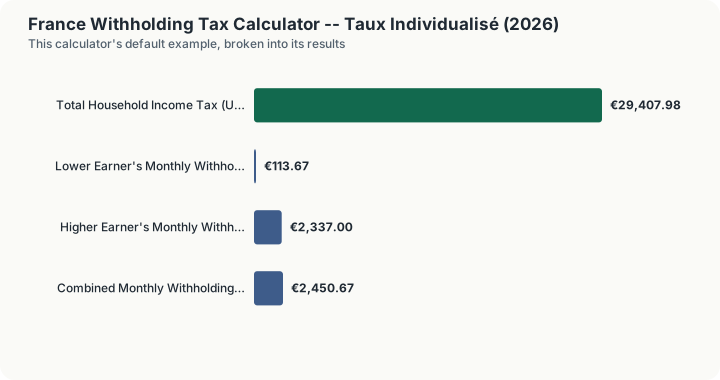
Quick Answer: A married couple with a combined €144,000 net taxable income, where one partner earns €24,000 and the other €120,000, owes €29,407.98 in total household income tax for 2026 -- unchanged by individualization. But instead of both partners being withheld at the same blended 20.42% "taux du foyer," the individualized rate assigns the lower earner 5.68% and the higher earner 23.37%, so each partner's paycheck withholding reflects their own income, not an average.
Overview
Since 1 September 2025, France's prélèvement à la source (withholding tax) system defaults every married or PACS couple filing jointly to a taux individualisé (individualized rate) -- a genuine change from the prior system, where the same single household rate applied to both partners' paychecks by default and individualization was something you had to actively request. Couples can still elect to keep the single household rate if they prefer, but as of the 2026 tax year, individualized withholding is the automatic starting point.
It is critical to understand what individualization changes and what it does not: the total amount of tax the household owes for the year is exactly the same either way. What changes is only the ALLOCATION of that total between the two paychecks each month. Under the household rate, both partners are withheld at an identical blended percentage regardless of how unevenly they actually earn. Under the individualized rate, the lower-earning partner is withheld at a rate reflecting their own, lower income bracket, while the higher earner is withheld at a correspondingly higher rate to make up the difference -- so the household's combined monthly withholding still adds up to exactly the same total tax bill.
How This Is Calculated
- Compute the household's total income tax for the combined net taxable income, using the standard quotient familial mechanism (see the France income tax calculator) -- this total never changes based on which withholding method is chosen.
- Identify each spouse's personal income and split any common/jointly-owned income (e.g. rental income from property owned together) 50/50 between them.
- Compute the lower-earning spouse's individualized rate from their own income (personal income plus their half of any common income), run through the standard progressive barème as if they were filing alone -- this produces a rate that reflects their own, lower tax bracket.
- Derive the higher-earning spouse's rate as the balancing remainder, calculated so that the sum of both partners' individualized withholding exactly equals the household's total tax -- since the lower earner's rate reflects a lower bracket, the higher earner's residual rate is necessarily higher than the blended household rate would have been.
- Compare against the single "taux du foyer" (household rate) -- the same blended percentage both partners would pay if the couple opts to keep the household rate instead of the individualized default.
Worked Example
Using the calculator's default inputs -- combined €144,000 net taxable income, €24,000 personal income for one partner, €120,000 for the other, no common income:
- Household tax: using the standard quotient familial (2 parts, no children) on €144,000, total household tax = €29,407.98.
- Household rate (for comparison): €29,407.98 ÷ €144,000 = 20.42% -- this is what BOTH partners would be withheld at under the single household rate.
- Lower earner's individualized rate: their own €24,000 income, run through the barème as if filing alone: (€24,000 − €11,600) × 11% = €1,364.00 → rate = €1,364.00 ÷ €24,000 = 5.68%.
- Higher earner's rate: the remainder of the household tax (€29,407.98 − €1,364.00 = €28,043.98) divided by their €120,000 income = 23.37%.
- Result: the lower earner is withheld at 5.68% instead of the blended 20.42%, and the higher earner at 23.37% instead of 20.42% -- each paycheck now reflects that individual's own income level, while the household's combined monthly withholding still totals exactly €29,407.98 ÷ 12 per month.
What This Does Not Account For
- This calculator implements a documented, simplified version of the official mechanism. The precise legal formula (CGI art. 204 M, detailed in BOFiP BOI-IR-PAS-20-20-20) distinguishes specific income categories (salary, pensions, business profits, etc.) and other technical adjustments (foreign tax credits, certain "revenus hors PAS" exclusions) that this calculator does not individually replicate. The core structure -- the lower earner's rate from their own barème-based income, the higher earner's rate as the balancing remainder so the household total is preserved exactly -- matches the official mechanism's shape, but edge cases in the full legal text are not all separately modeled. This is an explicitly disclosed simplification, not a claim of full official precision on every edge case.
- Quarterly/mid-year rate updates. Your actual individualized rate is recalculated by the tax administration each September based on your latest tax return, and can also be adjusted mid-year on request (modulation) -- this calculator produces a snapshot for the income figures you enter, not a running annual schedule.
- Withholding on capital income, self-employment income, or other categories subject to their own quarterly/monthly acompte (installment) mechanisms rather than the payroll-style withholding this calculator focuses on.
- The couple's option to keep the single household rate. This calculator shows what the individualized rate would be; it does not model the process or implications of opting out back to the household rate.
- Dependent children's effect on the household's total tax, which this calculator assumes is zero for simplicity -- use the France income tax calculator first to get an accurate household total if you have dependent children, then use that total tax figure here.
Common Pitfalls
- Assuming individualization changes how much tax the household owes. It does not -- it only changes who pays how much of the identical total, each month. The year-end tax liability, after your annual return, is exactly the same either way.
- Assuming both partners get the SAME individualized rate. They generally do not, unless their personal incomes (plus their share of common income) are genuinely equal -- the entire point of individualization is that it usually produces two DIFFERENT rates reflecting each partner's own earnings.
- Forgetting common/jointly-owned income is split 50/50 between partners for this calculation, regardless of whose bank account it lands in -- rental income from a jointly-owned property, for example, is not attributed entirely to either partner.
- Confusing this with a request for separate taxation. Married and PACS couples in France are still taxed JOINTLY as one household for the actual tax computation -- individualized withholding only affects the in-year payment mechanics, not the underlying joint tax return.
- Not realizing this became the DEFAULT in September 2025. Couples who took no action may have been switched from the household rate to the individualized rate automatically, which can be a surprise on a payslip if not anticipated.
Frequently Asked Questions
Does the individualized rate mean I pay less total tax?
Is the individualized rate mandatory?
Why would the higher earner's rate be higher than the household's blended rate?
How is jointly-owned income (like rental income) handled?
Can I switch back to the household rate?
Does this affect self-employed income differently?
Sources
- French Public Finances Directorate (impots.gouv.fr), the official authority for the national tax authority this calculator relates to. impots.gouv.fr
Note on verification: the calculator's exact formula is a documented, disclosed simplification of the official BOFiP mechanics (see "What This Does Not Account For" above); the core structural mechanism (lower earner's own-income rate, higher earner's residual rate, total preserved) is verified, but full replication of every official income-category edge case is flagged as a follow-up item.
Also consulted: CGI article 204 M (as amended) -- individualized withholding rate as the default for married/PACS couples subject to joint taxation, effective 1 September 2025; BOFiP-Impôts, BOI-IR-PAS-20-20-30-20 and BOI-IR-PAS-20-20-20 -- mechanics of the individualized rate and its calculation; Economie.gouv.fr, guidance on managing your prélèvement à la source rate; France income tax calculator: For the underlying household tax computation this calculator builds on.