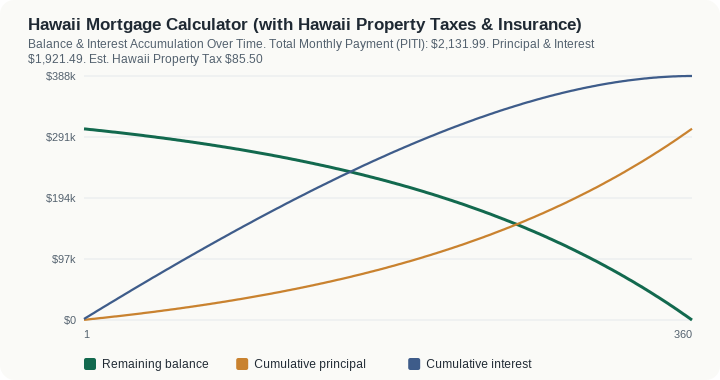
Quick Answer: A $380,000 Hawaii purchase with 20% down at 6.5% over 30 years comes to about $2,136.07 a month in this calculator: $1,921.49 of principal and interest, just $85.50 of property tax at Hawaii's 0.27% effective rate, and $129.08 of homeowners insurance.
The Lowest Tax Line, the Highest Prices
No state produces a smaller payment at the shared defaults. Run the same $380,000 house, 20% down and 6.5% through all fifty calculators and Hawaii finishes 50th of 50, $516.75 a month below Illinois at the top. Tax explains more than all of it: the Hawaii tax line is $522.50 lighter, while its insurance line is $5.75 heavier than the Illinois one. Hawaii's 0.27% is the lowest ratio in the table, against 0.89% for the unweighted average of the 50 state ratios, so the Hawaii line is $195.64 a month lighter than that average would give.
That ranking describes an imaginary Hawaii house. The Census Bureau's 2024 median for an owner-occupied home in the state is $875,900, more than double the default, and at that price the loan, not the tax, decides affordability. A Hawaii mortgage calculator is mostly a loan calculator with a small tax line attached.
Hawaii is also one of just five states (with Alabama, Colorado, Louisiana and South Carolina) where, at the $380,000 default, insurance outweighs tax. The two lines only meet at $573,689; below that, the $129.08 insurance figure is the bigger of the two.
How is this calculated?
At the defaults:
- The buyer brings $76,000, so the lender funds $304,000.
- The engine builds a 30-year schedule at 0.5417% a month (6.5% over twelve), rounding interest to the cent every period; the level payment is $1,921.49.
- The Hawaii tax line is 0.27% of the $380,000 price: $1,026 a year, or $85.50 monthly, frozen for the life of the loan.
- Insurance is $129.08 a month. That is the NAIC's average HO-3 premium written in Hawaii during 2023, $1,549 a year, which sits $188 under the $1,737 countrywide average and 27th among the fifty states. It averages every coverage amount on the islands, so it is not a quote, and it stays at $129.08 whatever price you type.
The 0.27% is 2024 Census data for Hawaii: median tax paid divided by median home value. It blends all four counties and every owner-occupied home. PMI never appears, whatever the down payment.
Worked Example
The state median, $875,900
With 20% down the loan is $700,720 and principal and interest are $4,429.03. Tax adds $197.08 and insurance $129.08, for $4,755.19 a month. The loan is 93.14% of the payment; tax is just 4.14%. Over 30 years the loan costs $893,727.40 in interest.
At 10% down the same house needs a $788,310 loan and shows $5,308.82 before any mortgage insurance. Rate matters more than anything else at this size: 6% gives $4,527.33 and 7% gives $4,988.07, a $460.74 spread for one point.
A $600,000 condo
Borrowing $480,000 costs $3,033.93 a month; with $135.00 of tax and $129.08 of insurance the total is $3,298.01. Tax has only just overtaken insurance here; the crossover sits about $26,000 lower.
A $1,200,000 house in Kailua or Kahala
A $960,000 loan costs $6,067.85 a month. Tax at 0.27% is $270.00, and the total is $6,466.93. Lifetime interest passes $1.22 million.
What the Counties Actually Charge
Hawaii's real bills come from four counties, each with its own rate per $1,000 of net taxable value. For the year July 1, 2026 to June 30, 2027, the Honolulu Real Property Assessment Division's statewide rate report lists these classes for homes:
| County | Owner-occupied class | Rate per $1,000 | Non-owner residential | Rate per $1,000 |
|---|---|---|---|---|
| Honolulu | Residential | $3.50 | Residential A, first $1,000,000 | $4.00 |
| Maui | Owner-Occupied, to $1,500,000 | $1.65 | Non-Owner-Occupied, to $1,000,000 | $6.25 |
| Kauai | Owner-Occupied | $2.59 | Non-Owner Occupied, to $1,300,000 | $5.45 |
| Hawaii | Homeowner | $5.75 | Residential, to $2,000,000 | $11.10 |
Applied by hand to the $875,900 median before any exemption, those owner-occupied rates give $3,065.65 a year in Honolulu, $1,445.24 on Maui, $2,268.58 on Kauai and $5,036.43 on the Big Island. The calculator's 0.27% produces $2,364.93 for every county. So the tax line runs high for a Maui owner-occupant and low for one in Hilo or Kona, and the higher non-owner rates mean a rental or second home can owe several times what the calculator shows.
Honolulu's Residential A Tier
Honolulu puts a home in Residential A when it is assessed at $1,000,000 or more and has no home exemption. Tier 1 is taxed at $4.00 per $1,000 on the first $1,000,000 and tier 2 at $11.40 on everything above it.
Take the $1,200,000 house above. As an owner-occupied Residential home, after the $120,000 home exemption the bill works out to $3,780 a year. Without an exemption it falls in Residential A and owes $4,000 plus $2,280, or $6,280. The calculator shows $3,240 a year either way. If you are buying on Oahu above $1 million as a second home or rental, budget from the Residential A figure, not this page. The home exemption itself, and its filing deadline, is covered on the Hawaii property tax calculator.
Escrow Timing on Oahu
Honolulu's tax year starts July 1, and bills are paid in two installments, due August 20 and February 20. A servicer pays the county on that schedule, so a buyer closing in late spring may see a large first-half installment come due within weeks. The state conveyance tax due when a deed records is a closing cost, not part of the monthly figure; see the Hawaii real estate transfer tax calculator.
What does this calculator not account for?
- County rates and classes. The table above shows how far they spread.
- Home exemptions, which lower the taxable value for owner-occupants.
- Your own insurance quote. The $129.08 is a statewide 2023 average, not a figure for your county, lava zone, hurricane exposure, construction, deductible, claims record or coverage amount. Separate hurricane cover is not in it.
- Leasehold land. Ground rent on leasehold property is a separate monthly cost the engine never sees.
- Condominium maintenance fees and HOA dues.
- PMI on loans with less than 20% down.
What mistakes do people make with this?
- Reading the 50th-place rank as cheap housing. At the median price the payment is $4,755.19.
- Using 0.27% for a rental. A non-owner class can be several times the owner-occupied rate.
- Crossing $1,000,000 in Honolulu without a home exemption. Tier 2 at $11.40 applies above that line.
- Assuming the insurance line is generous. Below $573,689 it is the larger escrow item, and a coastal or lava-zone premium can run well above the statewide average.
- Skipping the fee simple question. Ask whether the land is leased before comparing two condos on price.
Frequently Asked Questions
Why does Hawaii rank last on this calculator?
What is the mortgage payment in Hawaii on a median-priced home?
Which Hawaii county has the lowest owner-occupied rate?
Does this calculator know whether my Honolulu home is Residential A?
Does it include leasehold ground rent or condo fees?
Sources
- Census Bureau, American Community Survey, Hawaii, 2024: B25103 and B25077. data.census.gov/table/ACSDT1Y2024.B25077
- Honolulu RPAD, statewide report of FY2027 real property tax rates for all four counties. realproperty.honolulu.gov/media/b3pcwo2o/state-report-fy27-final_tax-rates.pdf
- Honolulu RPAD, Residential A Information sheet (classification, tiers, important dates). realproperty.honolulu.gov/media/ugxijaid/residential-a-information-rev-june-2025.pdf
- NAIC, Homeowners Insurance Report, data for 2023 (Table 4, HO-3 average premium, Hawaii). content.naic.org/sites/default/files/publication-hmr-zu-homeowners-report.pdf