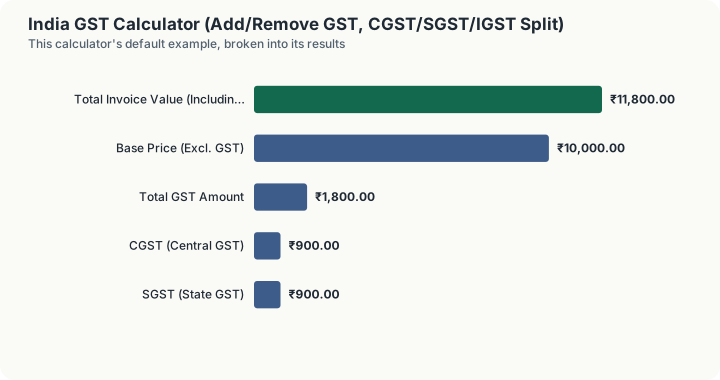
Quick Answer: A ₹10,000 base price with 18% GST added comes to ₹11,800 total -- split as ₹900 CGST + ₹900 SGST if the buyer and seller are in the same Indian state, or ₹1,800 IGST if they are in different states. This calculator is built for Indian businesses and GST-registered taxpayers, with all amounts shown in ₹ (INR).
Overview
This calculator is for Indian businesses, freelancers, and GST-registered taxpayers who need to add Goods and Services Tax to a price, or work backward from a GST-inclusive amount to find the underlying base price and tax component. It is built around India's current GST rate structure and shows the correct Central/State split for domestic (intra-state) transactions versus the Integrated GST used for inter-state and export-adjacent transactions.
India's GST rates changed materially on 22 September 2025. Following the 56th GST Council meeting on 3 September 2025, the Central Board of Indirect Taxes and Customs (CBIC) issued Notification No. 9/2025-Central Tax (Rate), replacing the older five-tier structure (Nil, 5%, 12%, 18%, 28%) with a simplified structure built primarily around 5% and 18%, plus a new 40% rate for a narrow set of luxury and "sin" goods. Most items that were previously taxed at 12% moved to 5% or 18%, and most items previously taxed at 28% moved to 18%, with the highest-rate items (tobacco, pan masala, aerated drinks, and select luxury vehicles) shifting to the new 40% slab instead of the old 28%-plus-cess structure. This calculator reflects that current, post-rationalization rate structure rather than the pre-September-2025 slabs.
GST in India is a destination-based, dual tax: the same transaction is taxed once by the Centre and once by the state (for domestic supply), or entirely as an integrated tax administered by the Centre and apportioned to the destination state (for inter-state supply). Getting the CGST/SGST versus IGST split right matters for GST return filing (GSTR-1, GSTR-3B), input tax credit eligibility, and invoice compliance -- an invoice that charges CGST+SGST on an inter-state supply, or IGST on an intra-state supply, is technically incorrect even if the total tax amount is right.
How This Is Calculated
Adding GST to a GST-exclusive base price:
Removing GST from a GST-inclusive total (working backward to find the base price):
Splitting the GST amount, intra-state supply (buyer and seller in the same state):
Splitting the GST amount, inter-state supply (buyer and seller in different states, or exports/imports):
The CGST+SGST 50/50 split for intra-state supply, and the single IGST charge for inter-state supply, are structural rules set out in the CGST Act, 2017 and the IGST Act, 2017 -- they do not vary by product or rate slab. Whatever the applicable GST rate is (5%, 18%, 40%, etc.), an intra-state sale always splits that rate evenly between CGST and SGST, and an inter-state sale always charges the full rate as IGST to the Centre, which then apportions the state's share to the destination state.
Worked Example
Scenario 1: Adding 18% GST to a ₹10,000 intra-state invoice. A Mumbai-based consultancy bills a Mumbai-based client ₹10,000 for services, standard-rated at 18%.
Step 1: Calculate the GST amount.
Step 2: Calculate the total invoice value.
Step 3: Split the GST, since this is an intra-state (Maharashtra-to-Maharashtra) supply.
The invoice shows ₹10,000 as the taxable value, ₹900 CGST, ₹900 SGST, and a ₹11,800 total.
Scenario 2: The same invoice, but the client is in Karnataka instead. Same ₹10,000 base, same 18% rate, but now it's an inter-state supply.
The total invoice value is identical at ₹11,800 -- only the tax head changes, from CGST+SGST to a single IGST line. This is exactly why the buyer's state (not the seller's registered office alone) determines the correct tax treatment.
Scenario 3: Extracting the base price from a GST-inclusive quote. A vendor quotes an "all-inclusive" price of ₹11,800 for the same 18%-rated service, and the buyer needs to know the taxable value for their books.
Step 1: Divide by (1 + rate).
Step 2: The GST amount is the difference.
This confirms the ₹11,800 quote is exactly the same transaction as Scenario 1, just expressed as a single inclusive figure instead of a base-plus-tax breakdown.
What This Does Not Account For
- HSN/SAC-specific rate lookup. This calculator applies whichever rate slab you select; it does not look up the correct GST rate for a specific product (HSN code) or service (SAC code). You must independently confirm which slab your specific goods or services fall into under CBIC's notified schedules.
- Composition scheme taxpayers. Small businesses registered under the GST Composition Scheme pay tax at a flat, lower turnover-based rate (commonly 1% or 5% depending on the business type) instead of the standard slab rates modeled here, and cannot claim input tax credit.
- Reverse charge mechanism (RCM). Certain supplies (e.g., from an unregistered supplier, or specific notified categories like legal services or GTA) shift the liability to pay GST from the supplier to the recipient. This calculator assumes normal forward-charge taxation.
- TCS/TDS under GST. E-commerce operators and certain government bodies must collect or deduct GST at source in specific scenarios; this calculator does not model those separate compliance obligations.
- Cess. Certain items (previously in the 28%+cess bracket) may still attract a compensation cess on top of the base GST rate in some categories; this calculator computes only the standard CGST/SGST/IGST components, not any additional cess.
- Input tax credit (ITC) eligibility. This tool calculates output tax on a single invoice; it does not net that against input tax credit available on purchases, which is what ultimately determines net GST payable in a GSTR-3B filing.
Common Pitfalls
- Applying the GST rate to an already-inclusive amount. If a price is already GST-inclusive, multiplying it again by the rate (instead of dividing by 1+rate) overstates both the tax and the total. Always confirm whether the number in hand is the base price or the final price before choosing "Add GST" or "Remove GST."
- Charging CGST+SGST on an inter-state invoice, or IGST on an intra-state invoice. The tax amount can come out identical, but incorrect tax-head classification causes GSTR-1/GSTR-3B mismatches and can block the buyer's input tax credit claim.
- Assuming every business now pays 18%. The September 2025 rationalization did not move everything to 18%; a large category of essentials and mass-consumption goods sits at 5% or even Nil, and luxury/sin goods sit at 40%, higher than the old 28% cap.
- Confusing the seller's registration state with the place of supply. GST's inter-state/intra-state determination is based on the place of supply rules, which for most goods and many services is the recipient's location -- not simply where the seller happens to be registered.
- Ignoring that the GST Council can still revise rates. GST rates are set by Council recommendation and CBIC notification, and have changed materially before (most recently September 2025). Always verify the currently applicable rate for your specific goods/services against the latest CBIC notification before finalizing an invoice.
Frequently Asked Questions
What are the current GST rate slabs in India?
What is the difference between CGST, SGST, and IGST?
How do I calculate GST CGST SGST split manually?
How do I remove GST from a total to find the base price?
Did GST rates actually change in September 2025?
Is GST the same rate for goods and services?
Sources
- Income Tax Department, Government of India, the official authority for the national tax authority this calculator relates to. incometax.gov.in/iec/foportal
Also consulted: Central Board of Indirect Taxes and Customs (CBIC), Notification No. 9/2025-Central Tax (Rate), dated 17 September 2025, effective 22 September 2025; Press Information Bureau, Government of India, Recommendations of the 56th GST Council Meeting, 3 September 2025; Central Goods and Services Tax Act, 2017 (CGST Act) -- statutory basis for CGST and the intra-state 50/50 CGST/SGST split; Integrated Goods and Services Tax Act, 2017 (IGST Act) -- statutory basis for IGST on inter-state supply.