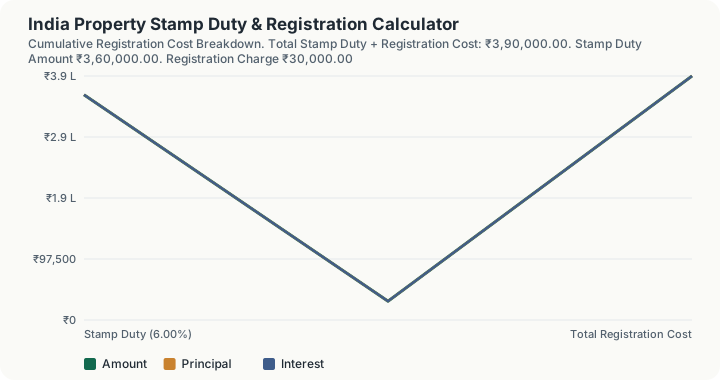
Quick Answer: A ₹60,00,000 property in Mumbai costs a male buyer ₹3,90,000 in stamp duty and registration (6% duty + 1% registration, capped at ₹30,000) -- and a sole female buyer only ₹3,30,000, since Maharashtra gives women a 1-percentage-point stamp duty discount. The same property in Delhi costs a male buyer ₹4,20,000 and a female buyer just ₹3,00,000, a ₹1,20,000 difference, because Delhi runs a genuine 3-tier gendered rate (Men 6%, Women 4%, Joint 5%).
Overview
Stamp duty and registration charges are a real estate buyer's single biggest upfront cost after the down payment itself, and they vary enormously by Indian state -- both in the base rate and in whether a female-buyer rebate exists at all. This calculator covers 10 state/area combinations across 8 states/UTs: Maharashtra (modeled separately for Mumbai/MMR and for Pune/Thane/Nagpur/Navi Mumbai, since the rate genuinely differs), Delhi (NCT), Karnataka (Bengaluru), Uttar Pradesh, Gujarat, Tamil Nadu, West Bengal (modeled separately for urban Corporation areas and rural Panchayat areas), and Telangana (modeled separately for urban GHMC areas and rural areas). All amounts are in Indian Rupees (₹, INR).
Every state charges stamp duty on the higher of your actual agreement/consideration value or the state's own official guidance value for that location -- called the Ready Reckoner Rate in Maharashtra, the Circle Rate in Delhi and Uttar Pradesh, the Guidance Value in Karnataka, the Jantri Rate in Gujarat, the Guideline Value in Tamil Nadu, and the Market Value in West Bengal. This calculator asks for a single "Property Value" input; enter whichever of the two is higher for your transaction, since that is what you will actually be charged on.
A note on verification confidence. Every state's rates in this calculator were cross-checked against multiple independent sources, but very few could be confirmed against a directly-loadable primary government rate table (most official state IGR/registration department portals are JavaScript-driven and did not yield an extractable table during verification). Delhi is the one exception, confirmed directly against the official revenue.delhi.gov.in page. For every other state, the secondary output "Source Confidence for This State" tells you whether a figure is primary-confirmed or secondary-corroborated -- treat secondary-corroborated figures as a strong estimate, not a guaranteed quote, and confirm with your Sub-Registrar or a local conveyancing advocate before a real transaction. See Sources below for full detail and every specific contradiction found during research.
How This Is Calculated
- Base stamp duty rate. Either a flat percentage of property value, or a value-based slab (Karnataka: 2%/3%/5%; West Bengal: a lower rate up to ₹1 crore, a higher rate above it).
- Registration charge. A separate percentage of property value, in some states capped at a flat rupee ceiling (Maharashtra caps it at ₹30,000).
- Additional cess/surcharge, where applicable. Karnataka adds a 10% cess plus a 2% (urban) or 3% (rural) surcharge, both computed on the stamp duty amount itself, not on the property value. Telangana adds a 1.5% transfer duty (urban areas only), computed directly on property value like stamp duty itself. Maharashtra's 1% metro cess (and, outside Mumbai, an additional 1% Local Body Tax) is already folded into its headline stamp duty rate.
- Female-buyer rebate, where one exists. Applied as either a reduction in the stamp duty rate (Maharashtra, Uttar Pradesh, and Delhi's tiered rates), a reduction in the registration rate (Tamil Nadu), or a full waiver of the registration fee (Gujarat) -- whichever mechanic that state actually uses. Karnataka, West Bengal, and Telangana have no gender-based rebate at all.
- Total. Stamp duty (post-rebate) + registration charge (post-rebate) + any additional cess/surcharge/transfer duty.
Worked Example
A ₹60,00,000 property, comparing a male buyer against a sole female buyer in three different states:
Maharashtra (Mumbai): - Male: 6% stamp duty (₹3,60,000) + 1% registration capped at ₹30,000 = ₹3,90,000 total - Female: 5% stamp duty (₹3,00,000, a 1-point rebate) + same capped registration = ₹3,30,000 total (₹60,000 saved)
Delhi (NCT): - Male: 6% stamp duty (₹3,60,000) + 1% registration (₹60,000) = ₹4,20,000 total - Female: 4% stamp duty (₹2,40,000) + 1% registration (₹60,000) = ₹3,00,000 total (₹1,20,000 saved) - Joint (male + female): 5% stamp duty (₹3,00,000) + 1% registration (₹60,000) = ₹3,60,000 total (₹60,000 saved)
Karnataka (Bengaluru), value above ₹45,00,000 so the top slab applies: - 5% stamp duty (₹3,00,000) + 2% registration (₹1,20,000) + 12%-of-duty cess and surcharge (₹36,000) = ₹4,56,000 total, with no gender rebate for any buyer type
What This Does Not Account For
- States and UTs not covered. This calculator models 8 states/UTs (10 area-level entries). It does NOT cover Rajasthan, Madhya Pradesh, Punjab, Haryana, Kerala, Bihar, Odisha, Andhra Pradesh, or any Union Territory other than Delhi, nor any other Indian state or city not explicitly named above. If your property is outside the covered list, this calculator will not give you an applicable figure.
- GST on under-construction property. Stamp duty and registration are separate from GST charged on an under-construction (not-yet-completed) property purchase; that is not modeled here.
- Legal/documentation fees, brokerage, and TDS on property purchase. Advocate fees for deed drafting, real estate broker commission, and the 1% TDS a buyer must deduct and deposit on a purchase above ₹50 lakh (Income-tax Act Section 194-IA equivalent) are all real transaction costs not included in this total.
- Local variation within a state. Guidance values, and in some states even the stamp duty rate itself, can vary by ward, zone, or municipal limit within the same state -- this calculator uses a single representative rate per state/area entry, not a hyper-local figure.
- Gift, partition, and inheritance deeds. This calculator models a standard sale/conveyance transaction only; gift deeds, family partition deeds, and inheritance transfers often carry different (usually lower) stamp duty rates in most states.
- Joint-ownership contradictions flagged during research. Maharashtra's treatment of a joint male+female purchase (whether it qualifies for the female rebate) is genuinely contested across sources and not modeled as eligible here; confirm with your Sub-Registrar. Uttar Pradesh's female rebate is modeled per a July 2025 state cabinet decision that could not be confirmed as formally notified as of this writing -- verify current UP rates directly on igrsup.gov.in.
Common Pitfalls
- Paying stamp duty on the agreement value when the guidance value is higher. Every state covered here charges duty on whichever figure is higher; under-quoting your agreement value below the guidance value does not reduce your stamp duty bill and can trigger a separate income-tax issue for both buyer and seller.
- Assuming every state has a female-buyer discount. Karnataka, West Bengal, and Telangana have none at all; assuming a rebate that doesn't exist in your state will leave you short at registration.
- Confusing a joint male+female purchase with a sole female purchase. Several states (Maharashtra, Gujarat, Tamil Nadu, and this calculator's modeled Uttar Pradesh rule) restrict the rebate to sole female ownership; only Delhi offers a distinct (smaller) rebate for a joint purchase.
- Missing the registration fee cap or waiver. Maharashtra caps registration at ₹30,000 regardless of property value above ₹30 lakh; Gujarat waives the entire 1% registration fee for a sole female buyer. Both are easy to miss if you assume registration is always a flat, uncapped percentage.
- Using stale rate information. Karnataka's registration fee doubled from 1% to 2% effective 31 August 2025, and Telangana's underlying rate order dates to 2021 -- older articles and even some calculators online may still show pre-revision figures.
Frequently Asked Questions
What is the stamp duty rate in Maharashtra for 2026?
Do women get a stamp duty discount in every state?
Is stamp duty calculated on the sale price or the government valuation?
Can I claim a stamp duty calculator Maharashtra 2026 rebate if I buy jointly with my spouse?
How much are registration charges in Delhi?
Sources
- Income Tax Department, Government of India, the official authority for the national tax authority this calculator relates to. incometax.gov.in/iec/foportal
Also consulted: Maharashtra: rate structure and female rebate corroborated across multiple independent sources (IGR Maharashtra's igrmaharashtra.gov.in confirmed as the live department portal, but its rate schedule is not extractable from a JS-rendered page) -- secondary-source confidence; Delhi (NCT): stamp duty rates (Men 6% / Women 4% / Joint 5%) directly confirmed from revenue.delhi.gov.in/revenue/property-registration -- primary-source confidence. The pandemic-era 20% circle-rate rebate is confirmed discontinued effective 1 July 2022 per ETV Bharat and Outlook India news coverage; Karnataka: slab structure, cess, and surcharge corroborated across multiple sources -- secondary confidence. Registration fee increase from 1% to 2%, effective 31 August 2025 under Notification No. RD/46/MNMU/2025, corroborated by Deccan Herald and Angel One news coverage and by an "Amendment to table of Registration fee" document listed on igr.karnataka.gov.in itself; Uttar Pradesh: base 7% rate widely corroborated. Female rebate modeled per a 22 July 2025 UP Cabinet decision reported by Prasar Bharati (newsonair.gov.in, a government outlet) and Deccan Herald; formal notification/Government Order status could not be independently confirmed -- verify current rules on igrsup.gov.in; Gujarat: rate and registration-fee-waiver mechanic corroborated across multiple sources; one less-corroborated source instead claims a direct stamp-duty-rate cut for women, which this calculator does not use -- secondary confidence; Tamil Nadu: rate and registration-only female concession (effective 1 April 2025) corroborated by DT Next (a Tamil Nadu English-language daily) and a Tamil Nadu government-adjacent source citing an underlying Government Order -- secondary confidence; West Bengal: slab structure corroborated across multiple sources; wbregistration.gov.in confirmed as the live department portal with an official Market Value e-calculator -- secondary confidence. No gender-based rebate exists; Telangana: rate components corroborated across multiple sources; registration.telangana.gov.in itself cites G.O.Ms.No.59, dated 20 July 2021, as the current authority, and hosts a live Ready Reckoner duty/fee calculator -- secondary confidence, with the underlying order's currency (2021) flagged for re-verification.