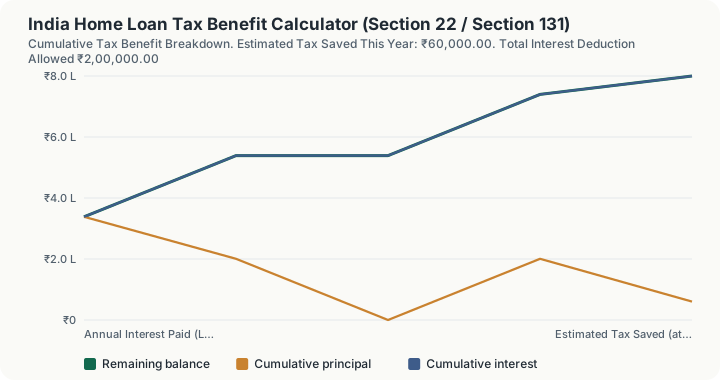
Quick Answer: On a ₹40,00,000 home loan at 8.5% for 20 years, year-1 interest is ₹3,36,946, but the Sec 22 self-occupied deduction caps at ₹2,00,000, worth roughly ₹60,000 of tax saved at a 30% marginal rate and only under the old tax regime. A loan sanctioned between 1 April 2019 and 31 March 2022 on a property valued at ₹45,00,000 or below can stack ₹1,36,946 more.
Overview
This calculator is built for Indian homeowners and property buyers who want to know exactly how much of their home loan interest is actually tax-deductible this year -- not a rule-of-thumb "₹2 lakh benefit," but the real, current-law figure for their specific loan year, occupancy status, and tax regime. All amounts are in Indian Rupees (₹, INR).
India's home loan interest deduction has always been more conditional than the commonly repeated "₹2 lakh cap" suggests, and it changed meaningfully as of 1 April 2026: the Income-tax Act, 1961 was repealed and replaced by the Income-tax Act, 2025, which is now the governing law (Tax Year 2026-27, Assessment Year 2027-28). The house-property interest deduction -- previously Section 24(b) -- is now Section 22 of the new Act. The additional deduction for affordable housing -- previously Section 80EEA -- is now Section 131. Both provisions carry over the same substantive rules as before, but this calculator uses the new section numbers throughout since that is the law that actually applies to income earned from 1 April 2026 onward.
Three things drive your real deduction, and this calculator models all three together instead of assuming a flat ₹2 lakh:
- Occupancy status. A self-occupied property's interest deduction is capped (₹2,00,000, or ₹30,000 if construction wasn't completed within 5 years of borrowing); a let-out (rented) property's interest is fully deductible against rental income with no cap, though the resulting loss that can offset your other income is itself capped.
- Tax regime. The new tax regime (Section 202, the default regime since it replaced old Section 115BAC) disallows the self-occupied interest deduction and the Section 131 additional deduction entirely, and blocks house-property loss set-off against other income. You only get these benefits under the old regime.
- Section 131 (ex-Section 80EEA) eligibility. This additional ₹1,50,000 deduction requires the loan to have been sanctioned between 1 April 2019 and 31 March 2022 -- a window that has not been reopened. As of today, this means Section 131 can only ever apply to a loan taken in that historical window and still being repaid, not to a new loan taken now.
How This Is Calculated
- Base loan amortization. Your loan amount, interest rate, and tenure are run through this platform's standard amortization engine (the same engine used by every mortgage and loan calculator here) to build a full monthly schedule. Interest is front-loaded in any amortizing loan, so the annual interest paid -- and therefore your deduction -- is highest in year 1 and falls every year after.
- Annual interest for the selected loan year. The calculator sums the 12 monthly interest payments for whichever loan year you choose to evaluate.
- Section 22 deduction (self-occupied). The lesser of that year's interest and the applicable cap: ₹2,00,000 if acquisition/construction was completed within 5 years of the end of the year the loan was borrowed (with a lender interest certificate), otherwise ₹30,000.
- Section 22 deduction (let-out). The full interest amount is deductible against the property's Net Annual Value (rent received) minus a flat 30% standard deduction. If this drives the property's income negative, that is a house-property loss.
- House-property loss set-off (let-out only, old regime). Up to ₹2,00,000 of a house-property loss can offset your other income (salary, etc.) this year; any excess is carried forward up to 8 assessment years, usable only against future house-property income.
- Section 131 additional deduction. If eligible (sanction window, ₹45,00,000 stamp duty value cap, and no other residential house property owned at sanction date, all satisfied), an additional deduction of up to ₹1,50,000 applies to interest not already absorbed by the Section 22 cap.
- New regime override. If you select the new tax regime, steps 3, 5, and 6 are overridden to zero -- the new regime does not allow the self-occupied deduction, the Section 131 addition, or loss set-off against other income, regardless of your other inputs.
- Estimated tax saved. The total allowed deduction is multiplied by the marginal tax rate you supply, since this calculator does not run a full slab computation -- it lets you apply your own effective marginal rate (excluding cess/surcharge) directly.
Worked Example
Using the calculator's default inputs: a ₹40,00,000 loan at 8.5% over 20 years, evaluated in loan year 1, old tax regime, self-occupied, construction completed within 5 years, loan not sanctioned in the 2019-2022 window, 30% marginal rate.
- Year-1 interest from the amortization schedule: ₹3,36,945.98
- Section 22 self-occupied cap: ₹2,00,000 (construction completed within 5 years)
- Section 22 deduction: the lesser of ₹3,36,945.98 and ₹2,00,000 = ₹2,00,000.00
- Section 131: not eligible (loan not sanctioned in the 2019-2022 window) = ₹0.00
- Total interest deduction allowed: ₹2,00,000.00
- Estimated tax saved at 30%: ₹2,00,000 × 30% = ₹60,000.00
Now suppose the same loan was sanctioned in the eligible window (say March 2021) and the property's stamp duty value is ₹42,00,000 (under the ₹45,00,000 cap), with no other house owned at sanction:
- Section 131 eligibility: Eligible
- Remaining interest after the Section 22 cap: ₹3,36,945.98 − ₹2,00,000 = ₹1,36,945.98, under the ₹1,50,000 Section 131 cap
- Section 131 deduction: ₹1,36,945.98
- Total interest deduction allowed: ₹2,00,000 + ₹1,36,945.98 = ₹3,36,945.98 (effectively the full interest)
- Estimated tax saved at 30%: ₹1,01,083.79
And if that same self-occupied, eligible-window loan were evaluated under the new tax regime instead: total interest deduction allowed drops straight to ₹0, since the new regime disallows both Section 22's self-occupied deduction and Section 131 entirely.
What This Does Not Account For
- Full income tax computation. This calculator estimates the tax saved by applying your supplied marginal rate to the allowed deduction; it does not compute your full tax liability, apply slab brackets, or add health and education cess (4%) or any surcharge. Use one of this platform's India income tax calculators for that, once published.
- Section 80C principal repayment deduction. The principal portion of your EMI can separately qualify for a deduction (old regime only) under a different section of the Act, subject to its own combined cap alongside other 80C investments; this calculator only covers the interest-side benefit.
- Pre-construction interest. Interest paid before a property's completion is deductible in 5 equal annual instalments starting from the year of completion, under its own separate mechanic; this calculator only models post-completion, in-year interest.
- Co-borrower / joint ownership splitting. If the loan and the property are jointly held, each co-borrower can claim their own share of the deduction (each up to the same caps) based on their ownership and repayment share; this calculator models a single filer's full interest amount only.
- Section 131 sanction-date verification. This calculator asks whether your loan was sanctioned in the 1 April 2019 - 31 March 2022 window as a yes/no input; it does not verify this against your actual loan sanction letter. Confirm the exact sanction date on your bank's sanction letter before relying on this figure for a filing.
- State-level stamp duty and registration cost. This calculator handles only the income-tax interest deduction; use this platform's India stamp duty calculator for state-specific registration cost.
Common Pitfalls
- Assuming the new tax regime still gives you a home loan tax break. It generally does not, for a self-occupied property -- this is the single most common misunderstanding among new borrowers who default into the new regime without realizing it forfeits this deduction.
- Assuming Section 131 (ex-Section 80EEA) is available for a loan taken today. The sanction window closed 31 March 2022 and has not reopened; a loan sanctioned in 2023, 2024, 2025, or 2026 does not qualify no matter how small the property or how modest the stamp duty value.
- Treating the let-out interest deduction as unlimited "free money." It is uncapped against that property's own rental income, but the portion that can be used to reduce your salary or other income is capped at ₹2,00,000 a year, with the rest merely deferred (carried forward), not lost -- but also not usable immediately.
- Forgetting the construction-completion timeline. If your under-construction property does not reach completion within 5 years of the end of the year you borrowed, your self-occupied cap silently drops from ₹2,00,000 to ₹30,000 -- a detail many borrowers only discover at filing time.
- Double-counting Section 131 on top of the full Section 22 cap. Section 131 is an additional deduction on the interest left over after Section 22, not a second independent ₹1,50,000 on top of a fully-claimed ₹2,00,000 -- if your interest is fully absorbed by other means, there is nothing left for it to apply to.
Frequently Asked Questions
Can I claim home loan interest deduction under the new tax regime?
What is the Section 24(b) home loan interest deduction limit in 2026?
Is Section 80EEA still available for home loans in 2026?
Can I claim both Section 22 and Section 131 on the same loan?
How is the deduction different for a let-out (rented) property?
Sources
- Income-tax Act, 2025 (in force 1 April 2026), Section 22 ("Deductions from income from house property") -- cross-referenced via incometaxindia.gov.in's official section-index pages and multiple independent professional tax-law breakdowns confirming the ₹2,00,000 / ₹30,000 self-occupied cap structure and uncapped let-out interest treatment carried forward from old Section 24(b). incometax.gov.in/iec/foportal
Also consulted: Income-tax Act, 2025, Section 131 ("Deduction in respect of interest on loan taken for certain house property") -- confirmed via multiple independent bare-act mirrors quoting the section's exact conditions: ₹1,50,000 cap, ₹45,00,000 stamp duty value ceiling, no other residential house property owned at sanction date, and the loan-sanctioned-between-1-April-2019-and-31-March-2022 window carried over unchanged from old Section 80EEA; Income-tax Act, 2025, Section 202 ("New tax regime," successor to old Section 115BAC) -- confirmed via multiple independent sources describing the new regime's default status from Tax Year 2026-27 and its disallowance of house-property deductions and loss set-off; House-property loss set-off cap (₹2,00,000 against other income, 8-year carry-forward against house-property income) -- a long-standing rule carried forward into the new Act, corroborated across multiple independent professional tax-law sources.