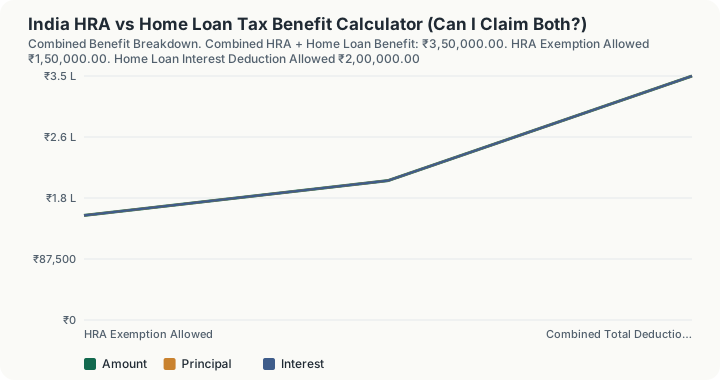
Quick Answer: A salaried employee earning ₹9,00,000 in basic salary + DA, receiving ₹3,00,000 HRA, paying ₹2,40,000 rent in a metro city, while separately servicing a home loan with ₹2,50,000 annual interest on a self-occupied home in a different city, can claim both: a ₹1,50,000 HRA exemption plus a ₹2,00,000 home-loan interest deduction (capped by Section 22), for a combined ₹3,50,000 reduction in taxable income -- but only under the old tax regime. Under the new regime, both drop to ₹0.
Overview
This calculator answers a specific, genuinely common question that a simple side-by-side of two separate calculators does not: if you own a home in one city (say, your hometown) and rent accommodation in a different city near your job, can you claim the HRA exemption on your rent AND the home-loan interest deduction on your owned property in the same year? All amounts are in Indian Rupees (₹, INR).
The short answer is: often yes, under the old tax regime, because these two benefits sit on two different heads of income and address two different, independently real facts -- but "often yes" depends on your regime, your actual rent and salary numbers, and whether the owned property is genuinely not your residence. This calculator models the real decision tree, not a coincidence of two unrelated numbers:
- HRA exemption reduces your Salary income, based on rent you actually pay for accommodation you actually live in, computed as the least of three figures set by law.
- Home-loan interest deduction reduces your House Property income (or your total income, subject to a set-off cap), based on interest on a loan for a residential property -- which can be a completely different property in a completely different city from where you live.
- Tax regime governs whether either benefit is available at all: the new tax regime (New Act Section 202, the default regime) disallows both.
Because the two benefits address genuinely separate facts (where you live and pay rent vs. what property you own and finance), Indian tax law and long-settled CBDT practice permit claiming both simultaneously, under the old regime, when the underlying arrangement is real -- a common, legitimate scenario for professionals who relocated for work but kept a family home elsewhere.
How This Is Calculated
HRA exemption (New Act Section 11, read with Schedule III): the exemption is the LEAST of: 1. Actual HRA received from your employer, 2. Rent paid minus 10% of salary (basic + DA only), 3. 50% of salary if you live in a metro city, or 40% if not.
Home-loan interest deduction on the owned property (New Act Section 22 / Section 131, the same mechanic used by this platform's india-home-loan-tax-benefit-calculator): - If the owned home is self-occupied (vacant, or occupied by family with no rent paid to you), interest is deductible up to ₹2,00,000/year (₹30,000 if construction wasn't completed within 5 years of borrowing). - If it is let-out (a tenant pays you rent), interest is fully deductible against that rental income, with any resulting loss usable against your other income capped at ₹2,00,000/year (8-year carry-forward for the excess). - An additional Section 131 (ex-Section 80EEA) deduction of up to ₹1,50,000 stacks on top if the loan was sanctioned between 1 April 2019 and 31 March 2022, the property's stamp duty value is ₹45,00,000 or below, and you owned no other residential house property at the sanction date.
New regime override: selecting the new tax regime zeroes out both the HRA exemption and the self-occupied home-loan deduction, regardless of your other inputs -- New Act Section 202 (the default regime, successor to old Section 115BAC) disallows both.
The "can I claim both" verdict: this calculator does not just add the two numbers -- it evaluates whether your inputs genuinely support claiming both (regime is old, and both computed amounts are actually greater than zero), and explains in plain language why or why not, including a reminder that claiming both requires the underlying facts to be real and documented.
Worked Example
A professional earning ₹9,00,000 in basic salary + DA, paying ₹2,40,000 rent in Mumbai (a metro city) near their job, receiving ₹3,00,000 HRA from their employer, while separately paying ₹2,50,000 in annual interest on a home loan for a self-occupied property they own in their hometown (construction completed within 5 years, loan not sanctioned in the 2019-2022 Section 131 window), under the old tax regime:
- HRA exemption: least of ₹3,00,000 (HRA received), ₹1,50,000 (₹2,40,000 rent − 10% of ₹9,00,000), and ₹4,50,000 (50% of ₹9,00,000 for a metro city) = ₹1,50,000
- Home-loan deduction: ₹2,50,000 interest, capped at the Section 22 self-occupied limit of ₹2,00,000 (Section 131 not eligible, since the loan wasn't sanctioned in the 2019-2022 window) = ₹2,00,000
- Combined benefit: ₹1,50,000 + ₹2,00,000 = ₹3,50,000
- Verdict: "Yes -- you can claim both, since they apply to two different income heads."
Run the same numbers under the new tax regime instead: HRA exemption drops to ₹0 (new regime taxes HRA in full) and the home-loan deduction drops to ₹0 (new regime disallows the self-occupied interest deduction) -- combined benefit: ₹0.
What This Does Not Account For
- Genuineness and documentation risk. This calculator computes what the law allows on paper; it does not verify that your specific arrangement is genuine. Claiming HRA for a home you don't actually live in, or a home-loan deduction on a property you actually do occupy, is not a timing or optimization question -- it is a misstatement of fact that can be challenged on audit regardless of what any calculator computes. Keep rent receipts/rental agreement, your loan interest certificate, and evidence of your actual residence (utility bills, address on official documents) on hand.
- Full income tax computation. This calculator computes the exemption and deduction amounts, not your full tax liability, slab-based tax, or cess/surcharge.
- A rented and owned property in the SAME city. This calculator's premise is a genuine two-city (or two-residence) situation. Claiming HRA while living in a home you also own in the same city you're renting in is a materially different, much higher-scrutiny fact pattern not modeled here.
- Multiple owned properties. If you own more than one additional residential property beyond the one modeled here, additional properties are typically deemed let-out at a notional rent even if vacant, under a separate rule not modeled in this calculator.
- Co-borrower/joint filing splits. This calculator models a single filer's full HRA and full loan-interest figures, not a split between joint borrowers or spouses.
Common Pitfalls
- Assuming both benefits combine automatically. They don't under the new tax regime -- this is the most consequential input in this calculator, since it can zero out the entire combined benefit regardless of your rent or loan numbers.
- Treating this as a same-city HRA-plus-mortgage-interest trick. This calculator models a genuine different-residence scenario (working in a different city from an owned home, or family occupying a hometown property); using HRA and home-loan claims to shelter income from a single residence you actually live in is a different, higher-risk claim not addressed here.
- Forgetting HRA uses basic + DA only. Using gross salary (including bonuses, other allowances) instead of just basic salary plus DA will overstate both the 10%-of-salary rent threshold and the metro-city salary cap.
- Missing that the metro-city list is disputed for FY 2026-27. This calculator defaults to the historically undisputed 4-city list (Mumbai, Delhi, Kolkata, Chennai) for the 50% cap; some secondary sources claim Bengaluru, Hyderabad, Pune, and Ahmedabad were added, but this could not be confirmed against a primary Income-tax Rules, 2026 text and is not applied here. If you rent in one of those four contested cities, verify your city's current classification before relying on the 50% cap.
- Assuming Section 131 (ex-Section 80EEA) helps a new loan. As with this platform's other India home-loan calculator, that additional ₹1,50,000 deduction requires a loan sanctioned between 1 April 2019 and 31 March 2022 -- closed to new loans.
Frequently Asked Questions
Can I claim HRA and home loan interest deduction at the same time?
Does owning a home in my hometown stop me from claiming HRA where I work?
Is this the same as claiming HRA and home loan benefit on the same house?
What tax regime should I choose if I have both a home loan and pay rent?
Which cities count as "metro" for the 50% HRA cap in FY 2026-27?
Sources
- Income-tax Act, 2025, Section 22 / Section 131 / Section 202 -- see this platform's India Home Loan Tax Benefit Calculator for full citations of the home-loan side of this calculator's math. incometax.gov.in/iec/foportal
Also consulted: HRA exemption computation rule (least of three; salary = basic + DA only) -- long-settled law carried forward from the old Act's Rule 2A, corroborated across multiple independent professional tax-law sources; New Act Section 11, read with Schedule III (Table Sl. No. 11), as the current-Act home for the HRA exemption -- confirmed by directly reading the Income-tax Bill 2025 text (PRS India's official bill copy); flagged as moderate-confidence since the text read was the as-introduced bill and the enacted Act's exact numbering could not be independently re-confirmed against incometaxindia.gov.in (access error during verification). Two secondary sources instead cite "Section 14(10)" or an unchanged "Section 10(13A)" -- this calculator uses the figure supported by direct legislative-text inspection; Metro-city list conflict for FY 2026-27 -- one research pass found roughly ten secondary sources citing Rule 279 of the Income-tax Rules, 2026 (CBDT Notification G.S.R. 198(E), 20 March 2026) expanding the list to 8 cities; a second, independent pass reading the Act's own text found no city named in the Act and could not corroborate the expansion. This calculator defaults to the undisputed 4-city list pending resolution; The principle that HRA and home-loan interest deduction can be claimed together for genuinely separate residences is corroborated across multiple independent professional tax-law sources describing this as settled, common practice for taxpayers working away from an owned family home.