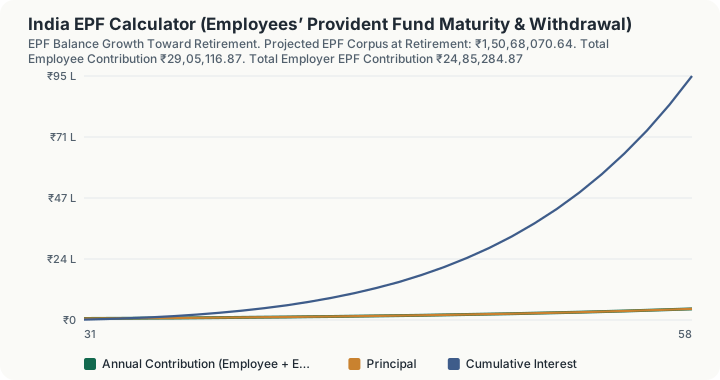
Quick Answer: An Indian salaried employee earning ₹25,000/month in Basic Wage + DA, starting from a ₹2,00,000 EPF balance at age 30, with 7% annual wage growth and contributions to the retirement age of 58, projects to roughly ₹1,50,68,070 of EPF, excluding the separate EPS pension pool: about ₹29.05 lakh own contributions, ₹24.85 lakh employer, and ₹94.78 lakh of interest at 8.25%.
Overview
This calculator is built specifically for India's Employees' Provident Fund (EPF) scheme, administered by the Employees' Provident Fund Organisation (EPFO), and shows figures in Indian Rupees (₹). It is not a US retirement account calculator. Every salaried employee in India covered by the EPF & Miscellaneous Provisions framework (recodified in 2026 as the EPF Scheme, 2026, under the Code on Social Security, 2020, replacing the EPF Scheme, 1952) has 12% of Basic Wages + Dearness Allowance (DA) deducted from their own pay and matched by an equal 12% employer contribution. The twist most calculators get wrong: the employer's 12% is not all going into your EPF balance. A fixed 8.33% slice of it (capped at a ₹15,000/month wage ceiling) is diverted every month into the separate Employees' Pension Scheme (EPS), now recodified as EPS, 2026, which is a defined-benefit pension formula, not a compounding balance. Only the remainder of the employer's share -- 3.67% of wages up to the ceiling, more than that above it -- actually lands in your interest-earning EPF account alongside your own 12%.
This calculator models exactly that split, year by year, compounding the EPF balance (employee contribution plus employer's EPF-portion only) at the EPFO's declared interest rate, and reports the EPS diversion separately since it does not belong to this balance. For a full EPS pension estimate, use the companion India EPS Pension Calculator, which applies the pensionable-salary formula to the diverted contributions.
How This Is Calculated
Step 1 -- split the contribution. Every month, the employee contributes 12% of Basic Wage + DA to EPF. The employer also contributes 12% of the same wage, but it is split: 8.33% of wages, capped at the EPS wage ceiling of ₹15,000/month (so a maximum of ₹1,249.50/month per employee, regardless of actual salary), goes to EPS. The remaining employer share -- 12% of wages minus that EPS amount -- goes to EPF. For a wage above ₹15,000, this means the EPS diversion stays fixed at ₹1,249.50 while the employer's EPF-bound remainder grows with wages.
Step 2 -- compound the EPF balance. Only the employee's 12% and the employer's EPF-bound remainder compound inside the EPF account. This calculator applies the EPFO's declared annual interest rate once per year to the running balance plus that year's contributions (matching how EPFO credits interest to member accounts annually, on the running monthly balance -- a monthly-averaging nuance this annual model simplifies; see "What This Does Not Account For").
Step 3 -- apply the 5-year tax rule. Withdrawal of the accumulated EPF balance is entirely tax-free if you have completed 5 years of continuous service (Income Tax Act, Section 192A). If you withdraw before that, and the withdrawal exceeds ₹50,000, TDS of 10% (with PAN on file) applies at source -- and the amount can still be taxable in your hands as income even where TDS doesn't apply, unless it falls under specific exceptions (e.g., termination due to ill health, business discontinuation, or reasons beyond the employee's control).
The current EPFO-declared interest rate used as this calculator's default is 8.25% per annum for FY 2025-26, approved by EPFO's Central Board of Trustees at its 239th meeting (2 March 2026) and forwarded for the Ministry of Finance's routine concurrence -- the same rate held for FY 2024-25. You can adjust this input if a newer rate has since been notified.
Worked Example
Consider Priya, age 30, with a current Basic Wage + DA of ₹25,000/month, an existing EPF balance of ₹2,00,000, expecting 7% annual wage growth, contributing until the normal EPF retirement age of 58 (28 years), at the current 8.25% EPFO rate.
Monthly split in year 1: Employee EPF = 12% × ₹25,000 = ₹3,000. EPS diversion = 8.33% × ₹15,000 (capped) = ₹1,249.50. Employer EPF = (12% × ₹25,000) − ₹1,249.50 = ₹1,750.50. Combined annual EPF deposit in year 1: (₹3,000 + ₹1,750.50) × 12 = ₹57,006.
Growth over 28 years: As wages rise 7% annually, both the employee and employer-EPF contributions rise with them (the EPS diversion stays capped once wages exceed ₹15,000/month, so it does not grow beyond ₹14,994/year). Compounding the running balance annually at 8.25%, starting from ₹2,00,000, the EPF account reaches approximately ₹1,50,68,070 by age 58.
The pieces: roughly ₹29,05,117 from Priya's own contributions, ₹24,85,285 from the employer's EPF-bound share, and about ₹94,77,669 in compounded interest -- none of which includes the roughly ₹4,19,832 diverted to the separate EPS pension pool over the same period, which instead becomes a monthly pension entitlement, not a lump sum.
Carrying The Balance Across The Twenty-Eight Years
Step 1 -- Age 31, the first year. Contribution ₹57,006, interest credited ₹16,500, closing balance ₹2,73,506
Step 2 -- Age 32. Contribution ₹62,046, cumulative interest ₹39,064, closing balance ₹3,58,116
Step 3 -- Age 41, where the compounding overtakes the saving. Cumulative interest rises from ₹5,72,723 to ₹7,06,172, so the year credits ₹1,33,449 of interest against ₹1,26,641 of contributions. From this year on, the account earns more each year than Priya and her employer put in.
Step 4 -- Age 58. Cumulative interest ₹94,77,669, closing balance ₹1,50,68,070
Interest is 62.9% of the final balance, and the crossover at age 41 is why. Eleven years of contributions built the base; the following seventeen were mostly the base working. Withdrawing and restarting a fund resets that clock, which is the single most expensive thing an EPF member can do.
What This Does Not Account For
- Monthly interest crediting. EPFO actually computes interest on the running monthly balance and credits it once a year, which differs slightly from this calculator's simplified once-a-year compounding on the annual total; the difference is typically small but not zero.
- Voluntary Provident Fund (VPF). Many employees elect to contribute more than the statutory 12% through VPF, which earns the same EPFO interest rate but is not modeled here.
- Job changes and the EPFO wage ceiling nuance. The 12%/12% mandatory contribution is compulsory only up to the ₹15,000 wage ceiling; contribution on wages above that ceiling is technically voluntary (an "excluded employee" can, with employer agreement, contribute on a lower base), though in practice most employers with employees above the ceiling continue contributing 12%/12% on the full actual wage, which is what this calculator assumes by default.
- Partial withdrawals. EPFO permits partial withdrawals for specific purposes (home purchase, medical emergencies, marriage, education) subject to service-length conditions; this calculator projects a single continuous account to a chosen exit age and does not model partial withdrawals along the way.
- Administrative and EDLI charges. Employer-side administrative charges and Employees' Deposit Linked Insurance (EDLI) premiums are separate line items in EPFO's accounting and do not affect the employee's EPF balance, so they are not modeled here.
- Early exit and re-employment gaps. The 5-year continuous-service clock can be affected by gaps in employment or account transfers; this calculator assumes unbroken, continuous service across the years you enter.
Common Pitfalls
- Assuming 12% + 12% both go to EPF. The single most common EPF math error: the employer's 8.33% EPS diversion is not part of your EPF balance and does not earn EPF interest. Confusing the two overstates your projected lump sum.
- Forgetting the EPS diversion is capped. Some assume the EPS contribution scales with actual salary above ₹15,000; it is capped at 8.33% of the ₹15,000 ceiling (₹1,249.50/month) for the vast majority of members, unless the employer has opted into contributing on higher actual wages under the post-2022 "higher pension" option.
- Withdrawing just before the 5-year mark. Employees close to the 5-year continuous-service threshold sometimes withdraw early to change jobs, triggering TDS and taxability that a few months' wait would have avoided entirely.
- Not accounting for the EPF Scheme, 2026 recodification. The EPF Scheme, 1952 and EPS, 1995 were formally replaced by the EPF Scheme, 2026 and EPS, 2026 (notified 29 June 2026 under the Code on Social Security, 2020) -- the underlying rates, ceiling, and formula are explicitly unchanged, but referring to "EPF 1952" in current paperwork is now outdated terminology.
- Ignoring that the EPS portion isn't a balance. Treating the diverted EPS contribution as "your money sitting in an account" is incorrect; it funds a pension formula, not a corpus you can withdraw as a lump sum in most cases.
Frequently Asked Questions
How much of my EPF contribution actually goes toward my retirement corpus?
Is EPF withdrawal taxable after 5 years?
What is the current EPF interest rate?
Did the EPF Scheme, 2026 change my contribution rate or wage ceiling?
Can I contribute more than 12% to EPF?
Sources
- Income Tax Department, Government of India, the official authority for the national tax authority this calculator relates to. incometax.gov.in/iec/foportal
Also consulted: Employees' Provident Fund Organisation, "Present Rates of Contribution" (epfindia.gov.in/site_docs/PDFs/MiscPDFs/ContributionRate.pdf) -- 12%/12% contribution rates, 8.33%/3.67% employer split, ₹15,000 EPS wage ceiling; EPFO Central Board of Trustees, 239th meeting (2 March 2026), reported via newsonair.gov.in (Prasar Bharati/Government of India) -- 8.25% EPF interest rate for FY 2025-26; Central Government notification, EPF Scheme, 2026 and Employees' Pension Scheme, 2026 (29 June 2026), under the Code on Social Security, 2020 -- recodification of the EPF Scheme, 1952 and EPS, 1995/Family Pension Scheme, 1971, rates/ceiling/formula unchanged; Income Tax Act, 1961, Section 192A -- TDS on premature EPF withdrawal; 5-year continuous-service exemption; ₹50,000 threshold.