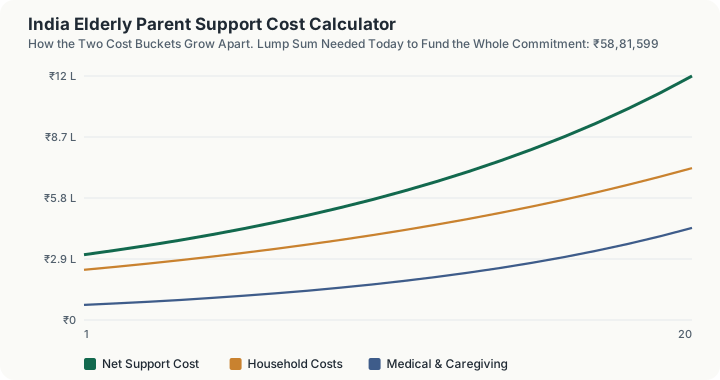
Quick Answer: Supporting parents costs two things that behave differently: household expenses, which rise roughly with general prices, and medical and caregiving expenses, which rise faster. On the default figures of ₹20,000 a month of household costs and ₹6,000 of medicines, the support bill is ₹26,000 a month today, ₹97,207 a month in year 20, and funding all twenty years from a single pot earning 7% after tax takes ₹58,81,599 set aside now.
Overview
Most families discover the cost of supporting elderly parents one bill at a time. The groceries were always there. Then a cardiologist adds a monthly prescription, then a knee gives way and someone has to be in the house during the day, and over four or five years a quiet contribution turns into a line item that rivals a home loan EMI. The question people eventually ask is not what it costs this month. It is what the whole commitment costs, and whether the money exists to meet it.
That question has two halves, and this calculator answers both. The first half is the running cost today: what your parents spend, minus what their own pension, Senior Citizens Savings Scheme interest or rent already covers, which is the part you actually fund. The second half is the size of the fund that would cover the entire commitment from today, with every future year's bill grown at the rate it is likely to grow and then discounted back at what your money would earn in the meantime.
Keeping household costs and medical costs apart is the point of the exercise. Groceries, electricity and household help broadly track general prices. Medicines, diagnostics, attendants and senior health insurance premiums have historically risen faster, and the premium on a senior policy also steps up with age independently of inflation. A single blended number hides this. Split in two, the pattern becomes visible immediately: on the default figures the medical bucket starts at 30% of the household bucket and ends at 61% of it after twenty years, which is why families who budget from today's split are repeatedly caught short later.
Why This Calculator Has No Built-In Cost Table
Every comparable tool online fills in Indian costs for you: a grocery figure for a metro, an attendant rate for a tier 2 city, a multiplier for a small town. Those numbers are invented. No Indian government agency publishes the cost of an elderly parent's groceries, medication or attendant by city, and the "tier 1, tier 2, tier 3" multipliers that circulate are borrowed from the Central Pay Commission's X, Y and Z city classification, which exists to set house rent allowance for government staff and is not a measurement of what anything costs.
So this page does not pretend. Every amount is yours to enter, because you know what your parents actually spend, and a figure you can verify from last month's bank statement beats a national average that was never measured. What the calculator contributes is the part nobody can do in their head: compounding two different inflation rates across two different cost buckets for twenty or thirty years, subtracting an income stream that may or may not rise with it, and discounting the result to a present value.
The same honesty applies to the inflation inputs. The commonly quoted "medical inflation of 10 to 14 percent in India" is a trade estimate from insurers and consultancies, not a published statistic. The Ministry of Statistics and Programme Implementation publishes the Consumer Price Index, including a health group, and that is the reference point to use. The default of 10% here is a planning assumption, labelled as one, and you should change it.
How This Is Calculated
Three inputs become three annual streams, each growing at its own rate.
The household stream starts at your monthly household figure times twelve and grows at the household inflation rate. The medical stream starts at medicines plus caregiving, times twelve, plus the annual insurance premium, and grows at the medical inflation rate. Your parents' own income starts at their monthly income times twelve and grows at whatever rate you set, which should be zero for a fixed annuity or an SCSS payout and something positive for a dearness-allowance-linked government pension.
For each year t from 1 to the number of years you are planning for:
Household cost in year t = annual household cost × (1 + household inflation)^(t−1)
Medical cost in year t = annual medical cost × (1 + medical inflation)^(t−1)
Parents' income in year t = annual income × (1 + income growth)^(t−1)
Net cost in year t = household cost + medical cost − parents' income
The lump sum needed today is the sum of each year's net cost discounted at the return your money earns:
Corpus = Σ net cost in year t ÷ (1 + return)^t
Costs are treated as falling at the end of each year, which is the conservative order: money is assumed to earn for a full year before being spent. The calculator sums the discounted years one at a time rather than using the textbook growing annuity formula, for two reasons. The formula breaks down when the growth rate equals the discount rate, producing a division by zero on perfectly ordinary inputs. And it cannot express two buckets growing at different rates minus an income stream growing at a third, which is exactly the situation here. The sum has no special cases, and it produces the year-by-year table shown above the sources, so every figure in the total can be traced to the year it came from.
A year can come out negative, and the calculator reports it as a surplus rather than flooring it at zero. If your parents' pension exceeds their costs today and will keep doing so for six years before medical costs overtake it, those six years genuinely reduce what you need to set aside, and hiding them would overstate the burden.
Worked Example
Take the default case: ₹20,000 a month of household costs, ₹6,000 a month of medicines and consultations, no paid attendant yet, no insurance premium, no pension income, twenty years of support, household inflation of 6%, medical inflation of 10%, and a post-tax return of 7%.
Year one is straightforward. Household costs are ₹20,000 × 12 = ₹2,40,000. Medical costs are ₹6,000 × 12 = ₹72,000. Nothing is subtracted, so the net cost is ₹3,12,000 for the year, which is ₹26,000 a month, the figure most families would quote if asked.
Year twenty is where the two rates separate. The household bucket has compounded nineteen times at 6%: ₹2,40,000 × 1.06^19 = ₹7,26,143.88. The medical bucket has compounded nineteen times at 10%: ₹72,000 × 1.10^19 = ₹4,40,345.45. The year's net cost is ₹11,66,489.33, or ₹97,207 a month. The monthly support bill has not doubled over twenty years. It has grown 3.7 times.
Added up without discounting, the twenty years cost ₹1,29,52,341.85. Funding them from one pot today, with the balance earning 7% after tax while it waits, takes ₹58,81,599.17. The gap between those two numbers, roughly ₹70 lakh, is what the return does for you, and it is the single strongest argument for setting money aside early rather than paying out of monthly income later.
Now change one thing: an attendant at ₹20,000 a month from year one. The medical bucket starts at ₹3,12,000 instead of ₹72,000, and because it compounds at the faster rate, the corpus required more than doubles. That sensitivity is the real finding here. The decision that moves this number is not the grocery budget, it is whether and when paid care begins.
The Section 80D Deduction
If you pay a health insurance premium for your parents, Section 80D of the Income-tax Act lets you deduct it: up to ₹25,000, rising to ₹50,000 where any person insured is a senior citizen. Preventive health check-ups count inside that limit, up to ₹5,000. This is over and above the deduction for your own family's policy.
Where no premium is paid at all and a parent is aged 60 or above, a second route allows a deduction of up to ₹50,000 for medical expenditure actually incurred on them. The two routes are alternatives, not additions: if you pay a premium, you use the premium route. The calculator applies whichever route the statute allows for your inputs and names it in the results, then values it at the marginal rate you enter.
One thing to watch. Section 80D is available under the old tax regime only. If you file under the new regime, the deduction is worth nothing to you, and you should enter a marginal rate of zero to see the support cost without it.
What This Does Not Account For
A one-off hospitalisation. This is a recurring-cost model. A bypass, a joint replacement or a cancer protocol is a lump sum arriving in a single year, and it should be planned as a separate emergency reserve rather than smoothed into a monthly figure. No credible published figure exists for how large that reserve should be, which is why this page does not name one.
Care that starts later. The attendant cost you enter applies from year one. Most families need no paid care for several years and then need a great deal of it. To model that, run the calculator twice, once for the years before care and once for the years after, and add the two corpus figures.
Insurance premiums that step up with age. Senior policy premiums rise with the age band as well as with medical inflation, and this model grows the premium only at the medical inflation rate.
Room rent sub-limits, co-pays and waiting periods. A senior citizen policy frequently pays less than the hospital bills, and the difference lands on the family. That gap is not modelled.
Government cover. CGHS, ECHS and Ayushman Bharat PM-JAY change the medical figure substantially for the households that have them. Enter your actual out-of-pocket cost, which may be close to zero.
Two parents with different needs. Enter the household cost once for the shared home, and the combined medical and caregiving cost for both. Where one parent's needs are much heavier, running them separately is more accurate.
Tax on the fund itself. The return you enter should already be net of tax. The calculator does not tax the growth.
Common Pitfalls
Using one inflation rate for everything. This is the mistake that makes long-horizon plans fail. Keep the medical rate separate and higher, and look at what the final year costs rather than the first.
Planning to a round number of years. Twenty is a habit, not a forecast. Life expectancy at 60 or at 70 is published by the Registrar General of India in the Sample Registration System abridged life tables, by state and sex, and planning to a figure from that table is a different exercise from planning to a round number. Underestimating the horizon is the most expensive error available here.
Counting a pension that does not grow as though it will. An SCSS payout and most annuities are fixed in rupee terms. Against 6% household inflation, a fixed pension loses roughly half its purchasing power in twelve years. Set income growth to zero unless the pension genuinely carries dearness allowance.
Forgetting that the fund is being spent. The lump sum here assumes the balance keeps earning the stated return while it is drawn down. If you hold it in a savings account instead, the real post-tax return is far lower, and the corpus needed is correspondingly larger.
Treating the deduction as a reason to insure. Section 80D makes a policy cheaper, not free. At a 30% marginal rate, a ₹50,000 deduction saves ₹15,000 of tax, which is a discount on the premium, not a return on it.
Frequently Asked Questions
Why does this calculator not tell me what things cost in my city?
What should I use for medical inflation?
How many years should I plan for?
Does the corpus figure assume I invest the money?
Can I use this if my parents live with me?
My parents have CGHS or Ayushman Bharat. What do I enter?
Is the Section 80D deduction available in the new tax regime?
Sources
- Income Tax Department, Section 80D deduction limits for health insurance premium and medical expenditure, individual return guidance for AY 2026-27. incometax.gov.in/iec/foportal/help/individual/return-applicable-1
- Ministry of Statistics and Programme Implementation, Consumer Price Index, including the health group used as the published reference for cost inflation. mospi.gov.in/web/mospi/cpi
- Office of the Registrar General of India, Sample Registration System abridged life tables, for remaining life expectancy by age, sex and state. censusindia.gov.in/census.website/data/SRSALT
- Department of Economic Affairs, Ministry of Finance, for the Senior Citizens Savings Scheme rate used when entering a parent's own income. dea.gov.in
This calculator stores no cost table. Every rupee figure in the result comes from the amounts you enter, and no Indian authority publishes elderly care costs by city for the page to cite instead.