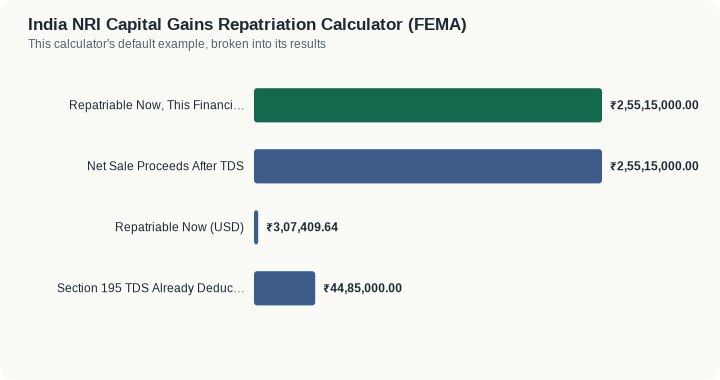
Quick Answer: An NRI selling Indian property for ₹3,00,00,000 (₹3 crore) with a ₹1,20,00,000 cost basis (a ₹1,80,00,000 long-term gain) faces ₹44,85,000 in TDS under Section 393 of the Income-tax Act, 2025 (formerly Section 195), leaving ₹2,55,15,000 in net proceeds: equivalent to roughly US $3,07,410 at ₹83/$, comfortably inside the USD 1 million per financial year FEMA repatriation ceiling, so the entire amount can be wired abroad within the same financial year, subject to Form 15CA/15CB certification.
What does this calculator do?
Selling a capital asset in India is only half the NRI journey, getting the money out of India legally is the other half, and it involves a completely separate legal framework: FEMA (Foreign Exchange Management Act), administered by the RBI, not the Income Tax Department.
This calculator chains together three things that NRIs usually have to piece together from separate sources:
- The capital gains tax and TDS (Section 393, formerly Section 195) on the sale (same mechanics as the companion Property TDS Calculator), because what's actually available to repatriate is the net-of-TDS proceeds, not the gross sale price.
- The FEMA repatriation ceiling: funds sourced from an NRO account (which is where sale proceeds land) can be repatriated abroad up to USD 1,000,000 per financial year (April-March), aggregated across all your NRO accounts and all repatriations in that year, not per-transaction.
- The Form 15CA/15CB certification requirement: under Rule 37BB, once your aggregate remittance in the financial year exceeds ₹5 lakh and is chargeable to tax, you need both Form 15CA (your own online declaration) and Form 15CB (a Chartered Accountant's certificate) verifying the tax position before a bank will process the transfer.
Do not confuse this USD 1 million NRO ceiling with the Liberalised Remittance Scheme (LRS) USD 250,000 limit. The LRS limit applies to resident Indians sending their own funds abroad for permitted purposes: it has nothing to do with an NRI repatriating their own India-sourced sale proceeds out of an NRO account. These are two entirely separate regimes, and conflating them is one of the most common NRI-forum mistakes.
How is this calculated?
1. Net proceeds after TDS (identical mechanics to the Property TDS Calculator):
Net Proceeds = Sale Consideration − TDS
2. Convert to USD at the exchange rate you provide, to compare against the FEMA ceiling:
Proceeds Available (USD) = (Net Proceeds (INR))/(USD/INR Rate)
3. Apply the remaining FEMA headroom for the financial year:
Remaining FEMA Limit = USD 1,000,000 − Already Repatriated This FY
Repatriable Now = min(Proceeds Available, Remaining FEMA Limit)
Any excess beyond the remaining limit carries forward and can only be repatriated starting the following financial year (when a fresh USD 1 million ceiling resets): this calculator projects that multi-year schedule when a single sale's proceeds exceed the annual ceiling.
4. Form 15CA/15CB threshold check:
Form 15CB Required = Net Proceeds (INR) ≥ Rs. 5,00,000
Worked Example
Using the calculator's default inputs: ₹3,00,00,000 sale, ₹1,20,00,000 cost basis, 60-month (long-term) holding, no lower-deduction certificate, ₹83/$ exchange rate.
- Capital gain: ₹3,00,00,000 − ₹1,20,00,000 = ₹1,80,00,000.
- Long-term, so 12.5% rate in force; the buyer deducts on the ₹3 crore price, and the surcharge band is set by that amount subject to deduction: above ₹1 crore, so the 15% capital-gains cap applies.
- Effective TDS rate: 12.5% × 1.15 × 1.04 = 14.95%.
- No certificate -> TDS on the full ₹3,00,00,000 consideration: ₹44,85,000.
- Net proceeds: ₹3,00,00,000 − ₹44,85,000 = ₹2,55,15,000.
- In USD at ₹83/$: ₹2,55,15,000 ÷ 83 = ≈US $3,07,410.
- Well under the USD 1,000,000 FEMA ceiling for the year -> the entire amount is repatriable within the same financial year.
- Since net proceeds exceed ₹5 lakh, Form 15CB (CA certificate) is required alongside Form 15CA Part C before the bank will process the outward remittance.
Now scale up: a ₹15 crore sale with a ₹4 crore cost basis produces net proceeds of roughly ₹12.76 crore (≈US $15.37 lakh), which exceeds the USD 1 million annual ceiling. This calculator projects that the first US $1,000,000 repatriates in the current financial year, with the remaining roughly US $537,000 carrying forward to be repatriated once the new financial year's ceiling resets on April 1.
What does this calculator not account for?
- Multiple asset sales or existing NRO balances in the same financial year. The "already repatriated" input lets you account for prior remittances, but this calculator does not track a running balance across multiple calculator sessions: you're responsible for aggregating all NRO-sourced repatriations for the year yourself.
- Marginal relief on surcharge, consistent with the companion Property TDS Calculator.
- DTAA relief or exemptions under Sections 54/54EC/54F that could reduce the underlying capital gains tax before TDS is even calculated: see the companion Property TDS and DTAA Relief calculators.
- Exchange rate movement between the sale date and the actual remittance date. This calculator uses a single rate you supply; real-world remittances lock in whatever rate the bank offers on the transfer date.
- NRE/FCNR-sourced funds, which are NOT subject to the USD 1 million ceiling at all (they're freely repatriable): this calculator models NRO-sourced sale proceeds specifically, which the ceiling does apply to.
- Bank-specific processing timelines and documentation beyond 15CA/15CB (e.g., the underlying sale deed, TDS challan copies, and the bank's own KYC/FEMA declaration forms).
What mistakes do people make with this?
- Confusing the USD 1 million NRO ceiling with the USD 250,000 Liberalised Remittance Scheme (LRS) limit. LRS applies to resident Indians sending money abroad; it is irrelevant to an NRI repatriating their own NRO-sourced sale proceeds. Do not apply the wrong limit.
- Forgetting that the ceiling is aggregate, not per-transaction. If you've already repatriated US $600,000 from other NRO sources this financial year, only US $400,000 of headroom remains for this sale's proceeds: the "already repatriated" input exists specifically for this.
- Assuming NRE and FCNR balances share the same ceiling as NRO. They don't: NRE/FCNR funds are freely and fully repatriable with no USD 1 million cap; only NRO-sourced funds are capped.
- Waiting until the transfer to think about Form 15CB. The CA certificate takes time to prepare properly (verifying the tax computation, TDS challans, and treaty position if applicable): start this well before you need the funds moved.
- Not accounting for TDS before checking against the FEMA limit. The FEMA ceiling applies to what you actually have to remit (net of TDS), not the gross sale price: a large gross sale can still fit under the ceiling once TDS is subtracted, as this calculator's default scenario shows.
Frequently Asked Questions
What is the FEMA repatriation limit for an NRI?
What's the difference between the USD 1 million NRO ceiling and the LRS USD 250,000 limit?
When do I need Form 15CB in addition to Form 15CA?
What happens to sale proceeds that exceed the USD 1 million ceiling in one year?
Does obtaining a lower-deduction certificate help with repatriation too?
Sources
- Income-tax Act, 2025 (Act 30 of 2025), Sections 393(2) and 395 (TDS on sums paid to non-residents; certificates and determinations), Gazette of India Extraordinary, 21 August 2025. egazette.gov.in/WriteReadData/2025/265620.pdf
- Finance Bill, 2026, First Schedule Part II (TDS rates and surcharge for non-residents). indiabudget.gov.in/doc/Finance_Bill.pdf
Also consulted: FEMA, 1999, and RBI Master Direction on Remittance of Assets (USD 1 million per financial year NRO repatriation ceiling); Rule 37BB, Income-tax Rules, 1962 (Form 15CA/15CB thresholds and requirements).
On the limits used: we could not confirm the USD 1 million per-financial-year NRO repatriation ceiling or the ₹5 lakh Form 15CB threshold in the RBI Master Direction or the Income-tax Rules themselves, so check a specific transaction against the RBI rules in force when you remit.