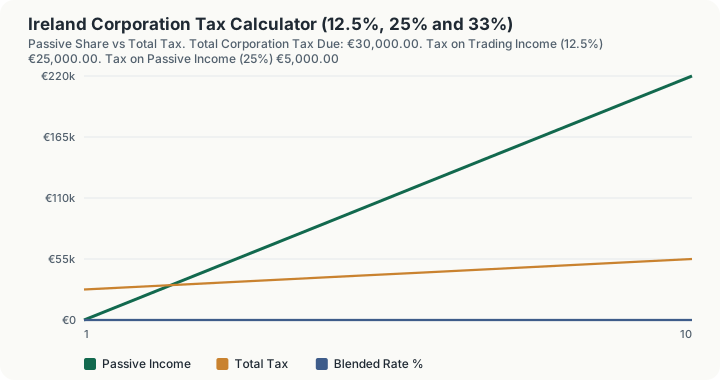
Quick Answer: A company with €200,000 of trading income and €20,000 of rental or deposit income pays €30,000.00 in Corporation Tax. Only the trading income gets the famous 12.5% rate; the passive income is taxed at 25%, double it. The blended effective rate is 13.64%, not 12.5%. Chargeable gains are taxed at 33%.
What does this calculator do?
Ireland's 12.5% rate is the most quoted number in European tax, and it is routinely misapplied. It covers trading income only.
A company actually faces three rates. Trading income is taxed at 12.5%. Non-trading or passive income (rent, deposit interest, royalties and most dividends) is taxed at 25%. Chargeable gains are taxed at 33%, higher than either corporation tax rate.
The practical consequence is that a company's real rate is almost never 12.5%. Any rental income, any deposit interest, any investment return drags the blended rate upward. A property holding company pays 25% on everything, and the headline rate never touches it.
How is this calculated?
Each stream is taxed at its own rate and the results are added:
Tax = 0.125 × Trading + 0.25 × Passive + 0.33 × Gains
Step 1: Floor each of the three inputs at zero. Negative trading income, passive income or gains are treated as zero. Losses are not carried anywhere.
Step 2: Tax the trading income at 12.5%. Trading income times 0.125, rounded to the cent.
Step 3: Tax the passive income at 25%. Passive income times 0.25. This is the rate that does the damage.
Step 4: Tax the chargeable gains at 33%. Gains times 0.33, applied separately from either corporation tax rate.
Step 5: Add the three charges. That sum is the total tax due.
Step 6: Add the three income figures. Trading plus passive plus gains is the total profit, and gains sit inside that denominator.
Step 7: Divide total tax by total profit. That quotient, times 100, is the blended effective rate.
Step 8: Price the same profit as if it were all trading. Total profit times 12.5%, which is the counterfactual the calculator reports alongside the real figure.
Step 9: Subtract the counterfactual from the actual tax. The difference is the extra tax caused purely by the income mix.
The blended effective rate equals 12.5% only where every euro of profit is trading income, and rises toward 25% as the passive share grows.
What counts as trading is a question of fact rather than election, and Revenue publishes extensive guidance on it. Broadly it requires an actual trade being carried on, with the activity, organisation and commercial risk that implies. Passively holding an asset and collecting income from it is not trading.
Worked Example
A software company bills €200,000 from its trade and collects €20,000 of rent on a floor it sublets. Both land in the same set of accounts, and only one of them meets the 12.5% rate.
Step 1: Tax the trading income. €200,000 x 12.5% = €25,000.00
Step 2: Tax the passive income. €20,000 x 25% = €5,000.00
Step 3: No chargeable gains this year. €0 x 33% = €0.00
Step 4: Total corporation tax. €25,000.00 + €5,000.00 + €0.00 = €30,000.00
Step 5: Total profit. €200,000 + €20,000 + €0 = €220,000.00
Step 6: The blended effective rate. €30,000.00 / €220,000.00 = 13.64%
Step 7: The same profit if it were all trading. €220,000 x 12.5% = €27,500.00
Step 8: The cost of the income mix. €30,000.00 - €27,500.00 = €2,500.00
That last figure is the whole point. The rent is 9% of the profit and it lifts the rate by more than a percentage point, because it is charged at double.
Strip the rent out and the headline rate becomes real:
Step 9: A purely trading company on the same €220,000. €220,000 x 12.5% = €27,500.00, a blended rate of 12.50%
Step 10: The same €220,000 as rent instead. €220,000 x 25% = €55,000.00, a blended rate of 25.00% and €27,500.00 more tax than the trading company on identical profit
Now add a disposal to the original company:
Step 11: A €50,000 chargeable gain. €50,000 x 33% = €16,500.00
Step 12: Total tax with the gain. €25,000.00 + €5,000.00 + €16,500.00 = €46,500.00
Step 13: The blended rate that produces. €46,500.00 / €270,000.00 = 17.22%, leaving €223,500.00 after tax
Three rates on one set of accounts, and the quoted 12.5% describes only the first of them.
What does this calculator not account for?
- The 15% Pillar Two minimum rate for groups with consolidated revenue above €750 million, which operates as a top-up rather than a change to the 12.5% rate itself.
- The close company surcharge, an additional 20% on undistributed investment and rental income of a close company, which materially raises the effective cost of retaining passive income.
- The R&D tax credit, increased to 35% in Budget 2026.
- The Knowledge Development Box, offering an effective 10% rate on qualifying intellectual property income.
- Start-up relief under section 486C for new trading companies in their first years.
- Group relief and loss relief, including the carry-back and carry-forward of trading losses.
- Transfer pricing and the treatment of intra-group transactions.
- Double taxation relief on foreign income and the participation exemption for certain foreign dividends.
- Whether the activity is a trade. This calculator takes your classification as given; it is often the whole question.
What mistakes do people make with this?
- Calling 12.5% the corporation tax rate. It is the trading rate. Any passive income is taxed at 25%, and the blended rate is what the company actually pays.
- Assuming rental income is trading income. It is not, unless the company is genuinely carrying on a property trading business. Ordinary landlord activity is passive and taxed at 25%.
- Forgetting the close company surcharge. A close company that retains rather than distributes investment or rental income can face a further 20% surcharge, on top of the 25%.
- Taxing chargeable gains at a corporation tax rate. Gains are charged at the CGT rate, which this calculator holds at 33%, not at 12.5% or 25%.
- Assuming Pillar Two replaced the 12.5% rate. It applies only to very large groups and works as a top-up to 15%; smaller companies are unaffected.
- Treating the classification as elective. Whether income is trading is a matter of fact determined by the activity, and Revenue examines it.
Frequently Asked Questions
Is Irish corporation tax really 12.5%?
What counts as passive income?
What rate does a property company pay?
How are company capital gains taxed?
Does the 15% global minimum rate apply to me?
Can I choose to classify income as trading?
Sources
- Revenue Commissioners (Ireland), the official authority for the national tax authority this calculator relates to. revenue.ie
All figures verified on 30 August 2026
Also consulted: Revenue Tax and Duty Manual Part 02-02-01: "Corporation Tax: General Background", the 12.5% trading rate and 25% rate on non-trading income; Revenue: "Capital gains for companies", chargeable gains charged at 33%; Revenue Tax and Duty Manual Part 02-02-06, general guidance on the classification of activities as trading; Revenue Budget 2026 summary, R&D tax credit rate increased from 30% to 35%.