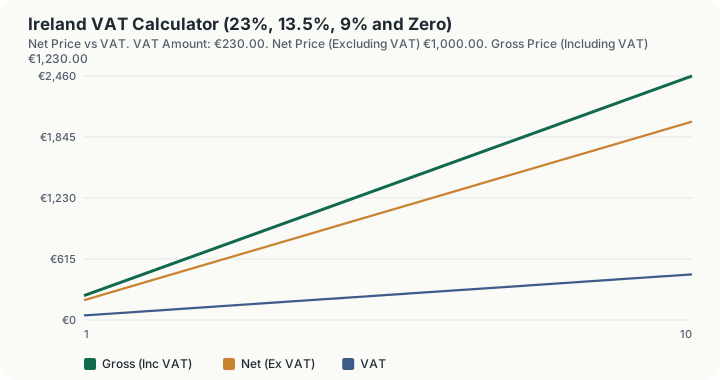
Quick Answer: Adding the standard 23% rate to a €1,000 net price adds €230.00, giving €1,230 gross. Removing VAT from a €1,000 gross price gives €186.99, not €230, because the VAT is 23/123 of the gross rather than 23% of it. Ireland also has two registration thresholds: €42,500 for services and €85,000 for goods.
What does this calculator do?
Ireland operates four VAT rates: the standard 23%, a reduced 13.5%, a second reduced 9%, and zero. This calculator adds VAT to a net price or removes it from a gross price at any of them, and checks turnover against the correct registration threshold.
Two things trip people up.
The first is that adding and removing VAT are not symmetrical. Adding 23% to €1,000 gives €230 of VAT. Removing VAT from €1,000 gives €186.99, because that €1,000 already includes the tax.
The second is that Ireland has two registration thresholds, unlike most countries. A business supplying services must register once turnover exceeds €42,500, while a business supplying goods has until €85,000. A consultancy and a shop with identical turnover can have opposite obligations.
How is this calculated?
Adding VAT to a net amount:
VAT = Net × rate; Gross = Net × (1 + rate)
Removing VAT from a gross amount uses the VAT fraction, because the VAT is a share of the gross:
VAT = Gross × rate/(1 + rate)
At 23% that fraction is 23/123. At 13.5% it is 13.5/113.5, and at 9% it is 9/109.
Step 1: Select the rate. 23%, 13.5%, 9% or 0%. The calculator does not classify your supply; you choose the rate.
Step 2: If adding, multiply the net amount by the rate. That product, rounded to the cent, is the VAT.
Step 3: If adding, add the VAT to the net. That is the gross.
Step 4: If removing, multiply the gross amount by rate/(1+rate). That is the VAT contained in the price.
Step 5: If removing, subtract the VAT from the gross. That is the net.
Step 6: Pick the registration threshold from the supply type. €85,000 for goods, €42,500 for services.
Step 7: Compare turnover to that threshold. Zero turnover is reported as not assessed. Otherwise the calculator reports whether you are above the threshold and required to register, or below it.
Separately, a single €10,000 threshold applies across all EU cross-border business-to-consumer sales, after which One Stop Shop registration is needed. That figure is reported for reference; it is not compared against your turnover.
Worked Example
A design consultancy is quoting €1,000 for a piece of work and needs the invoice total.
Step 1: The rate. Standard rate, so r = 23%
Step 2: The VAT on the net price. €1,000 x 23% = €230.00
Step 3: The gross invoice. €1,000.00 + €230.00 = €1,230.00
Now the same client sends back a €1,000 receipt and asks how much VAT is inside it. This is the direction that goes wrong.
Step 4: The VAT fraction, not the rate. 23 / 123 = 18.70% of gross
Step 5: Extract the VAT. €1,000 x (23 / 123) = €186.99
Step 6: The net price. €1,000.00 - €186.99 = €813.01
The wrong method, for contrast. These two lines are hand arithmetic, not outputs of this calculator:
Step 7: Deducting the rate from the gross. €1,000 x 23% = €230.00, giving a net of €770.00
Step 8: The error that introduces. €813.01 - €770.00 = €43.01 understated on a €1,000 receipt, and it scales linearly across every gross figure you touch
Run the invoice back through the other direction and the loop closes:
Step 9: Remove VAT from the €1,230 gross of Step 3. €1,230 x (23 / 123) = €230.00, with a net of €1,000.00, exactly where the example started
A hairdresser or restaurant on the same €1,000 net uses a different rate from 1 July 2026:
Step 10: The second reduced rate. €1,000 x 9% = €90.00, giving a gross of €1,090.00
That rate extends to hairdressing and to food and drink supplied as part of a restaurant, catering or hot takeaway service from 1 July 2026, excluding alcohol, bottled water, soft drinks, sports drinks and vegetable juices.
Finally the registration test, on €50,000 of rolling turnover:
Step 11: As a supplier of services. €50,000 against the €42,500 threshold: above it, so registration is required
Step 12: As a supplier of goods. €50,000 against the €85,000 threshold: below it, so no obligation arises
Same turnover, opposite answer, and the only thing that changed was what is being sold.
What does this calculator not account for?
- Which rate applies to which supply. Classification is the hard part of VAT and this calculator does not attempt it. Revenue publishes a searchable VAT rates database for that purpose.
- The 4.8% livestock rate, which applies to livestock, live greyhounds and the hire of horses.
- The flat-rate addition for unregistered farmers.
- Exempt supplies, which differ from zero-rated: exempt turnover does not count toward the registration thresholds and does not permit input VAT recovery.
- The mixed supply rule, where a business supplying both goods and services faces the €85,000 threshold only if 90% or more of turnover is from goods.
- VAT on imports and postponed accounting.
- The two-thirds rule, under which a service contract can be reclassified as a supply of goods where materials exceed two thirds of the total price.
- One Stop Shop mechanics beyond the €10,000 threshold figure.
- VAT on property, which has its own complex regime including the capital goods scheme.
What mistakes do people make with this?
- Deducting 23% from a gross price. €1,000 minus 23% is €770, which is wrong by €43.01. The correct net is €813.01, found using the 23/123 fraction.
- Using the goods threshold for a service business. At €42,500 the services threshold is exactly half the goods one. A consultancy turning over €50,000 must register; a shop at the same turnover need not.
- Assuming the thresholds are annual accounting periods. They are rolling 12-month tests, and there is also a forward-looking test if you expect to exceed the threshold.
- Confusing exempt with zero-rated. Zero-rated supplies are taxable at 0%, count toward the thresholds, and allow input VAT recovery. Exempt supplies do none of those things.
- Missing the €10,000 EU distance selling threshold. It is a single figure across all EU countries combined, far lower than the domestic thresholds, and it catches small online sellers.
- Applying the 9% hospitality rate before 1 July 2026. The extension to hairdressing and restaurant food takes effect on that date, not earlier in the year.
Frequently Asked Questions
Why is removing VAT not just taking off 23%?
What are Ireland's VAT registration thresholds?
When does the 9% rate apply to restaurants?
What is the €10,000 threshold?
Does zero-rated turnover count toward registration?
Can I register voluntarily below the threshold?
Sources
- Revenue Commissioners (Ireland), the official authority for the national tax authority this calculator relates to. revenue.ie
All figures verified on 30 August 2026
Also consulted: Revenue: "Current VAT rates", standard 23%, reduced 13.5%, second reduced 9%, zero; Revenue: "What are the VAT thresholds?", €85,000 for goods, €42,500 for services (raised from €40,000 on 1 January 2025), €10,000 for intra-Community distance sales; Revenue Budget 2026 summary, the second reduced 9% rate extended to hairdressing and to restaurant, catering and hot takeaway food and drink with effect from 1 July 2026.