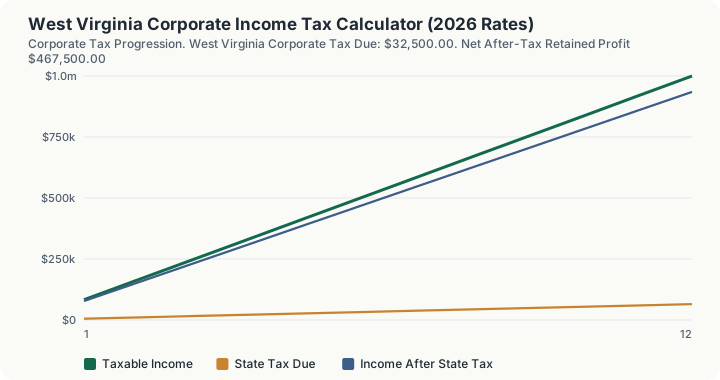
Quick Answer: On $500,000 of pre-apportioned taxable income, West Virginia's flat 6.50% corporate income tax rate produces $32,500.00 in state tax due and $467,500.00 in net after-tax profit.
Overview
West Virginia's flat 6.50% corporate income tax rate ties three other states in this dataset (Alabama, New York, and Tennessee), making it one of the most commonly repeated corporate tax figures in the country rather than a distinctly West Virginia number. Kansas is often added to that list, but its 6.50% is a top marginal rate on a graduated schedule, not a flat rate.
Because the rate is flat, apportionment is the primary lever available to a multistate corporation managing its West Virginia exposure: how sales, payroll, and property sourcing rules assign income to the state determines the base to which 6.50% applies. That rate sits above the national median for taxing states, modestly higher than neighboring Virginia's 6.00% just across the state line.
West Virginia's 6.50% rate turns the calculator's $500,000 example into $32,500.00 of state tax, identical to what Alabama, New York, and Tennessee would generate on the same income, and $2,500.00 more than the $30,000.00 a 6.00%-rate neighbor like Virginia would collect on the identical base. Kansas is often listed alongside these states at 6.50%, but its schedule is graduated and it produces $31,000.00 on this base.
How This Is Calculated
West Virginia repealed both its business franchise tax and its old corporate net income tax surcharge, leaving a plain flat 6.50% on apportioned income with nothing layered on top. It is a genuinely simple regime, and the honest description is that the analytical work in a West Virginia return sits entirely in apportionment and in the combined reporting rules, not in the rate.
- Read the income field as the taxable base. The single income input is taken as West Virginia taxable corporate income exactly as typed. The code applies no modification, allocation or deduction to it before the rate stage; it is the base.
- Apply the single statutory rate. West Virginia's 6.50% rate is multiplied against that figure with no bracket lookup, because the schedule has one band running from the first dollar: $500,000 x 6.50% = $32,500.00.
- Subtract credits and floor the result at zero. The credits field is subtracted from the step-2 figure and the difference is clamped at $0.00, so no credit entry can drive the liability negative. With the field at its $0 default the $32,500.00 stands; enter $13,000 of credits and the page returns $19,500.00, a reduction of exactly the credit entered because the subtraction is a straight one.
- Derive the reported rates from those two numbers. The effective rate is the tax divided by the income entered, 6.50% here, and the top statutory bracket is reported separately as 6.50%. Net after-tax retained profit is the income less the tax, $467,500.00. Those four outputs are the whole of what the engine produces.
Worked Example
Using this calculator's baseline scenario: a corporation with $500,000 in taxable income apportioned to West Virginia.
- Start with apportioned taxable income. The corporation has already apportioned $500,000 of its total taxable income to West Virginia using the state's statutory apportionment formula, before any state-level tax is applied.
- Apply West Virginia's flat statutory rate. West Virginia taxes all C-corporation income at a single flat rate of 6.50%, regardless of income size, so no bracket lookup is required: $500,000 × 6.50% = $32,500.00.
- West Virginia corporate tax due: $32,500.00.
- Net retained profit. Subtracting the state tax liability from taxable income leaves $500,000 − $32,500.00 = $467,500.00 in after-tax profit retained by the corporation, before any separate federal tax liability is applied.
Because West Virginia uses a single flat rate rather than graduated brackets, the 6.50% effective rate is identical to the marginal rate at every income level: a corporation earning $50,000 and one earning $50 million both face the same 6.50% state rate on their apportioned income.
Credits Against Rate, In Dollars
There is no threshold anywhere in this calculation. West Virginia taxes corporate income at a single 6.50% rate with no brackets, no minimum, no cap and no phase-out, so the sweep is a straight line. At $100,000 of apportioned income the tax is $6,500.00; at $500,000 it is $32,500.00; at $5,000,000 it is $325,000.00. The reported effective rate is 6.50% at all three, identical to the marginal rate.
The marginal cost of the next $1,000. Raising income from $500,000 to $501,000 moves the tax from $32,500.00 to $32,565.00. Each additional $1,000 of apportioned income costs $65.00, and it costs that at every income level the calculator accepts.
The one input that can move the effective rate. Credits are the only thing on this page that makes the effective rate differ from 6.50%. Enter $10,000 of credits against the $500,000 baseline and the tax falls from $32,500.00 to $22,500.00, with the reported effective rate dropping to 4.50% while the marginal rate stays at 6.50%. That gap between effective and marginal is entirely the credit; nothing in the rate schedule produces it.
The reverse question. How much credit extinguishes the bill? Exactly $32,500.00, the tax on $500,000 at 6.50%. Enter $50,000 of credits and the tax is $0.00 with an effective rate of 0.00%.
Right method against wrong method, priced. The engine takes the greater of zero and tax less credits. A $50,000 credit against a $32,500.00 liability therefore produces $0.00 and not a $17,500 refund: the excess is discarded in this code path, not carried forward and not refunded. Modelling a credit-rich year by subtracting the credit from income rather than from tax gets the wrong answer in the other direction, because $10,000 removed from the base is worth $650.00 at 6.50% rather than the full $10,000 the engine credits against tax.
What This Does Not Account For
- Federal Taxable Income Starting Point. Net corporate earnings are determined under IRC § 63 before West Virginia modifications. This calculator starts one step later: the income box is read as the finished West Virginia taxable figure and nothing is derived from a federal return.
- West Virginia Additions & Subtractions. The West Virginia tax deducted federally is added back, and the state applies its own depreciation and related-party expense adjustments. No addback and no subtraction is computed anywhere in this page's code path, so enter an income figure that already reflects them.
- Apportionment Factor Allocation. West Virginia apportions on a single sales factor with market-based sourcing, following its move away from the old three-factor formula. The engine performs no apportionment of any kind. The word does not appear in the primitive this page binds to; the figure you type is taken as the West Virginia figure and multiplied by the rate as it stands.
- Net Operating Loss (NOL) Deductions. Allowable West Virginia NOL carryforwards reduce the base before the rate is applied. No loss deduction is applied by this calculator. If a carryforward is available, subtract it yourself before entering the income.
- Combined Reporting Verification. West Virginia requires unitary combined reporting on a water's-edge basis by default, so the group rather than the entity is the taxpayer for apportionment purposes. No group, election or filing-method test is applied here. The code reads one income figure and one credit figure and nothing else.
- Credits in excess of tax are discarded. $50,000 of credits against the $32,500.00 baseline returns $0.00 with no carryforward modelled.
- No apportionment is performed. The $500,000 is assumed already apportioned to West Virginia.
- Federal corporate income tax (21% under IRC § 11).
- Specialized gross receipts taxes (e.g. Ohio CAT, Washington B&O, Texas Franchise Tax) where applicable.
- Minimum entity franchise tax fees or annual report filing charges.
- Base Erosion and Anti-Abuse Tax (BEAT) or Global Intangible Low-Taxed Income (GILTI) provisions.
- Local municipal corporate earnings taxes (e.g. NYC General Corporation Tax).
Common Pitfalls
- Mistaking the Flat Rate for the Final Bill: Assuming West Virginia's 6.50% rate applies directly to book income rather than to apportioned taxable income after state additions, subtractions, and NOL adjustments.
- Improper Apportionment Sourcing: Applying market-based sourcing vs cost-of-performance rules incorrectly for service revenue apportioned to West Virginia.
- Ignoring Unitary Group Combined Reporting: Failing to account for West Virginia's mandatory combined return requirements across related entities.
- Neglecting State NOL Carryforward Caps: Overlooking West Virginia's annual percentage limitations on net operating loss deductions, which matter more once the 6.50% rate is applied to a larger taxable base.
Frequently Asked Questions
Does West Virginia have a corporate income tax?
When are West Virginia corporate tax returns due?
Does West Virginia tax S-corporations and LLCs?
How is multi-state corporate income apportioned to West Virginia?
Sources
- West Virginia State Tax Department: Corporate Tax Statutes and Guidance (2026). tax.wv.gov
- Multistate Tax Commission (MTC): Uniform Apportionment and Allocation Guidelines. mtc.gov