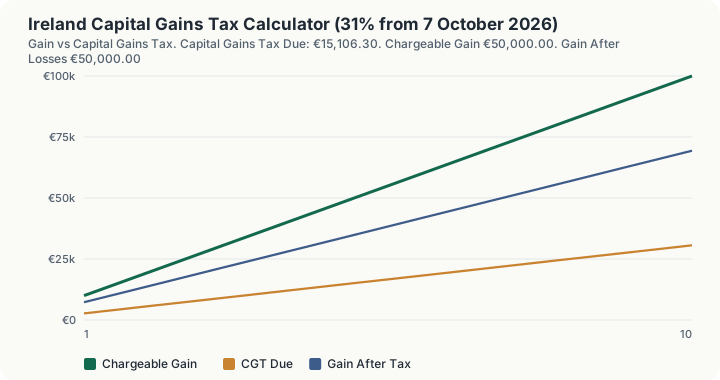
Quick Answer: A €50,000 gain on a disposal made on or after 7 October 2026 attracts €15,106.30 of Capital Gains Tax. Ireland charges a flat 31% on the gain after a personal exemption of just €1,270, so €48,730 is taxable; the same gain on a disposal before 7 October 2026 was taxed at the former 33%, €16,080.90. Unlike the UK, the rate does not depend on your income. Payment is due by 15 December of the same year for disposals made up to 30 November.
What does this calculator do?
Irish CGT is simpler than most and harsher than many. There is a single flat rate, with no split by income band: 31% for disposals made on or after 7 October 2026, after Budget 2027 cut it from the 33% that still applies to disposals from 1 January to 6 October 2026. Apart from development land, which stays at 33%, and a handful of special rates outside this calculator, it does not vary by asset type. Whether you earn €20,000 or €200,000, the rate on your gain is the same.
The annual exemption is €1,270, a figure that has not moved in decades and is now small enough to be nearly irrelevant on any substantial disposal. It is also not transferable between spouses, unlike most Irish reliefs, so a couple has two separate €1,270 exemptions that cannot be pooled.
The payment rules catch people out. Ireland has two payment windows in the year, split at 30 November, and the earlier one falls due before the tax year has even ended.
How is this calculated?
Step 1: The chargeable gain:
Gain = Proceeds − Cost − Allowable costs
Allowable costs are the incidental costs of buying and selling, such as legal and auctioneer fees, plus enhancement expenditure still reflected in the asset.
Step 2: Deduct losses. Current year and carried-forward capital losses are applied before the exemption.
Step 3: Apply the annual exemption of €1,270, capped at the remaining gain so it cannot create or increase a loss.
Step 4: Charge at the flat rate for the disposal date:
CGT = r × (gain after losses − exemption used)
where r is 31% for a disposal on or after 7 October 2026 and 33% for one from 1 January to 6 October 2026, chosen by the Date of Disposal input.
Payment. Disposals from 1 January to 30 November are payable by 15 December of the same year. Disposals in December are payable by 31 January of the following year.
Worked Example
€250,000 sale, €200,000 cost, disposed of on or after 7 October 2026:
- Chargeable gain: €50,000
- Less the €1,270 exemption: €48,730 taxable
- CGT: €48,730 × 31% = €15,106.30
- Effective rate on the gain: 30.21%, only marginally below the headline 31% because the exemption is so small
- Had the disposal been made before 7 October 2026, at 33%: €16,080.90
The same disposal with €20,000 of losses:
- Gain after losses: €30,000
- Less €1,270: €28,730 taxable
- CGT: €8,906.30
A gain of €800: entirely covered by the exemption, so no tax, and the unused €470 of exemption is lost rather than carried forward.
Walking the Exemption, and the Rest of the Sweep
The €1,270 exemption is the only boundary in the Irish CGT calculation, and the ten-row table under the calculator is otherwise a straight line. Both halves of that are worth pricing.
At a chargeable gain of €1,200. The exemption covers the whole gain, taxable gain is €0 and the calculator returns €0.00. The €70 of unused exemption is lost; it neither carries forward nor transfers to a spouse.
At €1,300, one hundred euro later. €1,270 is exempt, €30 is taxable, and the calculator returns €9.30. The effective rate on the gain jumps from 0.00% to 0.72% across those hundred euro.
That is the whole of the exemption boundary. It is not a cliff and it does not withdraw: above €1,270 every further euro is taxed at 31% and the exemption keeps its full value forever. Its value is fixed at €393.70 of tax (€419.10 at the former 33%), and that figure is visible in the table, where every single row's CGT ends in the same 30 cents.
Marginal cost of the next unit. Each additional €1,000 of chargeable gain costs €310.00. Raising sale proceeds from €250,000 to €251,000 on the same €200,000 cost moves the tax from €15,106.30 to €15,416.30. That increment never changes, because Ireland has no income-banded CGT rate: a €20,000 earner and a €200,000 earner pay the same €310 on the same extra €1,000.
What the ten rows show. The sweep runs the chargeable gain from €10,000 to €100,000 in €10,000 steps. Tax runs from €2,706.30 to €30,606.30, and the effective rate climbs from 27.06% to 30.61% as the fixed €393.70 exemption saving is spread over a larger gain. It approaches 31% and never reaches it. At the default €50,000 gain the effective rate is 30.21%.
The reverse question, and the one input that moves it most. Losses, not the exemption, are the lever with real money in it. The default €50,000 gain returns €15,106.30; the same disposal with €20,000 of carried-forward losses returns €8,906.30, a difference of €6,200.00, which is exactly 31% of the losses. Allowable costs work identically: adding €6,000 of legal and agent fees to the same disposal drops the tax to €13,246.30, saving €1,860.00. Both are worth 31 cents in the euro, and both are entered by you rather than inferred, so an under-recorded fee is money left on the table that no gate in this engine can detect.
A larger disposal, for scale. A €400,000 sale of an asset that cost €200,000 produces a €200,000 chargeable gain and €61,606.30 of CGT, an effective rate of 30.80%, leaving €138,393.70.
What this section deliberately does not price. The engine holds a full Principal Private Residence apportionment routine, computeIrelandPPR, which time-apportions the gain over the ownership period and adds the final twelve months as deemed occupation. This calculator does not call it. Every figure above is a no-relief figure. If the asset is your main home, the numbers here are an upper bound and a substantial one.
What does this calculator not account for?
- Principal Private Residence relief, which exempts the gain on your main home, subject to apportionment for periods of non-occupation and for land over one acre.
- Retirement relief, available on the disposal of business or farm assets by those aged 55 and over, subject to thresholds.
- Entrepreneur relief, which reduces the rate to 10% on qualifying business disposals up to a lifetime limit of €1 million.
- Transfers between spouses, which are made on a no gain, no loss basis.
- Indexation relief, abolished for periods of ownership after 31 December 2002 but still relevant to assets acquired before then.
- Development land, which has its own restrictions on losses and reliefs and is still charged at 33% under section 649A TCA 1997.
- The Finance Act. The 31% rate is applied from 7 October 2026 as announced in Budget 2027 and already applied by Revenue; the Finance Bill that writes it into section 28(3) TCA 1997 had not been enacted when this page was updated. If the enacted rate or start date differs, the calculator will be updated.
- Non-residents, taxable only on specified Irish assets such as land and buildings.
- The 15% withholding a purchaser must deduct on disposals over €500,000 where no CG50A clearance certificate is produced.
- CGT on death, where there is no disposal and the beneficiary acquires at market value.
What mistakes do people make with this?
- Expecting a UK-style banded rate. Ireland charges a flat 31% (33% before 7 October 2026) regardless of income. A basic rate taxpayer and a high earner pay identical CGT on the same gain.
- Overestimating the exemption. €1,270 is small and unchanged for many years. It removes €393.70 of tax at most at 31%.
- Trying to pool exemptions between spouses. Each spouse has their own €1,270 and it cannot be transferred, which is unusual among Irish reliefs.
- Missing the December payment date. Tax on a disposal made in, say, March is due on 15 December of the same year, well before the return is filed the following October.
- Applying the exemption before losses. Losses come first. Applying the exemption first would waste it.
- Assuming unused exemption carries forward. It does not. It is use it or lose it each year.
Frequently Asked Questions
What is the Irish CGT rate?
How much is the annual exemption?
When do I have to pay?
Do losses reduce my gain?
Is my home exempt?
Does the exemption apply per disposal or per year?
Sources
- Revenue (revenue.ie), "How to calculate CGT" (published 07 October 2026): the 31% rate for most gains from 7 October 2026, the historic 33% rate for disposals from 6 December 2021 to 6 October 2026, the 33% development land rate and the €1,270 annual personal exemption. Read 2026-10-08. revenue.ie/en/gains-gifts-and-inheritance/transfering-an-asset/how-to-calculate-cgt.aspx
- Department of Finance, Budget 2027: Tax Policy Changes, section 4.1, the standard rate in section 28(3) TCA 1997 reduced from 33% to 31% for disposals made on or after 7 October 2026, with no change to the 33% development land rate in section 649A. assets.gov.ie/static/documents/c6792805/Budget_2027_Tax_Policy_Changes_v2.pdf
All figures verified on 30 August 2026; the CGT rate re-verified on 8 October 2026 after Budget 2027.
Also consulted: Revenue: "Capital Gains Tax (CGT) on the disposal of an asset", the payment deadlines; Citizens Information: "Capital Gains Tax", the €1,270 annual personal exemption; Revenue Tax and Duty Manual Part 02-03-01a, Capital Gains Tax rate of charge, section 28.