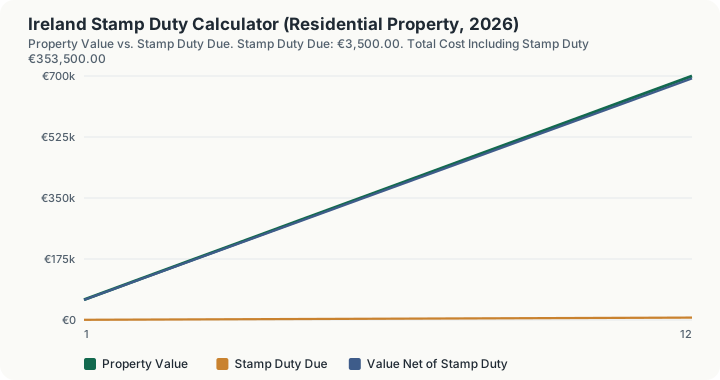
Quick Answer: Buying a €350,000 home in Ireland in 2026 costs €3,500.00 in stamp duty (1% of the purchase price), bringing the total cost including stamp duty to €353,500.00.
Overview
Stamp duty is a tax paid on the legal instrument (the deed) that transfers ownership of Irish property, and every residential buyer pays it -- there is no first-time-buyer exemption or reduced rate in the current Irish stamp duty regime, despite that being one of the most common misconceptions among buyers. The rate structure is tiered, similar in shape to income tax bands: the first slice of the purchase price is taxed at 1%, the next slice at 2%, and anything above €1.5 million at 6%. A separate, much higher 15% flat rate exists, but it targets large-scale institutional buyers (funds and other bulk purchasers acquiring ten or more houses within a year), not individual home buyers.
This calculator applies the exact 2026 residential rates published by Revenue, which have been unchanged since 2 October 2024 and were not amended in Budget 2026. It shows both the standard tiered calculation and, if applicable, the bulk-purchaser override rate, along with the effective overall rate and total cost of the purchase including stamp duty.
How This Is Calculated
Standard residential stamp duty is charged on the full purchase price (the "consideration") using three marginal tiers -- each tier only taxes the portion of the price that falls within it, the same way income tax brackets work:
where $P$ is the purchase price. So a property priced at or below €1,000,000 is taxed at a flat 1% of the full price; only the portion of a higher-priced property above €1,000,000 (and again above €1,500,000) is taxed at the higher marginal rates.
Bulk-purchaser override. If a single buyer (or connected buyers) acquires 10 or more residential houses -- excluding apartments -- within any rolling 12-month period, Section 31E of the Stamp Duties Consolidation Act 1999 charges a flat 15% rate on the qualifying transactions, replacing the standard tiered calculation entirely for those purchases:
This provision was introduced specifically to discourage institutional investors from buying up large numbers of houses (not apartments) that would otherwise go to individual buyers, and has no relevance to a typical single home purchase.
Worked Example
Example 1 -- A €350,000 house, the ordinary case
Step 1 -- Test the first threshold. €350,000 is below €1,000,000, so the whole price sits in the 1% tier
Step 2 -- Charge the 1% tier. €350,000 x 1% = €3,500.00
Step 3 -- The effective rate. €3,500.00 / €350,000 = 1.000%
Step 4 -- Cash needed at closing, duty included. €350,000.00 + €3,500.00 = €353,500.00
Below €1,000,000 the tiered structure never bites, which is why most Irish buyers experience stamp duty as a flat 1%.
Example 2 -- A €1,200,000 house, two tiers in play
Step 1 -- The 1% tier. €1,000,000 x 1% = €10,000.00
Step 2 -- The 2% tier. (€1,200,000 - €1,000,000) x 2% = €200,000 x 2% = €4,000.00
Step 3 -- Total stamp duty. €10,000.00 + €4,000.00 = €14,000.00
Step 4 -- The effective rate. €14,000.00 / €1,200,000 = 1.167%
Applying a flat 2% to the whole price would give €24,000, which is €10,000 too much. The tiers are marginal.
Example 3 -- An €1,800,000 house, all three tiers
Step 1 -- The 1% tier. €1,000,000 x 1% = €10,000.00
Step 2 -- The 2% tier. (€1,500,000 - €1,000,000) x 2% = €500,000 x 2% = €10,000.00
Step 3 -- The 6% tier. (€1,800,000 - €1,500,000) x 6% = €300,000 x 6% = €18,000.00
Step 4 -- Total stamp duty. €10,000.00 + €10,000.00 + €18,000.00 = €38,000.00
Step 5 -- The effective rate. €38,000.00 / €1,800,000 = 2.111%
The top slice of €300,000 carries almost half the bill on its own.
Example 4 -- A €5,000,000 bulk acquisition
Step 1 -- Test the bulk-purchase flag. Ten or more houses in twelve months, so Section 31E applies and the tiers are replaced entirely
Step 2 -- Apply the flat rate. €5,000,000 x 15% = €750,000.00
Step 3 -- The same price under the standard tiers, for contrast. €10,000.00 + €10,000.00 + (€5,000,000 - €1,500,000) x 6% = €10,000.00 + €10,000.00 + €210,000.00 = €230,000.00
Step 4 -- The size of the deterrent. €750,000.00 - €230,000.00 = €520,000.00 of additional duty, an effective rate of 15.000% against 4.600%
That gap is the policy, not an accident of the arithmetic.
What This Does Not Account For
- Legal fees, surveys, and other closing costs. Stamp duty is only one line item in the total cost of buying a home; solicitor's fees, a structural survey, Land Registry fees, and mortgage arrangement fees are separate and not included in this calculator's "total cost" figure.
- Non-residential and mixed-use property. Non-residential property (commercial, agricultural, or mixed-use) is taxed at a flat 7.5%, an entirely different rate not modeled by this calculator, which covers residential property only.
- The multi-apartment-block variant. A separate rule applies to the purchase of three or more apartments in the same development in a single transaction (1% up to €1,000,000, 2% above, with no 6% tier) -- a narrower case this calculator does not separately model; use the bulk-purchase toggle only for the 10-or-more-houses scenario it is designed for.
- Exemptions and reliefs for specific transactions. Certain transfers -- for example, between spouses on separation or divorce, or transfers of family farms under Consanguinity Relief -- carry full or partial stamp duty relief. This calculator assumes a standard arm's-length residential purchase with no applicable relief.
- The Residential Development Refund Scheme. Developers who commence construction within set timeframes after buying land can reclaim a substantial portion of stamp duty paid; this is a developer-specific refund mechanism, not relevant to an individual home buyer, and is not modeled here.
Common Pitfalls
- Assuming there's a first-time-buyer stamp duty discount. There is currently no reduced stamp duty rate or exemption for first-time buyers in Ireland -- every residential buyer pays the same standard tiered rates. Confusingly, first-time buyers do have access to separate, unrelated supports (the Help to Buy scheme and the First Home Scheme), but neither reduces the stamp duty rate itself.
- Calculating the tiered bands as a flat rate on the whole price. A €1.2 million home is not taxed at a flat 2% (which would be €24,000) -- only the portion above €1,000,000 is taxed at 2%, so the real figure is €14,000, roughly 42% lower than the flat-rate misconception would suggest.
- Confusing the 15% bulk-purchaser rate with a penalty on any large single purchase. The 15% rate only applies once a buyer crosses the 10-houses-in-12-months threshold (and excludes apartments entirely) -- buying one expensive individual house, no matter the price, is always taxed under the standard 1%/2%/6% tiers, never at 15%.
- Forgetting stamp duty is due on the full price, not just any mortgage amount. Stamp duty is calculated on the purchase price of the property regardless of how much of it is financed by a mortgage versus a cash deposit.
- Not budgeting stamp duty separately from the deposit. Stamp duty is typically paid by your solicitor to Revenue around closing, in addition to your deposit and other closing costs -- it is not deducted from the mortgage itself, so it needs to be available as cash alongside your deposit.
Frequently Asked Questions
Is there a first-time buyer stamp duty exemption in Ireland?
Are the stamp duty bands marginal (like income tax) or a flat rate on the whole price?
What counts as a "bulk purchase" for the 15% rate?
Who actually pays stamp duty -- the buyer or the seller?
Does stamp duty apply to a mortgage, or only to a cash purchase?
Sources
- Revenue Commissioners: "Stamp Duty and Property" -- residential stamp duty rates (revenue.ie/en/property/stamp-duty/property/stamp-duty-property/rates.aspx), confirming rates unchanged since 2 October 2024 and not amended by Budget 2026. revenue.ie
Also consulted: Stamp Duties Consolidation Act 1999, Section 31E -- the 15% bulk-purchaser rate for 10 or more residential houses acquired within 12 months; Revenue Commissioners: Budget 2026 Summary (7 October 2025) -- confirming no stamp duty rate changes for 2026.