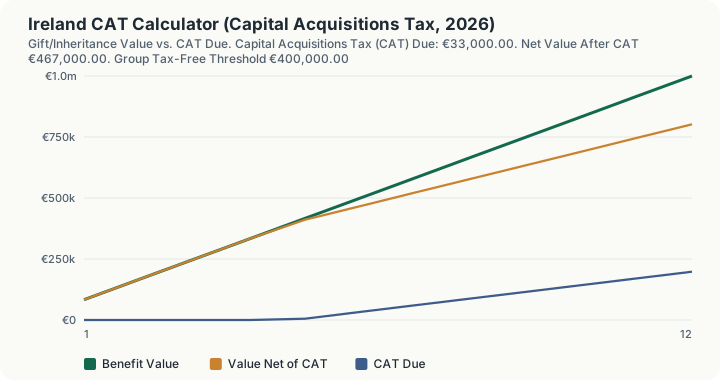
Quick Answer: A child inheriting €500,000 from a parent in Ireland in 2026 (Group A, no prior gifts or inheritances) pays €33,000.00 in Capital Acquisitions Tax -- 33% of the €100,000 that falls above the €400,000 Group A tax-free threshold -- leaving €467,000.00 net.
Overview
Capital Acquisitions Tax (CAT) is Ireland's tax on gifts and inheritances -- what many people simply call "inheritance tax," even though it applies equally to lifetime gifts. It is charged at a flat 33% rate, but only on the amount you receive above a tax-free threshold that depends entirely on your relationship to the person giving or leaving you the money or property (the "disponer"). There is no CAT on your first euro received; there is CAT at a flat 33% on every euro above your threshold.
The three thresholds -- Group A, B, and C -- are not per-gift limits. They are lifetime, cumulative allowances that track every gift and inheritance you have received from anyone in that same group since 5 December 1991. Someone who received a large gift from a parent a decade ago has already used up part of their Group A threshold, even if they've forgotten about it, and a new inheritance from another parent (or grandparent transferring assets down a generation, treated as Group A in limited circumstances) is measured against what remains of that same lifetime allowance, not a fresh one.
This calculator applies the current 2026 CAT rate and group thresholds, correctly handles lifetime aggregation against prior benefits you've already received, and applies the separate €3,000-per-year Small Gift Exemption where it's relevant (gifts only, never inheritances).
How This Is Calculated
1. Determine your group and threshold. Your relationship to the disponer sets which lifetime threshold applies: - Group A -- €400,000: broadly, a child receiving from a parent (and, in limited circumstances, a parent receiving from a child). - Group B -- €40,000: broadly, a sibling, niece, nephew, grandchild, or other lineal relative outside Group A. - Group C -- €20,000: everyone else -- including more distant relatives, in-laws, and unrelated individuals.
2. Apply the Small Gift Exemption, if relevant. For gifts (never inheritances), the first €3,000 per donor per recipient per calendar year is exempt and does not count toward the lifetime group threshold at all.
3. Aggregate against prior benefits from the same group. Add this benefit's taxable value to any prior taxable gifts/inheritances received from the same group since 5 December 1991, then compare the running total to the group threshold. Only the newly-taxable slice -- the amount that pushes the cumulative total further above the threshold than it already was -- is taxed now, so any tax already assessed on prior benefits is not charged again.
4. Apply the flat 33% rate.
Worked Example
CAT is a threshold tax with a lifetime memory, so the figures that matter are the ones on either side of the group threshold and the ones that show aggregation biting on a later gift.
A Group A inheritance crossing the threshold
Step 1 -- The Group A lifetime threshold. €400,000
Step 2 -- An inheritance of exactly €400,000, no prior benefits. Taxable: €400,000 - €400,000 = €0.00 CAT due: €0.00 Net received: €400,000.00
Step 3 -- An inheritance of €500,000 instead. Taxable: €500,000 - €400,000 = €100,000.00
Step 4 -- Apply the flat rate. €100,000.00 x 33% = €33,000.00 Net received: €467,000.00
Step 5 -- What the extra €100,000 was actually worth. €467,000.00 - €400,000.00 = €67,000.00 of additional net value
The threshold is an allowance rather than a cliff: the first €400,000 stays untaxed even when the benefit exceeds it, and only the excess is charged. Note also that no small gift exemption appears in steps 2 to 4, because that relief applies to gifts and never to inheritances.
The same money through a different relationship
Step 6 -- A Group B inheritance of €60,000 from an uncle. Threshold: €40,000 Taxable: €60,000 - €40,000 = €20,000.00 CAT: €20,000.00 x 33% = €6,600.00 Net: €53,400.00
A nephew inheriting €60,000 pays €6,600. A child inheriting the same €60,000 would pay nothing at all, having ten times the threshold. The rate never varies; the relationship does all the work.
Aggregation, and what the Small Gift Exemption is worth
A Group A recipient who has already taken €395,000 of taxable benefits since 5 December 1991 now receives a €10,000 gift.
Step 7 -- Apply the Small Gift Exemption to the current gift. €10,000.00 - €3,000.00 = €7,000.00 taxable current benefit
Step 8 -- Add it to the lifetime running total. €395,000.00 + €7,000.00 = €402,000.00
Step 9 -- Only the newly-taxable slice is charged. €402,000.00 - €400,000.00 = €2,000.00 CAT: €2,000.00 x 33% = €660.00 Net gift received: €9,340.00
Step 10 -- The same gift without the exemption. Taxable now: €5,000.00 CAT: €1,650.00, net €8,350.00 The exemption is therefore worth €1,650.00 - €660.00 = €990.00 here
Step 11 -- The next €10,000 gift, a year later. The running total is now €402,000, already above the threshold, so the exemption still removes €3,000 but the remaining €7,000 is fully taxable CAT: €7,000.00 x 33% = €2,310.00, net €7,690.00
Steps 9 and 11 are the same gift from the same donor to the same recipient, and the second one costs €1,650.00 more. Once the lifetime threshold is exhausted, every subsequent euro above the annual €3,000 exemption is charged at the full 33%. The €3,000 exemption is the only part that keeps working indefinitely, which is precisely why it is used year after year rather than once.
What This Does Not Account For
- Business Relief and Agricultural Relief. Qualifying business assets and agricultural property can reduce the taxable value of a gift or inheritance by up to 90% before CAT is even calculated. These are substantial, commonly-used reliefs not modeled here -- if farmland or a trading business is involved, the real CAT liability could be dramatically lower.
- Dwelling House Exemption. A qualifying inheritance of a family home can be fully exempt from CAT if strict conditions are met (the recipient lived there for a set period before and continues to live there after, and owns no other residential property). This calculator does not apply this exemption.
- CAT reporting and payment deadlines (pay & file). CAT for gifts/inheritances with a valuation date in the year to 31 August must generally be paid and returned by 31 October the same year; a valuation date after 31 August shifts the deadline to the following 31 October. This calculator estimates liability only -- it does not model filing deadlines or late-payment interest.
- Spousal and charitable exemptions. Gifts and inheritances between spouses or civil partners are entirely exempt from CAT, as are gifts and bequests to registered charities. This calculator assumes the recipient is a non-exempt individual in one of the three CAT groups.
- Multiple disponers within the same year. If you receive gifts or inheritances from several different people within the same CAT group in the same year, each must be aggregated against the same lifetime threshold; this calculator handles one current benefit against one prior aggregate figure at a time, so combine your figures accordingly for a fully accurate multi-source estimate.
Common Pitfalls
- Treating the group thresholds as per-gift limits instead of lifetime totals. The €400,000 Group A threshold is not "up to €400,000 tax-free every time" -- it is a single lifetime allowance shared across every gift and inheritance ever received from anyone in that group since 5 December 1991.
- Applying the Small Gift Exemption to an inheritance. The €3,000 annual exemption applies only to gifts made during the disponer's lifetime -- it has no application to an inheritance received on death.
- Forgetting that a gift and an inheritance from the same person share one aggregate. If a parent gives an adult child a large gift years before their death, that gift already used part of the child's Group A threshold -- the later inheritance from the same parent is measured against whatever remains, not a fresh €400,000.
- Confusing Group B and Group C relationships. Nieces, nephews, grandchildren, and siblings fall into the more generous Group B (€40,000); more distant relationships -- cousins, in-laws, unrelated friends -- fall into Group C (€20,000), a much lower threshold that catches people by surprise.
- Assuming CAT is charged on the full amount received, not just the excess. CAT never applies to the portion of a gift or inheritance within your remaining threshold -- only euro received above that threshold is taxed at 33%.
Frequently Asked Questions
What is the current CAT rate in Ireland?
Are the Group A/B/C thresholds annual or lifetime?
Does the Small Gift Exemption apply to inheritances?
What relationships fall into Group B versus Group C?
Do I have to pay CAT immediately when I receive a gift or inheritance?
Sources
- Revenue Commissioners: "Capital Acquisitions Tax (CAT) thresholds, rates and aggregation rules" and "CAT rates" -- confirming the current 33% CAT rate (revenue.ie/en/gains-gifts-and-inheritance/cat-thresholds-rates-and-aggregation-rules/cat-rates.aspx). revenue.ie
Also consulted: Revenue Commissioners: "CAT group thresholds" -- Group A/B/C thresholds effective 2 October 2024, unchanged by Budget 2026 (revenue.ie/en/gains-gifts-and-inheritance/cat-thresholds-rates-and-aggregation-rules/cat-thresholds.aspx); Revenue Commissioners: "Small Gift Exemption" (revenue.ie/en/gains-gifts-and-inheritance/cat-exemptions/small-gift-exemption/index.aspx).