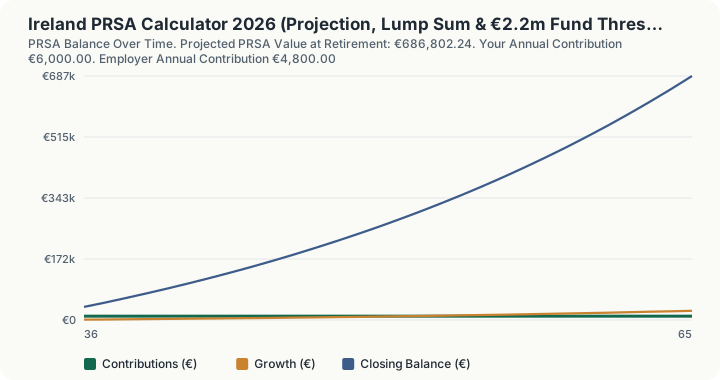
Quick Answer: A 35-year-old on €60,000 paying 10% with an 8% employer contribution, opening at €25,000 and retiring at 65, is projected to reach €686,802.24 after a 1% annual management charge trims 5% growth to 4%. A 25% lump sum of €171,700.56 would be entirely tax free, since it sits below the €200,000 lifetime tax-free amount, leaving €515,101.68 to provide income.
What does this calculator do?
A Personal Retirement Savings Account is a portable, contract-based Irish pension. This page answers the pot question: what the account is projected to be worth, and how it is taxed on the way out. The companion Ireland pension relief calculator answers the different question of how much of this year's contribution attracts relief.
Three things determine the answer, and only one of them is a market assumption. The growth rate is your assumption, not a statutory or guaranteed figure. The annual management charge is a contractual fact you can look up: standard PRSAs cap it at 1%, non-standard PRSAs can charge more, and it is deducted from the growth rate every single year. The tax treatment on exit is statutory: the first €200,000 of retirement lump sums across your lifetime is tax free, the slice from €200,001 to €500,000 is taxed at the standard rate of 20%, and anything above €500,000 is taxed under PAYE at 40%.
The fourth figure worth watching is the Standard Fund Threshold, which rose to €2,200,000 for 2026. A fund above it attracts chargeable excess tax at 40% on the excess. Most savers never approach it; high earners with long contribution histories and generous employer contributions sometimes do, and the calculator shows the headroom either way.
How is this calculated?
The fund is built by an explicit year-by-year loop, not a closed-form shortcut, so you can read each year off the schedule. Contributions are treated as paid at the end of each year, which means the first year's contribution earns no growth:
Balanceₜ = Balance_(t − 1) × (1 + r_net) + Contributions; r_net = r_gross − AMC
Step 1: Find the term. 65 - 35 = 30 years
Step 2: Compute the employee contribution. €60,000 x 10% = €6,000 a year
Step 3: Compute the employer contribution. €60,000 x 8% = €4,800 a year
Step 4: Add them. €6,000 + €4,800 = €10,800 going in each year
Step 5: Find the net growth rate the fund actually compounds at. 5% - 1% = 4.00%
Step 6: Run the loop for 30 years from the opening balance. Year one: €25,000 x 4% = €1,000 of growth, then €10,800 added, closing at €36,800. Repeat for thirty years. €686,802.24 projected fund value
Step 7: Total the contributions paid. €10,800 x 30 = €324,000
Step 8: Isolate the investment growth. €686,802.24 - €25,000 - €324,000 = €337,802.24
Step 9: Check the relief position on this year's employee contribution. At 35 the age band is 30 to 39, giving 20% of capped earnings. min(€60,000, €115,000) x 20% = €12,000 maximum relievable €6,000 is inside that, so €0 is above the relief limit
Step 10: Compute the net annual cost to you. Your contribution less income tax relief on the relievable part, at 40%. No USC or PRSI relief is applied, because none exists. €6,000 - (€6,000 x 40%) = €3,600
Step 11: Check the employer limit. Since 1 January 2025 an employer's PRSA contributions are limited to 100% of your salary; the excess is a benefit-in-kind on you. €4,800 against a €60,000 limit = €0 of BIK excess
Step 12: Check the Standard Fund Threshold. €2,200,000 - €686,802.24 = €1,513,197.76 of headroom, so €0 of chargeable excess
Step 13: Take the lump sum, capped at 25% of the fund. €686,802.24 x 25% = €171,700.56
Step 14: Tax the lump sum across the three slices. Tax free, first €200,000: min(€171,700.56, €200,000) = €171,700.56 Taxed at 20%, the €200,001 to €500,000 slice: €0 Taxed at 40%, above €500,000: €0 Total lump sum tax = €0, net lump sum = €171,700.56
Step 15: What is left for income. €686,802.24 - €171,700.56 = €515,101.68
Worked Example
A 35-year-old on €60,000 with €25,000 already in a PRSA contributes 10% of salary while her employer adds 8%. She plans to retire at 65 and assumes 5% growth on a standard PRSA charging the full 1%.
Step 1: What goes in each year. €6,000 from her, €4,800 from her employer, €10,800 in total.
Step 2: What it actually costs her. Her €6,000 is fully within her €12,000 relievable ceiling, so relief at 40% is €2,400 and her net cost is €3,600 a year.
Step 3: What the fund compounds at. 5% gross less the 1% charge = 4.00% net.
Step 4: Where she lands. €686,802.24 at 65, of which €324,000 is contributions, €25,000 was already there, and €337,802.24 is investment growth.
Step 5: Her lump sum. 25% of the fund is €171,700.56, entirely within the €200,000 lifetime tax-free amount, so no tax is due on it.
Step 6: Her remaining fund. €515,101.68 to convert into retirement income.
The single most instructive change is to set the annual management charge to zero. Running the identical contributions and gross return without the 1% charge shows what three decades of that charge actually cost, and for most savers the answer is a six-figure sum. The charge is deducted from the growth rate every year, so its effect compounds exactly as returns do, only in reverse.
Carrying The Fund To The Year Growth Overtakes Contributions
Step 7: Age 36, the first year. €10,800 in, €1,000 of growth, closing balance €36,800.00
Step 8: Age 37. €10,800 in, growth €1,472.00, closing balance €49,072.00
Step 9: Age 52, the crossover. Growth of €11,301.18 in the year, the first year it exceeds the €10,800 contributed. Closing balance €304,630.63.
Step 10: Age 65. Growth in the final year alone is €26,000.09, and the fund closes at €686,802.24
Step 11: The accumulated split. €324,000 contributed, €25,000 already there, €337,802.24 of growth
Seventeen years of contributing before the fund out-earns the contributions, and then thirteen years in which it compounds past everything paid in. That is the argument for starting at 35 rather than 45 stated as a date rather than a slogan, and it is also why the 1% charge in step 3 does most of its damage in the second half.
What does this calculator not account for?
- Salary growth. Contributions are a fixed percentage of your current salary held constant for the whole term. Real salaries rise, and so would the contributions.
- Contribution timing within the year. Contributions are treated as paid at the end of each year, so the first year's contribution earns no growth. Monthly contributions would compound slightly more.
- Contribution charges and allocation rates. Only the annual management charge is modelled. Some contracts also take a percentage of each contribution.
- The age band changing as you age. The relief figures shown apply to your current age band. The band steps at 40, 50, 55 and 60 and would raise your relievable ceiling in later years; the projection does not re-derive relief year by year.
- Any lump sum you have already taken. The €200,000 tax-free amount is a lifetime figure across all your retirement lump sums. The calculator assumes none has been used.
- How the residual fund is drawn. ARF, annuity and taxable drawdown are not modelled. Only the lump sum is taxed here.
- USC and PRSI. No relief is applied to them, because none exists, and they are not charged on anything the calculator computes.
What mistakes do people make with this?
- Quoting the gross growth rate as though it were the return. The fund compounds at growth minus the annual management charge. At 5% and 1% that is 4%, and over thirty years the difference is enormous.
- Assuming the whole 25% lump sum is always tax free. Only the first €200,000 across your lifetime is. Above that, the next €300,000 is taxed at 20% and everything beyond €500,000 at 40% under PAYE.
- Ignoring the employer BIK rule. Since 1 January 2025 employer PRSA contributions above 100% of your salary are a benefit-in-kind charged on you. Very large employer contributions are no longer unlimited.
- Assuming a non-standard PRSA is worth the extra charge. The 1% cap applies only to standard PRSAs. A non-standard contract must out-earn its extra charge every year to be worth holding.
- Treating 5% as a forecast. It is an assumption you supplied. Nothing on this page is guaranteed, and a lower realised return changes every figure proportionally.
- Overlooking the Standard Fund Threshold on a long horizon. A high earner starting early with a generous employer contribution can breach €2.2m and face 40% chargeable excess tax on the excess.
Frequently Asked Questions
What is the Standard Fund Threshold for 2026?
How much of my PRSA lump sum is tax free?
Does the annual management charge really matter that much?
Can my employer pay into my PRSA without limit?
When can I access a PRSA?
Is the 5% growth rate realistic?
Sources
- Revenue, "Retirement lump sums": the €200,000 tax-free lifetime amount, the €200,001 to €500,000 slice taxable at the standard rate of 20%, and amounts above €500,000 taxed under PAYE at the higher rate. revenue.ie/en/jobs-and-pensions/pension/private/retirement-lump-sums.aspx (read 2026-08-30) revenue.ie/en/jobs-and-pensions/pension/private/retirement-lump-sums.aspx
Also consulted: Revenue, "Chargeable excess tax", the Standard Fund Threshold of €2,000,000 for 2025 rising to €2,200,000 for 2026, with amounts above it liable to chargeable excess tax at 40%. revenue.ie/en/jobs-and-pensions/pension/private/chargeable-excess-tax.aspx (read 2026-08-30); Revenue, "Pension contributions" (benefit-in-kind for employers): employer PRSA contributions limited to 100% of the employee's salary from 1 January 2025, with contributions above the limit resulting in a BIK charge on the employee. revenue.ie/en/employing-people/benefit-in-kind-for-employers/other-benefits/pension-contributions.aspx (read 2026-08-30); Revenue, "Tax relief limits": the age-related percentage limits and the €115,000 earnings cap used for the relief figures on this page. revenue.ie/en/jobs-and-pensions/pension/relief/tax-relief-limits.aspx (read 2026-08-30).