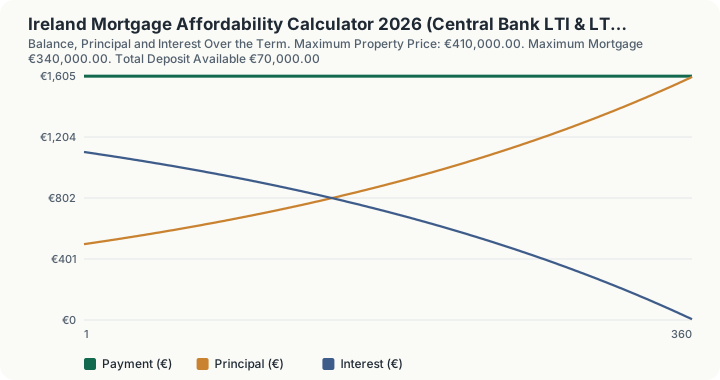
Quick Answer: A first-time buyer with EUR 85,000 of combined gross income, EUR 40,000 saved and EUR 30,000 of Help to Buy can buy up to EUR 410,000: a EUR 340,000 mortgage at 3.9% over 30 years plus a EUR 70,000 deposit. Income is the binding constraint, because the 4x loan-to-income limit caps the loan before the deposit and the 90% LTV ceiling do, and the repayment comes to EUR 1,603.67 a month.
What does this calculator do?
Irish mortgage affordability is not a judgement call. The Central Bank of Ireland sets two hard limits, and exactly one of them binds you at any given moment. Everything else (your rate, your term, your monthly repayment) affects what you pay, not what you can borrow.
The two limits are:
Loan-to-income (LTI). A first-time buyer may borrow up to 4 times gross income. Second and subsequent buyers, and buy-to-let borrowers, are capped at 3.5 times.
Loan-to-value (LTV). Owner-occupiers must put down a minimum 10% deposit, a 90% LTV ceiling. Buy-to-let borrowers must put down a minimum 30%, a 70% ceiling.
The reason this matters more than any other calculation on the page is that the two limits respond to completely different actions. If income binds, saving another EUR 10,000 raises your maximum price by exactly EUR 10,000, because the loan cannot grow at all. If the deposit binds, saving another EUR 10,000 raises your maximum price by EUR 100,000, because every euro of deposit unlocks nine euro of borrowing at the 90% ceiling. Knowing which one you are in changes what you should do with the next year of your life.
This calculator identifies the binding constraint explicitly and tells you exactly how far the other one is away.
How is this calculated?
P_max = min(d/(1 − LTV) (deposit limit), I × LTI + d (income limit))
where $d$ is the total deposit available, $I$ is gross annual income, LTI is the income multiple and LTV is the ceiling for your buyer category.
Step 1: Look up the limits for the buyer category. First-time buyer: 4.0x income, 90% LTV, 10% minimum deposit
Step 2: Add up the deposit. EUR 40,000 savings + EUR 30,000 Help to Buy = EUR 70,000
Step 3: Apply the income multiple. EUR 85,000 x 4.0 = EUR 340,000 of loan the income limit allows
Step 4: Find the price that deposit alone supports at the LTV ceiling. EUR 70,000 / (1 - 0.90) = EUR 70,000 / 0.10 = EUR 700,000
Step 5: Find the price the income-limited loan supports with that deposit. EUR 340,000 + EUR 70,000 = EUR 410,000
Step 6: Take the lower of the two. EUR 410,000 is less than EUR 700,000, so the maximum property price is EUR 410,000 and income binds
Step 7: Back out the actual mortgage. EUR 410,000 - EUR 70,000 = EUR 340,000
Step 8: Find the deposit at which income would stop being the binding limit. Income binds while deposit exceeds LTI x (1 - LTV) / LTV: EUR 340,000 x 0.10 / 0.90 = EUR 37,777.78. Your EUR 70,000 is already well above it, so the shortfall to reach the income limit is EUR 0.
Step 9: Price the repayment on the maximum mortgage. EUR 340,000 at 3.9% / 12 over 360 months = EUR 1,603.67 a month
Step 10: Express it against gross income. EUR 1,603.67 / (EUR 85,000 / 12) = EUR 1,603.67 / EUR 7,083.33 = 22.64% of gross monthly income
Step 11: Stress it by your chosen margin. 3.9% + 2.0 points = 5.90%, at which the same EUR 340,000 over 360 months costs EUR 2,016.66, an increase of EUR 412.99 a month and 28.47% of gross income
Worked Example
Two people, same income, same house, and the arithmetic runs in opposite directions.
Buyer A has EUR 70,000 (the default).
Step 1: Income limit: EUR 85,000 x 4 = EUR 340,000 Step 2: Price from income: EUR 340,000 + EUR 70,000 = EUR 410,000 Step 3: Price from deposit: EUR 70,000 / 0.10 = EUR 700,000 Step 4: Binding: income. Another EUR 10,000 saved raises the ceiling to EUR 420,000, a one-for-one return.
Buyer B has EUR 20,000 and no Help to Buy.
Step 5: Income limit is unchanged: EUR 340,000 Step 6: Price from income: EUR 340,000 + EUR 20,000 = EUR 360,000 Step 7: Price from deposit: EUR 20,000 / 0.10 = EUR 200,000 Step 8: Binding: deposit. The ceiling is EUR 200,000, and the income limit is irrelevant. Step 9: Another EUR 10,000 saved: EUR 30,000 / 0.10 = EUR 300,000, a ten-for-one return.
Buyer B needs EUR 37,777.78 of deposit for the income limit to become the binding one. Below that figure, every euro saved is worth ten. Above it, every euro saved is worth one. That is the single most useful number on this page for anyone still saving.
Note also what the Help to Buy support does in Buyer A's case: because income binds, the EUR 30,000 raises the reachable price by exactly EUR 30,000, not by EUR 300,000. It is a deposit top-up, not leverage.
Carrying Buyer A's Repayment Into The Schedule
Step 10: Month one of the EUR 340,000 loan. Of the EUR 1,603.67 payment, EUR 1,105.00 is interest and only EUR 498.67 touches the balance, leaving EUR 339,501.33
Step 11: Month two. EUR 500.29 of principal and EUR 1,103.38 of interest. Two months in, cumulative interest is EUR 2,208.38 against EUR 998.96 of principal repaid.
Step 12: Month sixty, the end of year five. The split has moved to EUR 603.88 principal and EUR 999.79 interest, the balance is EUR 307,022.30, and cumulative interest has reached EUR 63,242.50
Step 13: Month one hundred and eighty, the halfway point in time. Principal EUR 891.36 against interest EUR 712.31, the first month where principal exceeds interest by a clear margin. Balance EUR 218,280.13, cumulative interest EUR 166,940.73.
Step 14: Month three hundred and sixty. Total interest over the term: EUR 237,322.44 on EUR 340,000 borrowed
Halfway through the term in time, Buyer A has paid 70.3% of the interest but retired only 35.8% of the balance. That asymmetry is why the deposit question on this page matters more than the rate question: the loan-to-income cap decides how much of that EUR 237,322.44 you sign up for, and the first five years buy back almost none of it.
What does this calculator not account for?
- Lender affordability assessment. The Central Bank limits are a ceiling, not an approval. Every lender runs its own affordability model on your net disposable income, childcare costs, commitments and proven repayment capacity, and will frequently lend less than the limits allow.
- The lender allowance. Lenders may write 15% of first-time-buyer lending, 15% of second and subsequent buyer lending and 10% of buy-to-let lending above the limits. This is a portfolio allowance held by the institution, not a borrower entitlement, so the engine reports it and never applies it to your maximum.
- Any regulatory stress test. There is no stress-test margin in the mortgage measures. The stressed figure on this page is simply your rate plus a margin you choose, and it is labelled that way.
- Stamp duty, legal fees, valuation and survey costs. None are deducted from the deposit. Your usable deposit is smaller than your savings.
- Help to Buy eligibility. The scheme has its own conditions on property type, price and tax paid. The engine takes whatever figure you enter at face value.
- Existing monthly debt payments are collected and reported in the total debt-to-income ratio, but they do not reduce the maximum loan, because the Central Bank limits do not reference them.
- Mortgage protection insurance and home insurance, both mandatory in practice and neither included in the repayment.
What mistakes do people make with this?
- Saving harder when income is what binds. At the defaults, the next EUR 50,000 saved raises the maximum price by EUR 50,000 and the maximum mortgage by nothing. A pay rise is worth four times as much as savings, euro for euro.
- Assuming the 4x multiple applies to everyone. It is first-time buyers only. Second and subsequent buyers get 3.5x, which on EUR 85,000 is EUR 42,500 less borrowing.
- Treating the lender allowance as something to ask for. It is a share of the lender's own book, allocated at their discretion, not a rule you can invoke.
- Reading the maximum price as an approval. It is the regulatory ceiling. Your lender's own affordability test sits underneath it and is usually stricter.
- Forgetting the buy-to-let deposit. A 30% minimum, not 10%, changes the arithmetic completely: the same EUR 70,000 deposit supports only EUR 233,333 of price on the deposit test.
- Comparing a stress figure against a rule. The 5.90% here is your 3.9% plus your chosen 2 points. It is a sensitivity check you asked for, not a Central Bank requirement.
Frequently Asked Questions
What are the Central Bank mortgage limits in Ireland?
Should I save more or earn more?
Does Help to Buy increase how much I can borrow?
Do the Central Bank limits change when interest rates rise?
How much is being a second-time buyer worth?
Will my bank actually lend me the maximum shown?
Sources
- Central Bank of Ireland, "What are the mortgage measures?", read 2026-08-30 at centralbank.ie/consumer-hub/explainers/what-are-the-mortgage-measures: the source of the 4x and 3.5x loan-to-income limits, the 10% and 30% minimum deposits, and the 15% / 15% / 10% lender allowances. The Central Bank makes these limits, so its own published statement of them is the primary source.
- Revenue Commissioners (Ireland), the official authority for the national tax authority this calculator relates to. revenue.ie
Also consulted: The limits themselves sit in macroprudential regulations made under section 48 of the Central Bank (Supervision and Enforcement) Act 2013; The interest rate, the term and the stress margin are market and user choices, not statutory figures, and the engine treats all three as inputs. There is no official stress-test margin in the mortgage measures.