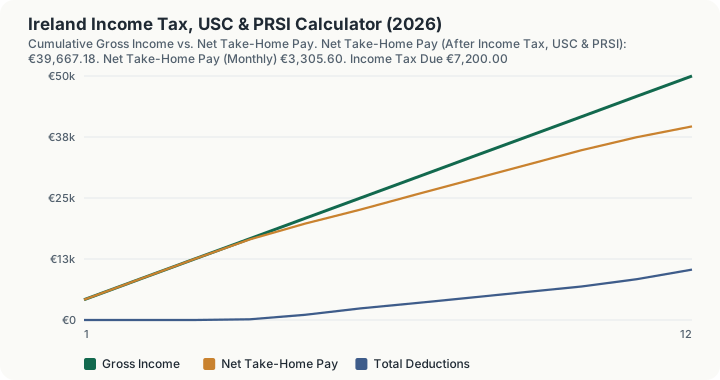
Quick Answer: A single PAYE employee in Ireland earning €50,000.00 in 2026 pays €7,200.00 in income tax, €1,032.82 in USC, and €2,100.00 in employee PRSI -- €10,332.82 in total deductions -- leaving €39,667.18 in net take-home pay, or about €3,305.60 a month.
Overview
Every payslip in Ireland carries three separate deductions that most people lump together as "tax": Income Tax (PAYE), the Universal Social Charge (USC), and Pay Related Social Insurance (PRSI). Each has its own rates, its own bands, and its own exemption rules, and none of them are calculated the same way. This calculator combines all three into a single net take-home pay figure for 2026, using the exact standard rate cut-off points, USC bands, and PRSI rules published by Revenue and the Department of Social Protection.
Income Tax is the one most people are familiar with: 20% on income up to a "standard rate cut-off point" (the band), 40% above it, reduced by your tax credits. USC is a separate charge applied in four tiered bands from 0.5% up to 8%, with no equivalent of a personal credit -- everyone above the €13,000 exemption pays it on their full income. PRSI is your social insurance contribution, a flat 4.2% of gross pay for most employees in 2026, but with a genuine exemption below €352 a week and a tapered credit just above it that a lot of online calculators get wrong.
For a married couple or civil partnership, Ireland allows joint assessment: combined income is taxed against one shared standard rate band, worth thousands of euro a year if one spouse earns significantly more than the other. USC and PRSI are never combined this way -- each spouse's own income is charged separately against their own bands, always, regardless of how the couple is assessed for income tax. Getting that distinction right is the single biggest source of error in DIY take-home pay estimates for married couples.
How This Is Calculated
1. Income Tax. Your assessable income (combined household income if married and jointly assessed) is split across the standard rate band and taxed at 20% up to that band, then 40% on the remainder.
The 2026 standard rate band is €44,000 for a single person, €53,000 for a married couple or civil partnership with one income, and €53,000 plus up to €35,000 transferable from the lower earner (capped at that spouse's own income) for a couple where both work -- a combined maximum of €88,000.
Two tax credits then reduce the gross tax directly: the Personal Tax Credit (€2,000 single, €4,000 married/civil partnership) and the Employee (PAYE) Tax Credit (€2,000 per employed spouse).
2. Universal Social Charge (USC). USC is charged on each individual's own income separately -- never combined for a couple -- using four tiered 2026 rates: 0.5% up to €12,012, 2% from €12,012.01 to €28,700, 3% from €28,700.01 to €70,044, and 8% above €70,044. If your total income for the year is €13,000 or less, you pay no USC at all; above that, you pay USC on your full income using the standard bands (there is no separate USC-specific personal credit).
3. PRSI (Class A employee). PRSI is also always calculated on each individual's own income. Weekly earnings of €352 or less are exempt entirely. Above that, a tapered credit of up to €12 a week softens the entry into PRSI: for weekly earnings between €352.01 and €424, the credit is €12 minus one-sixth of earnings over €352.01, falling to nil at €424/week. Above €424 a week, PRSI is a flat 4.2% of gross pay with no credit -- which, worked through algebraically, means annual PRSI for anyone earning more than about €22,048 a year simply equals annual income × 4.2%.
Worked Example
Example 1 -- A single PAYE employee on €50,000
Start with the income tax, which is the only one of the three charges that credits touch.
Step 1 -- The standard rate cut-off point. Single, so the band is €44,000
Step 2 -- The 20% slice. €44,000 x 20% = €8,800.00
Step 3 -- The 40% slice. (€50,000 - €44,000) x 40% = €6,000 x 40% = €2,400.00
Step 4 -- Gross income tax. €8,800.00 + €2,400.00 = €11,200.00
Step 5 -- The credits. €2,000 personal + €2,000 employee = €4,000.00
Step 6 -- Income tax due. €11,200.00 - €4,000.00 = €7,200.00
Now USC, which ignores those credits entirely and runs on its own four bands.
Step 7 -- USC band 1. €12,012 x 0.5% = €60.06
Step 8 -- USC band 2. (€28,700 - €12,012) x 2% = €16,688 x 2% = €333.76
Step 9 -- USC band 3. (€50,000 - €28,700) x 3% = €21,300 x 3% = €639.00
Step 10 -- Total USC. €60.06 + €333.76 + €639.00 = €1,032.82
Then PRSI, which has no bands at all once you clear the taper.
Step 11 -- Test the weekly taper. €50,000 / 52 = €961.54 a week, well above the €424 ceiling, so no credit applies
Step 12 -- PRSI due. €50,000 x 4.2% = €2,100.00
Step 13 -- Total deductions. €7,200.00 + €1,032.82 + €2,100.00 = €10,332.82
Step 14 -- Net take-home pay. €50,000.00 - €10,332.82 = €39,667.18, or €3,305.60 a month
Step 15 -- Effective versus marginal. €10,332.82 / €50,000 = 20.67% overall, against a 40.00% marginal income tax rate on the next euro earned. The gap between those two numbers is why a pay rise feels smaller than the payslip average suggests.
Example 2 -- A married couple, both working, on €60,000 and €30,000
Here the band transfers but nothing else does.
Step 1 -- The base married band. €53,000
Step 2 -- The transferable increase. The lower earner's €30,000 is below the €35,000 cap, so €30,000 transfers
Step 3 -- The combined band. €53,000 + €30,000 = €83,000
Step 4 -- The 20% slice on combined income. €83,000 x 20% = €16,600.00
Step 5 -- The 40% slice. (€90,000 - €83,000) x 40% = €7,000 x 40% = €2,800.00
Step 6 -- Credits for a two-earner couple. €4,000 personal + €4,000 (two employee credits) = €8,000.00
Step 7 -- Income tax due. €16,600.00 + €2,800.00 - €8,000.00 = €11,400.00
Step 8 -- USC on the higher earner alone. €60.06 + €333.76 + (€60,000 - €28,700) x 3% = €60.06 + €333.76 + €939.00 = €1,332.82
Step 9 -- USC on the lower earner alone. €60.06 + €333.76 + (€30,000 - €28,700) x 3% = €60.06 + €333.76 + €39.00 = €432.82
Step 10 -- Total USC. €1,332.82 + €432.82 = €1,765.64
Step 11 -- PRSI, also separate. €60,000 x 4.2% = €2,520.00 and €30,000 x 4.2% = €1,260.00, so €3,780.00
Step 12 -- Total deductions. €11,400.00 + €1,765.64 + €3,780.00 = €16,945.64
Step 13 -- Net household take-home pay. €90,000.00 - €16,945.64 = €73,054.36, an effective rate of 18.83%
Note what steps 8 through 11 do not do: they never add the two incomes together. Only the income tax band is shared. A calculator that pools household income for USC would report a materially different, and wrong, figure.
What This Does Not Account For
- Pension contributions and other salary-sacrifice deductions. Employee pension contributions, PRSA/AVC payments, and salary-sacrifice benefits (bike-to-work, travel passes) reduce taxable pay for Income Tax purposes and are not modeled here; enter your income net of these deductions for a closer estimate.
- Additional tax credits. This calculator applies only the two universal PAYE credits (Personal and Employee). It does not apply the Home Carer Tax Credit, Single Person Child Carer Credit, Age Tax Credit, Incapacitated Child Credit, Rent Tax Credit, or Medical Insurance relief -- all of which reduce actual tax due further if you qualify.
- The PRSI rate increase from 1 October 2026. Employee Class A PRSI is 4.2% from 1 January through 30 September 2026, then rises to 4.35% from 1 October 2026 under the multi-year PRSI increase schedule. This calculator uses the 4.2% rate that applies for three quarters of the year; your actual PRSI for pay dates on or after 1 October 2026 will be slightly higher.
- Self-employed / Schedule D income. This calculator models PAYE employment income only. Self-employed individuals pay Class S PRSI (a flat 4% with no employer contribution and different exemption rules) and are not eligible for the Employee Tax Credit, though they can claim an equivalent Earned Income Tax Credit of the same €2,000 amount.
- Emergency tax and mid-year changes. This is an annualized full-year estimate. It does not model emergency tax (applied when Revenue has no up-to-date record of your employment), or the effect of starting or leaving a job partway through the year.
- USC surcharge for non-PAYE income. Self-assessed individuals with non-PAYE income over €100,000 pay an additional 3% USC surcharge on that excess, which is not modeled here.
Common Pitfalls
- Assuming USC and PRSI combine for married couples the way Income Tax does. This is the single most common error in DIY take-home pay estimates. Joint assessment genuinely aggregates a couple's income against one shared Income Tax band -- but USC and PRSI are always calculated on each spouse's own individual income, never combined, no matter how the couple is assessed for Income Tax.
- Forgetting the PRSI weekly exemption applies per week, not per year. A weekly income of exactly €352 or less is fully PRSI-exempt, but a single unusually large paycheck later in the year (a bonus, for example) can push that week's income over the threshold and trigger PRSI on that week even if your average weekly pay is lower.
- Believing USC has a tax-free personal allowance like Income Tax does. Above the €13,000 exemption threshold, USC applies to your entire income from the first euro -- there is no equivalent of the Income Tax personal credit that shields part of your income from USC specifically.
- Not accounting for the tapered PRSI credit. Because the tapered credit falls away gradually between €352.01 and €424 a week, a small pay rise in that exact range barely increases net PRSI paid -- many manual calculations skip this and simply apply 4.2% flat from the very first euro above €352, overstating PRSI for anyone in that band.
- Missing the mid-2026 PRSI rate change. Payslips dated from 1 October 2026 onward will show 4.35% Class A employee PRSI, not the 4.2% used for most of the year; a full-year total that assumes one flat rate for all twelve months will be marginally understated.
Frequently Asked Questions
Why are USC and PRSI calculated separately from Income Tax for married couples?
Do I pay PRSI on my whole salary, or just the amount above €352 a week?
Is the USC exemption threshold of €13,000 the same as a tax-free allowance?
Why did my payslip's PRSI deduction change partway through 2026?
What's the difference between the Personal Tax Credit and the Employee Tax Credit?
Sources
- Revenue Commissioners: Budget 2026 Summary (Budget Statement of 7 October 2025) -- standard rate cut-off points, Personal Tax Credit, and Employee Tax Credit. revenue.ie
Also consulted: Revenue Commissioners: "Standard rates and thresholds of USC" and "Universal Social Charge (USC)" -- 2026 USC bands and the €13,000 exemption threshold; Department of Social Protection: SW14 PRSI Contribution Rates and User Guide (January 2026) -- Class A employee rate, weekly exemption, and tapered credit, under the Social Welfare (Miscellaneous Provisions) Act 2024 phased-increase schedule.