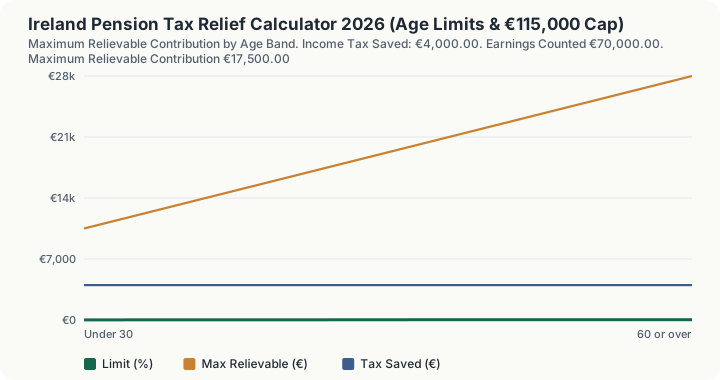
Quick Answer: A €10,000 personal pension contribution by a 42-year-old earning €70,000 saves €4,000 of income tax at the 40% marginal rate, so the net cost of putting €10,000 into the pension is €6,000. The age band allows 25% of earnings, so a further €7,500 could go in this year and still get full relief.
What does this calculator do?
Irish pension contributions attract relief at your marginal rate of income tax, subject to two limits that operate together. The first is an age-related percentage of your earnings, rising in six steps from 15% under 30 to 40% from age 60. The second is an earnings cap: only the first €115,000 of earnings is taken into account, whatever you actually earn.
The point that costs people money is not either of those limits. It is that Irish pension relief is relief from income tax only. USC and PRSI are charged on your gross pay before the pension deduction is taken, so a €1 pension contribution by a higher-rate taxpayer saves 40 cent, not 48 cent. Every tax-saving figure this calculator produces is computed at the income tax rate alone, because no USC or PRSI relief exists to apply.
The calculator also reports what the relief would have been worth had USC and PRSI been relieved, clearly labelled as a counterfactual. That number is there to size the gap, not because anything applies it. At the defaults the gap is €720 a year, and it is the amount by which people routinely overestimate the value of their pension contributions.
How is this calculated?
The relievable ceiling is a percentage of capped earnings, and the relief is the marginal rate applied to whatever contribution fits inside it:
Max Relievable = min(Earnings, € 115,000) × Age Percentage
Tax Saved = min(Contribution, Max Relievable) × Marginal Rate
Step 1: Find the age band. The bands are: under 30 at 15%, 30 to 39 at 20%, 40 to 49 at 25%, 50 to 54 at 30%, 55 to 59 at 35%, and 60 or over at 40%. Age 42 falls in the third band. 25%
Step 2: Apply the earnings cap. min(€70,000, €115,000) = €70,000 of earnings counted
Step 3: Note the earnings the cap discards. €70,000 - €70,000 = €0 ignored
Step 4: Compute the maximum relievable contribution. €70,000 x 25% = €17,500
Step 5: Split the actual contribution against that ceiling. min(€10,000, €17,500) = €10,000 gets relief max(€10,000 - €17,500, 0) = €0 above the limit
Step 6: Apply the marginal income tax rate. This is the headline. €10,000 x 40% = €4,000 of income tax saved
Step 7: Work out the net cost of the contribution. €10,000 - €4,000 = €6,000
Step 8: Express the relief as a share of the whole contribution. €4,000 / €10,000 = 40.00%
Step 9: Compute the headroom still available this year. €17,500 - €10,000 = €7,500
Step 10: Size the relief that does not exist. Applying the combined USC and PRSI rate you entered alongside the income tax rate gives the counterfactual saving. €10,000 x (40% + 7.2%) = €4,720
Step 11: The shortfall is the difference. €4,720 - €4,000 = €720 of relief you do not get
Worked Example
A 42-year-old on €70,000, taxed at the higher rate, puts €10,000 into a pension this year.
Step 1: Her age band. 40 to 49, giving a 25% limit.
Step 2: Her relievable ceiling. €70,000 x 25% = €17,500. The €115,000 cap is irrelevant to her; she earns well under it.
Step 3: Her contribution against the ceiling. €10,000 fits entirely inside €17,500, so all of it attracts relief.
Step 4: Her income tax saving. €10,000 x 40% = €4,000.
Step 5: What it actually cost her. €10,000 - €4,000 = €6,000 out of net income.
Step 6: Her unused headroom. €7,500 more could go in this year at the same 40% relief.
Step 7: The relief she did not get. €720, because USC and PRSI were charged on the gross €10,000 before the pension deduction.
Now change the inputs to see the limits bite. Contribute €25,000 instead and €7,500 of it sits above the €17,500 ceiling, attracting no relief in this tax year and dragging the effective relief rate below 40%. Earn €180,000 instead of €70,000 and the cap becomes the binding constraint: €65,000 of salary is simply invisible to the relief calculation, so the ceiling is 25% of €115,000 rather than 25% of €180,000. And at the standard rate of 20% the same contribution buys exactly half the relief, which is why pension contributions are far less efficient for someone below the standard rate cut-off point.
What does this calculator not account for?
- USC and PRSI relief, because none exists. The counterfactual figure the calculator reports is labelled as such and is never applied to reduce any tax due.
- Employer contributions. They do not use up your personal age-related limit and are not modelled here. The PRSA calculator handles the employer side.
- Carrying excess contributions forward. A contribution above this year's age limit is permitted but gets no relief this year. Irish rules allow relief to be carried forward to later years in defined circumstances; this calculator prices the current year only.
- The relief deadline. Contributions made before the 31 October filing deadline (or the ROS extended date) can in some cases be backdated to the previous tax year. The calculator assumes the contribution belongs to the year you are modelling.
- The Standard Fund Threshold. Relief on contributions is a separate question from whether the eventual fund exceeds the €2.2m threshold. See the PRSA calculator for that.
- How your marginal rate is determined. You select 20% or 40%. The calculator does not compute where your standard rate cut-off point sits.
What mistakes do people make with this?
- Assuming relief is 48% or 52%. It is 40% at the higher rate. Adding USC and PRSI to the relief rate is the most common error in Irish pension planning and it overstates the benefit by roughly a fifth.
- Thinking a higher salary always raises the limit. Above €115,000 it does not. Extra salary beyond the cap does not increase your relievable contribution by a cent.
- Missing a band change. The bands step at 30, 40, 50, 55 and 60. Turning 50 in the tax year lifts you from 25% to 30% of earnings, which on €70,000 is €3,500 of extra relievable room.
- Contributing above the limit without meaning to. The excess is allowed but gets no relief this year, so it sits in the pension having cost you full income tax. Check the headroom figure before topping up.
- Confusing the personal limit with the total that can go in. Employer contributions are additional and do not consume your age-related percentage.
Frequently Asked Questions
What are the Irish pension tax relief age limits for 2026?
Do I get USC and PRSI relief on pension contributions?
What happens if I contribute more than my age limit?
Does the €115,000 cap apply to my whole pension or just this year?
Is it worth contributing to a pension if I only pay the standard rate?
Do employer contributions use up my age-related limit?
Sources
- Revenue, "Tax relief limits": the six age-related percentage limits and the statement that the maximum amount of earnings taken into account for calculating tax relief is €115,000 per year. revenue.ie/en/jobs-and-pensions/pension/relief/tax-relief-limits.aspx (read 2026-08-30) revenue.ie/en/jobs-and-pensions/pension/relief/tax-relief-limits.aspx
Also consulted: Revenue, "Retirement lump sums" and "Chargeable excess tax", background on how the eventual fund is taxed, which is priced in the companion PRSA calculator rather than here. revenue.ie/en/jobs-and-pensions/pension/private/.