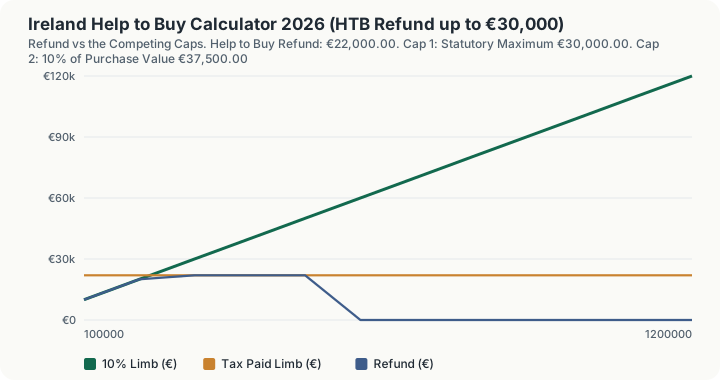
Quick Answer: A €375,000 new build with a €300,000 mortgage, bought by someone who has paid €22,000 of income tax over the four prior years, attracts a Help to Buy refund of €22,000.00. It clears the 70% loan-to-value minimum and the €500,000 ceiling, so the refund is the lowest of three caps: €30,000 statutory, €37,500 at 10% of value, and the €22,000 tax pot.
What does this calculator do?
Help to Buy under section 477C TCA 1997 refunds income tax and DIRT you have already paid, to help fund the deposit on a new-build home or self-build. Two things about it consistently surprise applicants.
The first is that the refund is the lowest of three separate ceilings, not a percentage of the purchase price. The €30,000 headline is a statutory maximum, not an entitlement. 10% of the purchase value is a second cap. And the third, which binds for the great majority of PAYE applicants, is the income tax and DIRT you actually paid in the four years before the claim. USC and PRSI do not count, which is why the pot is smaller than most people assume from looking at their payslips.
The second is that a large deposit can disqualify you. The mortgage must be at least 70% of the purchase value. Someone who has saved hard and needs only a 55% mortgage is ineligible, which is a genuinely counterintuitive outcome for a deposit-assistance scheme.
The €500,000 property value ceiling is a cliff, not a taper. At €500,001 the relief is zero, not relief on the first €500,000.
The enhanced relief, at the €30,000 and 10% levels, runs to 31 December 2029.
How is this calculated?
HTB = min(30,000, 0.10V, T + D), if V ≤ 500,000 and M/V ≥ 0.70; 0, otherwise
where $V$ is purchase value, $M$ the mortgage, $T$ income tax paid over four years and $D$ DIRT paid.
Step 1: Compute loan-to-value. Mortgage divided by purchase value.
Step 2: Test the property value ceiling. The purchase value, or the approved valuation for a self-build, must be greater than zero and no more than €500,000.
Step 3: Test the loan-to-value floor. Loan-to-value must be at least 70%.
Step 4: Compute cap 1, the statutory maximum. €30,000.
Step 5: Compute cap 2, ten per cent of value. Purchase value multiplied by 10%.
Step 6: Compute cap 3, the tax pot. Income tax paid over the four prior years plus DIRT paid over the same period. Nothing else is added: USC and PRSI are excluded.
Step 7: Take the lowest of the three.
Step 8: Apply the eligibility gates. If either gate in Steps 2 and 3 fails, the refund is zero regardless of the caps. The calculator still reports all three caps, so you can see what you would have received.
Step 9: Report which cap binds. Comparing the lowest against each cap in turn tells you what would actually raise your refund.
Step 10: Compute the two "what would it take" figures. The extra mortgage needed to reach 70% LTV, which is 70% of the purchase value less the current mortgage, floored at zero. And the extra tax needed before the tax pot stops binding, which is the lower of the other two caps less the current pot, floored at zero.
Step 11: Compute the cash deposit still needed. Purchase value, less mortgage, less the refund, floored at zero.
Worked Example
A couple buying a €375,000 new build with a €300,000 mortgage, having paid €22,000 of income tax and no DIRT across the four qualifying years.
Step 1: Loan-to-value. €300,000 / €375,000 = 80.00%
Step 2: Property value test. €375,000 is at or below €500,000, so this gate passes
Step 3: Loan-to-value test. 80.00% is at or above 70%, so this gate passes
Step 4: Cap 1, statutory maximum. €30,000.00
Step 5: Cap 2, ten per cent of purchase value. €375,000 x 10% = €37,500.00
Step 6: Cap 3, the four-year tax pot. €22,000 income tax + €0 DIRT = €22,000.00
Step 7: The lowest of the three. min(€30,000.00, €37,500.00, €22,000.00) = €22,000.00
Step 8: Help to Buy refund. Both gates passed, so the refund is €22,000.00
Step 9: Which cap binds. The income tax and DIRT paid over the four prior years
Step 10: Extra tax needed before a different cap binds. min(€30,000, €37,500) - €22,000 = €8,000.00
Step 11: Refund as a share of purchase value. €22,000 / €375,000 = 5.87%, not the headline 10%
Step 12: Cash deposit still needed. €375,000 - €300,000 - €22,000 = €53,000.00
Change one thing at a time and the structure becomes visible. Raise the four-year income tax to €40,000 and the €30,000 statutory maximum binds instead. Cut the mortgage to €200,000, a 53% loan-to-value, and the refund falls to zero despite the larger deposit. Raise the purchase value to €510,000 and the refund is zero as well, because the ceiling is a cliff.
What does this calculator not account for?
- USC and PRSI are excluded from the tax pot and this is not an oversight. Only income tax and DIRT count. The calculator takes both as inputs and never infers them from a salary figure, so the number you enter is the number it uses.
- The five-year owner-occupation condition is not computed. The property must be lived in as your main home for five years. That is a condition with a clawback attached, not arithmetic, and the calculator does not model it.
- First-time-buyer status is not tested. HTB is confined to first-time buyers, and this calculator does not ask or check. If you are not a first-time buyer the refund is nil whatever this page says.
- Only new builds and self-builds qualify, and that is not tested either. A second-hand home does not qualify at all.
- The contractor-approval requirement is not modelled. For a purchase, the developer must be a Revenue-approved qualifying contractor.
- Tax compliance is assumed. You must be tax compliant, with returns filed for the four years in question, for a claim to be paid.
- The mortgage is assumed to be a qualifying loan. A loan that is not a qualifying mortgage on the property does not count towards the 70% test.
- The refund is treated as available at purchase. In practice the payment mechanics differ between a purchase (paid to the contractor against the deposit) and a self-build (paid to the loan account), and this calculator shows only the amount.
- The comparison table holds your loan-to-value constant. It scales the mortgage with the purchase value across each row, so it shows how the caps interact rather than what a different mortgage would produce.
What mistakes do people make with this?
- Assuming the refund is 10% of the price. It is the lowest of three caps. On the worked example, 10% of value would be €37,500 but the refund is €22,000, or 5.87% of value, because the tax pot is smaller.
- Counting USC and PRSI towards the pot. They are excluded. For a typical PAYE earner, USC and PRSI are a large share of total deductions, so including them can overstate the refund by many thousands.
- Saving too large a deposit. The 70% loan-to-value floor means a very large deposit disqualifies the claim entirely. A €200,000 mortgage on a €375,000 home is 53% LTV and gets nothing.
- Expecting a taper above €500,000. There is none. €500,001 gives zero. Negotiating a purchase price a few thousand euro below the ceiling can be worth up to €30,000.
- Using the wrong four years. The pot is the income tax and DIRT paid in the four years prior to your application, not the four calendar years of your choosing, and returns for those years must be filed.
- Forgetting the five-year occupation condition. Selling or letting the property inside five years triggers a clawback of the refund.
- Confusing HTB with the First Home Scheme. They are different schemes with different mechanics and can interact; this calculator models only HTB.
Frequently Asked Questions
How much can I actually get from Help to Buy?
Does USC or PRSI count towards my Help to Buy refund?
Can a big deposit disqualify me from Help to Buy?
What happens if the property costs more than €500,000?
Does Help to Buy apply to second-hand homes?
How long does the enhanced relief last?
Sources
- Revenue (revenue.ie), revenue.ie/en/property/help-to-buy-incentive/how-much-can-you-claim.aspx, read 2026-08-30: "10% of the purchase value of a new home or of the approved valuation of the property, in the case of self-builds"; the €30,000 maximum under the enhanced relief running "between 23 July 2020 and 31 December 2029"; and the pot as "the amount of Income Tax and Deposit Interest Retention Tax (DIRT) you have paid for the four years prior to your application".
- Revenue (revenue.ie), revenue.ie/en/property/help-to-buy-incentive/who-can-claim-htb.aspx, read 2026-08-30: "purchase value or approved valuation no greater than €500,000 at the time"; the mortgage must be at least "70% of the purchase value of the property or approved valuation, in the case of a self-build"; and the five-year main-home occupation condition.
Also consulted: Section 477C TCA 1997 is the legal basis for the incentive. Full citation block, and the explicit note that USC and PRSI are not part of the pot, is in engine/primitives/ireland-help-to-buy.ts.