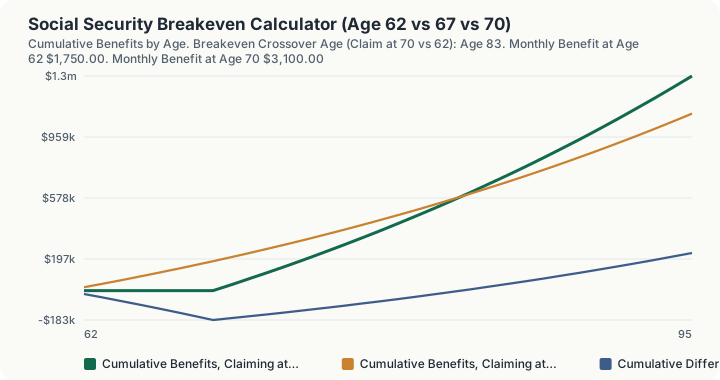
Quick Answer: Claiming Social Security later produces a permanently higher monthly benefit, and the breakeven age is the point at which cumulative lifetime benefits from delaying catch up to and surpass what you would have collected by claiming early.
Overview
Social Security lets you claim retirement benefits any time between age 62 and age 70, but the monthly amount you receive is not the same at every claiming age. Your Primary Insurance Amount (PIA), the benefit you would receive exactly at your Full Retirement Age (FRA, generally 67 for anyone born in 1960 or later), is adjusted up or down depending on when you actually start collecting. Claim at 62, the earliest allowed age, and your benefit is permanently reduced to roughly 70% of your PIA. Wait until 70, the latest age at which delaying still increases your benefit, and you receive roughly 124% of your PIA, the result of delayed retirement credits accruing at 8% per year for each year you wait past FRA.
That creates a genuine tradeoff rather than an obviously correct answer: claiming early means more total years of payments at a smaller monthly amount, while delaying means fewer years of payments at a larger monthly amount. The breakeven age is the mathematical crossover point, the age at which cumulative total dollars received from the higher, later-starting benefit catches up to and exceeds cumulative dollars received from the lower, earlier-starting benefit. Live past the breakeven age and delaying was the better financial choice in pure lifetime-dollar terms; die before it and claiming early collected more money overall.
This calculator computes the monthly benefit at all three common claiming ages (62, 67, and 70) directly from your stated Full Retirement Age benefit, applies your assumed annual COLA to each benefit stream once that claiming age is reached, and projects cumulative benefits collected at each age out to age 95, letting you see the crossover point emerge from the actual compounding numbers rather than relying on a single rule of thumb.
How This Is Calculated
Step 1: Derive the three claiming-age benefit levels from your Full Retirement Age benefit (PIA).
The 70% early-claiming reduction and the 124% delayed-credit increase reflect the standard actuarial adjustment factors published by the Social Security Administration for a Full Retirement Age of 67.
Step 2: Project cumulative lifetime benefits at each claiming age, compounding your assumed COLA annually. For every age from 62 to 95, twelve months of the applicable benefit are added to that claiming strategy's running cumulative total, starting from whichever age you began collecting. Each benefit stream also grows by your assumed annual COLA every year after its claiming age is reached, so the monthly amount used in later years is larger than the starting benefit, not held flat:
The same compounding-then-summing logic applies to the age-67 and age-70 streams, each starting its own COLA compounding only once that claiming age arrives.
Step 3: Identify the crossover age. The breakeven age is the first age at which a later-claiming stream's running cumulative total overtakes the age-62 stream's cumulative total, found directly from the year-by-year projection rather than estimated with a static rule of thumb. Because each stream now compounds COLA independently, the exact crossover age shifts with your assumed COLA rate.
Worked Example
Using this calculator's baseline input: a $2,500 Full Retirement Age monthly benefit (PIA) with a 2.5% assumed annual COLA.
- Monthly benefit at 62 (starting amount): $2,500 × 0.70 = $1,750
- Monthly benefit at 67, FRA (starting amount): $2,500
- Monthly benefit at 70 (starting amount): $2,500 × 1.24 = $3,100
- Each stream compounds by the assumed 2.5% COLA every year after its own claiming age, so by age 82 the age-62 stream's monthly payment has grown well past its $1,750 starting point, and by age 82 the age-70 stream's monthly payment has grown past its $3,100 starting point.
- Cumulative benefit at 62, by age 82: $570,848.76, reflecting 20 years of collecting with 19 years of compounding on top of the $1,750 starting benefit.
- Cumulative benefit at 70, by age 82: $563,224.43, reflecting 12 years of collecting with 11 years of compounding on top of the $3,100 starting benefit. That's still slightly behind the age-62 total.
- Cumulative benefit at 70, by age 83: $614,505.05, versus $606,119.97 for age 62 at the same age. The age-70 stream has now overtaken the age-62 stream. Age 83 is this scenario's real breakeven age for claiming at 70 versus 62.
- Claiming at 67 versus 62 crosses over one year earlier, at age 81: the age-67 stream's cumulative total reaches $537,957.80 against the age-62 stream's $536,437.81. Since the gap between $1,750 and $2,500 per month is smaller than the gap to $3,100, less time is needed for the higher benefit to catch up.
The practical takeaway: someone confident of living into their early-to-mid 80s or beyond, based on personal health and family longevity history, comes out ahead in total lifetime dollars by delaying to 70. Someone with a shorter life expectancy, or who needs the income sooner, collects more total dollars by claiming earlier. Raising or lowering the assumed COLA shifts these exact crossover ages: a 0% COLA assumption on the same $2,500 PIA moves the breakeven ages earlier, to age 78 (62 vs. 67) and age 80 (62 vs. 70), since none of the three streams grows over time and the larger starting benefits catch up faster in nominal dollars. A second reference point from this calculator's own test suite confirms the proportional scaling of the starting amounts: a higher $3,800 PIA produces a $2,660 starting benefit at 62 and a $4,712 starting benefit at 70, the same 70%/124% adjustment factors applied to a larger base benefit.
What This Does Not Account For
- Individual mortality and health status. The breakeven age is a pure arithmetic crossover point; it says nothing about your actual life expectancy, which depends heavily on personal health history, family longevity, and demographic factors not captured in a single benchmark age.
- Spousal and survivor benefit strategies. Married couples have substantially more complex optimal claiming strategies, including the option for a lower-earning spouse to claim early while a higher-earning spouse delays to maximize the survivor benefit; this calculator models a single claimant only.
- Taxation of Social Security benefits. Depending on total provisional income, up to 85% of Social Security benefits can be subject to federal income tax; this calculator reports gross, pre-tax benefit amounts.
- The time value of money. This model compares nominal cumulative dollars received at each age without discounting for the fact that a dollar received at 62 could itself be invested and grow before a dollar received at 70 is even paid out.
Common Pitfalls
- Treating the breakeven age as a universal recommendation. The breakeven age is a mathematical crossover point based on assumed constant benefit levels, not personalized financial or medical advice; the right claiming age depends on health, other income sources, spousal considerations, and personal risk tolerance.
- Ignoring that delayed retirement credits stop accruing at age 70. There is no additional benefit to delaying past age 70; doing so only forfeits months of payments with no offsetting increase.
- Forgetting the early claiming reduction is permanent. Unlike some other retirement decisions, the reduction from claiming before Full Retirement Age is not temporary; it lowers your monthly benefit for the rest of your life (subject to annual COLA increases on that reduced base).
- Overlooking spousal and survivor benefit interactions. For married couples, the claiming decision of the higher earner directly affects the surviving spouse's eventual survivor benefit, often making delaying more valuable for a couple than a single-person breakeven analysis alone would suggest.
- Assuming everyone's Full Retirement Age is 67. Full Retirement Age varies by birth year, ranging from 66 for those born in 1943-1954 up to 67 for anyone born in 1960 or later; using the wrong FRA changes both the benefit percentages and the reference points in any breakeven analysis.
Frequently Asked Questions
What is Full Retirement Age and why does it matter?
Why does delaying to 70 increase my benefit by 24% instead of some other amount?
Is there any benefit to delaying past age 70?
How accurate is the breakeven age this calculator reports for my own situation?
Should I claim early if I plan to keep working?
Does this calculator account for my spouse's benefits?
Sources
- Social Security Administration, Retirement Benefits: Early or Late Retirement, ssa.gov/benefits/retirement/planner/agereduction.html
- Social Security Administration, Delayed Retirement Credits, ssa.gov/oact/ProgData/ar_drc.html
- Social Security Administration, Period Life Table and Actuarial Publications, ssa.gov/oact/STATS/table4c6.html