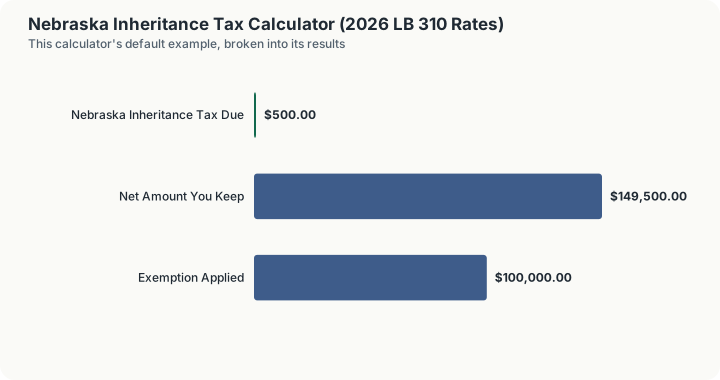
Quick Answer: An immediate relative (child, parent, sibling, or grandchild) inheriting $150,000 from a Nebraska resident owes $500 after the $100,000 exemption (1% on the remaining $50,000). A remote relative (aunt, uncle, niece, nephew) inheriting $100,000 owes $6,600 after the $40,000 exemption (11%). An unrelated beneficiary inheriting $75,000 owes $7,500 after the $25,000 exemption (15%). A surviving spouse owes $0.
Overview
Nebraska is one of only five states that still tax beneficiaries directly on what they individually inherit, rather than taxing the estate as a whole the way an estate tax does. Unlike Pennsylvania, Maryland, Kentucky, and New Jersey -- which are state-level taxes -- Nebraska's inheritance tax is unusual in that it is levied and collected at the county level, even though the rates and exemptions are set uniformly by state statute.
Nebraska overhauled this tax substantially with LB 310, passed in 2022 and effective for deaths on or after January 1, 2023. LB 310 roughly doubled or more the exemption for close relatives (from $40,000 to $100,000) and cut the top rates for more distant relatives and unrelated beneficiaries by about 15% (from 18% to 15%, and from 13% to 11%). A further proposal in 2025 (LB 468) to cut the two higher rates to 3% each and unify all three exemptions at $100,000 advanced through debate but stalled in the Legislature and did not pass, so the LB 310 rates below remain current. A separate 2026 bill, LB 838, clarified -- but did not change the rates of -- which relatives qualify as immediate ("Class 1") family, including certain acknowledged-parent relationships.
How This Is Calculated
Nebraska applies a single flat rate above a class-specific exemption -- there are no progressive brackets. Each beneficiary is evaluated individually against their own relationship class.
| Relationship Class | Exemption | Rate |
|---|---|---|
| Surviving spouse | Unlimited | 0% |
| Immediate relatives (parent, grandparent, sibling, child, other lineal descendant) | $100,000 | 1% |
| Remote relatives (aunt, uncle, niece, nephew, their descendants) | $40,000 | 11% |
| All other transferees (unrelated individuals, most organizations) | $25,000 | 15% |
- Identify the beneficiary's class under Neb. Rev. Stat. §§ 77-2004 through 77-2006.
- Subtract the class exemption from the amount that specific beneficiary receives.
- Apply the flat class rate to the remaining taxable amount -- there is no tiered bracket structure once above the exemption.
- File and pay at the county level, typically within twelve months of the date of death (interest accrues at 14% annually on late payments, with penalties up to 25% of the unpaid tax).
Worked Example
- Start with the amount inherited. This example uses a $150,000 bequest to an adult child, an immediate relative under Class 1.
- Apply the exemption. Immediate relatives are exempt on the first $100,000 they receive.
- Taxable amount. $150,000 − $100,000 = $50,000.
- Apply the 1% rate. $50,000 × 1% = $500 in Nebraska inheritance tax.
- Net to the child. $150,000 − $500 = $149,500.
- Compare to a niece. The same $150,000 to a remote relative (niece/nephew) would be taxed on $150,000 − $40,000 = $110,000 at 11% = $12,100 -- 24 times the immediate-relative tax on an identical bequest.
Class 1, 2, and 3 in Detail
- Class 1 (immediate relatives): parents, grandparents, siblings, children and other lineal descendants (including legally adopted children), and certain people the decedent stood in an acknowledged-parent relationship with for at least ten years before death, plus the spouses of those relatives. $100,000 exemption, 1% above it.
- Class 2 (remote relatives): aunts, uncles, nieces, nephews, and their descendants and spouses. $40,000 exemption, 11% above it.
- Class 3 (all other transferees): anyone not in Class 1 or 2, including unrelated individuals and most organizations that are not qualified charities. $25,000 exemption, 15% above it.
- Surviving spouses are fully exempt regardless of amount, and beneficiaries under age 22 pay no inheritance tax at all under current law, regardless of their relationship class.
How Nebraska Compares to the Other Four Inheritance-Tax States
Nebraska's structure is closer to Pennsylvania's than to Kentucky's or New Jersey's: a flat rate per class rather than progressive brackets. But Nebraska is the only one of the five states that layers a class-specific dollar exemption underneath a flat rate for every class, including close relatives -- Pennsylvania's lineal-descendant rate applies from the first dollar with no exemption at all, while Nebraska exempts the first $100,000 an immediate relative receives before any tax applies. Nebraska is also the only one of the five states administered at the county rather than state level, a holdover from the tax's 19th-century origins as a local revenue source for Nebraska counties -- which is also why the 2025 proposal to cut rates further (LB 468) stalled: counties depend on this revenue and any reduction had to be paired with new county fee authority to offset the loss, an estimated $34 million a year statewide.
What This Does Not Account For
- Nebraska's homestead allowance, exempt property allowance, and family maintenance allowance, which pass to a surviving spouse or minor children free of inheritance tax before the class-based computation above even applies.
- The county-level administrative variation in how returns are processed, since -- unlike the other four inheritance-tax states -- Nebraska's tax is assessed and collected by the county rather than a single state agency.
- Federal estate tax, assessed separately against estates above the federal exemption ($15 million per decedent in 2026).
- Qualified charitable transfers, which are generally exempt regardless of class.
- Any pending future legislation (such as the stalled 2025 LB 468 rate-reduction proposal) that has not yet been enacted into law.
Common Pitfalls
- Using stale pre-2023 figures. Many older articles still cite the pre-LB 310 exemptions ($40,000 for close relatives, $15,000 for remote relatives, $10,000 for others) and higher top rates (13%-18%) -- those numbers have not applied since January 1, 2023.
- Forgetting Nebraska taxes at the county level. Executors sometimes mail returns or payments to the wrong office because Nebraska, unlike Pennsylvania or New Jersey, does not centralize inheritance tax administration at the state department of revenue.
- Missing the 12-month payment deadline. Nebraska's 14%-per-year interest rate on late payment is materially higher than most states' inheritance tax penalty regimes.
- Assuming remote relatives get the same treatment as immediate family. An aunt or uncle receiving the same dollar amount as a child pays a dramatically higher effective rate once past their much smaller $40,000 exemption.
- Confusing Nebraska's Class 1/2/3 system with Kentucky's or New Jersey's Class A/B/C/D/E system -- the class names are similar across states but the membership, exemptions, and rates are entirely different.
Frequently Asked Questions
Does Nebraska have a state estate tax in addition to the inheritance tax?
What is the Nebraska inheritance tax exemption for children?
Are surviving spouses subject to Nebraska inheritance tax?
What is the Nebraska inheritance tax rate for a niece or nephew?
Who collects Nebraska's inheritance tax?
Did Nebraska recently change its inheritance tax rates?
Sources
- Nebraska Department of Revenue, Property Assessment Division -- Inheritance Tax: revenue.nebraska.gov/PAD/inheritance-tax.
Also consulted: Nebraska Revised Statutes §§ 77-2004, 77-2005, 77-2006: Inheritance tax rates and exemptions for immediate relatives, remote relatives, and all other transferees, as amended by LB 310 (2022), effective for deaths on or after January 1, 2023; LB 838 (2026), Nebraska Legislature: Clarified Class 1 beneficiary definitions; operative July 18, 2026; estate tax calculator: For the separate federal estate tax computation.