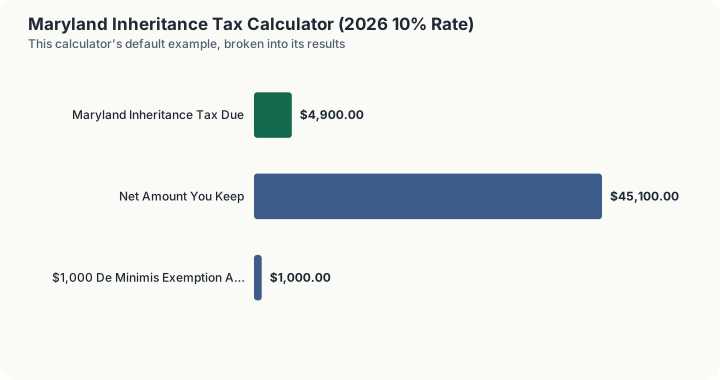
Quick Answer: A niece inheriting $50,000 from a Maryland resident owes $4,900 in inheritance tax -- a flat 10% on the amount above the $1,000 per-beneficiary exemption ($49,000 × 10%). A child, spouse, sibling, or grandchild inheriting any amount owes $0, because those relationships are exempt outright.
Overview
Maryland holds a distinction no other state shares: it is the only state in the country that levies both a state estate tax and a separate inheritance tax at the same time. The Maryland estate tax calculator computes the tax owed by the estate itself, on the total taxable estate above Maryland's exemption, before any distribution. This calculator computes a completely different tax: the inheritance tax owed by an individual beneficiary, based on their personal relationship to the decedent, regardless of how large or small the overall estate is. A single Maryland estate can trigger both taxes simultaneously -- the estate tax on the way in, and the inheritance tax on specific bequests to non-exempt beneficiaries on the way out.
Unlike Pennsylvania, Nebraska, Kentucky, or New Jersey -- all of which grade rates across several relationship tiers -- Maryland's inheritance tax has only two outcomes: a beneficiary is either fully exempt, or they pay a flat 10% on nearly everything above a small $1,000 de minimis exemption. There is no intermediate rate.
How This Is Calculated
Maryland's rate structure is the simplest of the five inheritance-tax states: one flat rate, one exemption amount, applied per beneficiary.
(For any beneficiary in an exempt relationship, the tax is simply $0 regardless of amount.)
- Determine whether the beneficiary's relationship is exempt under Md. Code, Tax-General § 7-203. If so, the computation stops here at $0.
- If not exempt, subtract the $1,000 de minimis exemption that Maryland grants to every beneficiary regardless of relationship.
- Apply the flat 10% rate to the remaining amount.
- File and pay through the Register of Wills in the county administering the estate.
Worked Example
- Start with the amount inherited. This example uses a $50,000 bequest to a niece -- a relationship Maryland does not exempt.
- Apply the $1,000 de minimis exemption. $50,000 − $1,000 = $49,000 taxable.
- Apply the 10% rate. $49,000 × 10% = $4,900 in Maryland inheritance tax.
- Net to the niece. $50,000 − $4,900 = $45,100.
- Compare to an exempt relationship. If that same $50,000 instead passed to the decedent's child, sibling, or spouse, the tax would be $0 -- the exact same dollar amount, entirely different outcome, purely because of the relationship.
Maryland's Exempt Relationships (Broader Than Most People Assume)
Maryland's exemption list under Tax-General § 7-203 is wider than the "just spouse and kids" assumption many beneficiaries start with: - Spouse and registered domestic partner (full exemption effective for deaths on/after October 1, 2023). - Children (including legally adopted children) and their descendants -- grandchildren, great-grandchildren. - Stepchildren -- Maryland's statutory definition of "child" for inheritance tax purposes includes stepchildren, so they are treated the same as biological or adopted children. - Parents and grandparents. - Siblings -- a point of frequent surprise, since several other inheritance-tax states (Pennsylvania, New Jersey) do tax transfers to siblings. - The spouse of a decedent's child (i.e., a son-in-law or daughter-in-law), for deaths on or after July 1, 2000. - A domestic partner's interest in jointly held real property used as a primary residence (a narrower, real-property-only exemption distinct from the full registered-domestic-partner exemption above). - Qualified 501(c)(3) charities, religious institutions, and organizations to which transfers are deductible under IRC § 2055. - Pension or employee benefit plan payments that are not taxable for federal estate tax purposes.
Everyone else -- nieces, nephews, cousins, in-laws (other than a child's spouse), friends, and unrelated individuals -- is a "collateral heir" and pays the flat 10% rate above the $1,000 exemption.
Filing and Payment
Maryland inheritance tax is administered locally: the Register of Wills for the county in which the estate is being probated collects the tax, rather than a centralized state department handling every return the way Pennsylvania's Department of Revenue does. The tax is generally due within a relatively short window after the property passes to the beneficiary -- executors typically remit it as part of settling the estate's account with the Register of Wills, and interest accrues on late payments. Because collection happens county-by-county, exact procedural timelines and required forms can vary slightly depending on where in Maryland the estate is being administered, even though the substantive 10%-rate-and-exemption-list rules described above are set uniformly by state statute.
What This Does Not Account For
- Maryland's separate state estate tax, assessed against the total taxable estate above Maryland's exemption threshold before distribution -- see the Maryland estate tax calculator for that computation. A single estate can owe both taxes.
- Federal estate tax, assessed separately against estates above the federal exemption ($15 million per decedent in 2026).
- The credit Maryland allows against its estate tax for inheritance tax actually paid on the same property, which can reduce a large estate's combined state death tax burden below what the two taxes would sum to independently.
- Real property located outside Maryland, which is generally not subject to Maryland inheritance tax regardless of the decedent's residence.
- Small-estate or modified administration procedures that can change filing mechanics without changing the tax computed here.
Common Pitfalls
- Assuming siblings are taxed like they are in Pennsylvania or New Jersey. Maryland exempts siblings outright -- a beneficiary researching multi-state rules can easily import the wrong assumption from a different state's inheritance tax.
- Forgetting the dual-tax structure. Because Maryland runs both an estate tax and an inheritance tax, some executors budget for only one and are caught off guard by the other.
- Overlooking the stepchild exemption. Blended families sometimes assume a stepchild will be taxed as an "other" beneficiary; Maryland treats them as exempt children.
- Missing the $1,000 de minimis exemption on small bequests. A modest $800 keepsake or cash gift to a non-exempt beneficiary owes no tax at all, but a $1,500 gift is taxed on the $500 above the threshold.
- Confusing "collateral heir" with "distant relative." Maryland's collateral-heir category is defined by exclusion (anyone not on the exempt list), not by degree of kinship -- a first cousin and a total stranger are taxed identically.
Frequently Asked Questions
Does Maryland really have both an estate tax and an inheritance tax?
Is a sibling exempt from Maryland inheritance tax?
What is the Maryland inheritance tax rate for a niece or nephew?
Are stepchildren exempt from Maryland inheritance tax?
Is there a small-bequest exemption in Maryland?
Who collects the Maryland inheritance tax?
Does Maryland tax retirement accounts and life insurance the same as other property?
Can Maryland's estate tax and inheritance tax overlap on the same property?
Sources
- Maryland Register of Wills, Inheritance Tax: registers.maryland.gov/main/taxes.html.
- Comptroller of Maryland, the official state tax authority for Maryland rates, rules and forms. marylandtaxes.gov
Also consulted: Maryland Code, Tax-General Article, Title 7, Subtitle 2: § 7-201 (10% flat rate), § 7-202(b) ($1,000 de minimis exemption), § 7-203 (exempt relationships); Maryland estate tax calculator: For the separate state estate tax Maryland also levies against the total estate; estate tax calculator: For the federal estate tax computation.