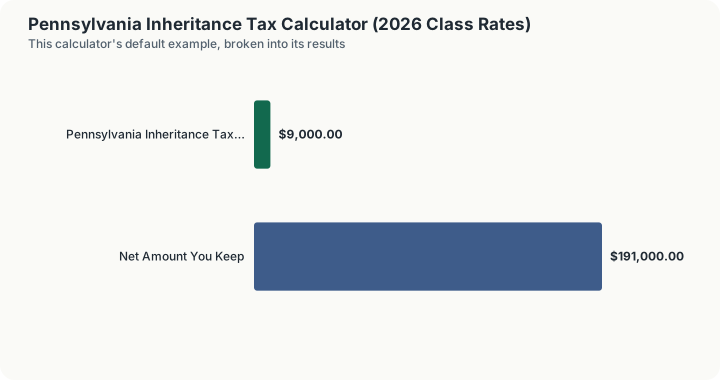
Quick Answer: A child inheriting $200,000 from a Pennsylvania parent owes $9,000 in inheritance tax (4.5% lineal rate). A sibling inheriting $150,000 owes $18,000 (12%). A niece, nephew, or unrelated beneficiary inheriting $50,000 owes $7,500 (15%). A surviving spouse -- and a transfer between a parent and a child age 21 or younger, in either direction -- owes $0.
Overview
Pennsylvania is one of only five states that still levy a genuine inheritance tax: a tax paid directly by the person who receives property from an estate, calculated on what that individual beneficiary personally inherits and scaled entirely by that beneficiary's relationship to the decedent. This is fundamentally different from an estate tax, which is assessed against the total estate before any distribution and does not care who the heirs are. Pennsylvania does not levy a separate state estate tax at all -- the inheritance tax computed here is the only Pennsylvania death tax a beneficiary or executor needs to plan around, aside from the federal estate tax that only applies to estates north of $15 million.
Pennsylvania's rate schedule is unusually simple compared to Kentucky or New Jersey: there are no dollar-bracket tiers and, except for spouses and certain parent-child transfers, no exemption threshold at all. Every dollar a taxable beneficiary receives is taxed at their class's flat rate from the first dollar. That makes the calculation almost entirely a function of who is receiving the money, not how much total wealth the estate holds.
How This Is Calculated
Pennsylvania inheritance tax is computed per beneficiary, not per estate. Each beneficiary's distributive share is multiplied by the flat statutory rate assigned to their relationship class under 72 P.S. § 9116.
Pennsylvania recognizes six relationship classes, each with its own flat rate:
| Relationship Class | Rate |
|---|---|
| Surviving spouse | 0% |
| Parent ↔ child age 21 or younger (either direction) | 0% |
| Lineal descendants/ascendants (children over 21, grandchildren, parents, grandparents) | 4.5% |
| Siblings (including half-siblings) | 12% |
| Charities, exempt institutions, and government | 0% |
| Everyone else (nieces, nephews, friends, unrelated individuals) | 15% |
- Identify the beneficiary's class. Pennsylvania looks only at the relationship between the decedent and the specific person receiving the property -- not at the total estate value.
- Value the distributive share. Fair market value, at date of death, of the specific bequest or intestate share that beneficiary receives.
- Apply the class rate. Multiply the full distributive share by the flat rate for that class -- there is no bracket structure and (outside the exemptions above) no dollar exemption to subtract first.
- Net proceeds to the beneficiary. Distributive share minus the computed inheritance tax.
Worked Example
- Start with the distributive share. This example uses a $200,000 bequest to an adult child -- a lineal descendant.
- Identify the class. Children (over 21), grandchildren, parents, and grandparents are all lineal descendants/ascendants, taxed at 4.5% with no exemption.
- Apply the rate. $200,000 × 4.5% = $9,000 in Pennsylvania inheritance tax.
- Net amount to the child. $200,000 − $9,000 = $191,000.
- Compare to a sibling. If that same $200,000 instead passed to a sibling (12% rate), the tax would be $24,000 -- $15,000 more than the lineal rate, purely because of the relationship.
- Compare to a niece or nephew. At the 15% "other" rate, the same $200,000 would owe $30,000, over three times the lineal-class tax on an identical dollar amount.
Who Qualifies for Pennsylvania's 0% Rate
Pennsylvania's 0% rate is narrower than many people assume: - Surviving spouses pay 0% on any amount inherited from a deceased spouse, and property held jointly between spouses passes outside the inheritance tax entirely. - Parent-to-child transfers where the child is age 21 or younger at the time of the parent's death are taxed at 0% (natural, adoptive, or stepparent), under 72 P.S. § 9116(a)(1.2), added by Act 13 of 2019 and effective for deaths on or after January 1, 2020. - Child-to-parent transfers where the child was 21 or younger at death are also 0%, under § 9116(a)(1.1) -- this covers the (rarer) case of a young child predeceasing a parent. - Charities, religious and educational institutions, and government entities are exempt regardless of amount. - Everyone else in the "lineal" class -- including children over 21 inheriting from a parent, and any transfer to or from a grandparent or grandchild -- pays the standard 4.5%, with no exemption and no 0% carve-out.
Filing Deadlines and the Early-Payment Discount
The Pennsylvania inheritance tax return (Form REV-1500 for residents; REV-1737-A for nonresident decedents) is due, and the tax becomes delinquent, nine months after the date of death. Pennsylvania is unusual among the five inheritance-tax states in offering a real financial incentive to move quickly: paying the tax in full within three months of death earns a 5% discount off the amount due. Executors routinely file and pay from estate assets before final distribution, but the beneficiary remains the party legally liable for the tax on what they receive.
What This Does Not Account For
- The 5% early-payment discount Pennsylvania grants on tax paid within three months of death. It is a real statutory benefit, but the calculator returns the undiscounted tax; multiply by 0.95 yourself if the estate will pay early.
- Federal estate tax, which is assessed separately against the total estate above the federal exemption ($15 million per decedent in 2026) and does not depend on beneficiary relationship.
- Pennsylvania's agricultural/family-farm exemption for qualifying farmland transferred to eligible family members, effective for deaths after June 30, 2012.
- The military-service exemption for personal property from a service member who died from a service-related injury or illness on or after September 6, 2022.
- Life insurance proceeds paid to a named beneficiary, which are generally exempt from Pennsylvania inheritance tax regardless of relationship.
- Small-estate or informal-administration procedures that may change filing mechanics without changing the tax computed here.
- Any other state's inheritance or estate tax, if the decedent owned real property outside Pennsylvania.
Common Pitfalls
- Assuming spouse-level treatment applies to unmarried partners. Pennsylvania's 0% spousal rate requires a legal marriage; long-term unmarried partners fall into the 15% "other" class with no relationship-based relief.
- Missing the 21-or-younger age test. The 0% parent-child rate is a bright-line age test measured at the date of death -- a 22-year-old child inheriting from a parent is taxed at the full 4.5% lineal rate, not 0%.
- Confusing this with Pennsylvania estate tax. Pennsylvania has no separate state estate tax; some executors mistakenly budget for both when only the inheritance tax computed here applies.
- Forgetting the 5% discount deadline. The three-month window for the early-payment discount is easy to miss when an estate is waiting on asset valuations or a federal estate tax closing letter.
- Treating stepchildren informally. Stepchildren are treated as lineal descendants (4.5%) under Pennsylvania law even without formal adoption, which surprises some blended families expecting the 15% "other" rate.
Frequently Asked Questions
Does Pennsylvania have both an estate tax and an inheritance tax?
What is the Pennsylvania inheritance tax rate for a spouse?
What is the Pennsylvania inheritance tax rate for children?
What is the Pennsylvania inheritance tax rate for siblings?
What is the Pennsylvania inheritance tax rate for nieces, nephews, or friends?
When is the Pennsylvania inheritance tax return due?
Is life insurance subject to Pennsylvania inheritance tax?
Sources
- Pennsylvania Department of Revenue, Inheritance Tax: pa.gov/agencies/revenue/resources/tax-types-and-information/inheritance-tax (rate table, filing deadlines, 5% discount).
- Pennsylvania Department of Revenue, the official state tax authority for Pennsylvania rates, rules and forms. revenue.pa.gov
Also consulted: 72 P.S. § 9116: Statutory rate schedule, including the 0% parent/child-21-or-younger provisions added by Act 13 of 2019 (effective for deaths after December 31, 2019); estate tax calculator: For the separate federal estate tax computation, which Pennsylvania estates may also owe above the federal exemption.