Quick Answer: A Roth IRA grows tax-free through monthly compounding on your contributions, and its main advantage over a Traditional IRA is that qualified withdrawals in retirement owe no income tax at all.
Overview
A Roth IRA is funded with after-tax dollars: you get no upfront tax deduction the year you contribute, but in exchange, qualified withdrawals in retirement, including all of the investment growth, are entirely free of federal income tax. That trade only pays off if the account has time to compound, which is why this calculator models growth on a monthly compounding basis across your full working career rather than a single lump-sum projection.
The annual contribution limit modeled here is $7,500 for 2026, with an additional $1,100 catch-up contribution available starting at age 50, bringing the effective limit to $8,600 for older savers, a scenario this calculator's built-in "Age 50+ Catch-Up" toggle applies directly. Both figures come from IRS Notice 2025-67, "2026 Amounts Relating to Retirement Plans and IRAs," which raised the IRA limit from the $7,000 that applied in 2025.
Eligibility to contribute directly to a Roth IRA also phases out at higher modified adjusted gross income (MAGI) levels. For 2026, under the same notice, the phase-out ranges are $153,000 to $168,000 for single and head-of-household filers, and $242,000 to $252,000 for married couples filing jointly. Married filing separately, if you lived with your spouse at any point in the year, phases out over $0 to $10,000, a range that is not indexed for inflation. Below the floor of your range you can contribute the full limit; within the range your maximum contribution is reduced proportionally; above the ceiling you cannot contribute directly at all. This calculator does not enforce those thresholds, so it assumes you are eligible to contribute the full amount you specify.
The calculator's core purpose is the side-by-side comparison it draws between the Roth balance and an equivalent Traditional IRA balance taxed at your stated retirement tax bracket. Roth withdrawals are untaxed, and Traditional withdrawals are taxed as ordinary income when you take them out, so the same accumulated balance is worth less in a Traditional account once you actually spend it. Read that gap as an illustration of one specific comparison, equal nominal contributions to each account type, rather than as a complete Roth-versus-Traditional verdict; the Common Pitfalls section below explains why a strict like-for-like comparison would also credit the Traditional contributor with the upfront tax deduction.
How This Is Calculated
Step 1: Convert to monthly compounding. Your time horizon in years is converted to months, your annual return to a monthly rate, and your annual contribution to a monthly contribution:
Step 2: Compound monthly across the full horizon. Each month, interest is earned on the existing balance, then the monthly contribution is added. That is an ordinary annuity, twelve periods to a year, solved by the shared time-value-of-money engine:
Step 3: Decompose growth versus contributions.
Step 4: Compare against an equivalent Traditional IRA. The final Roth balance is compared to what the same balance would be worth net of tax if withdrawn from a Traditional account at your stated retirement tax bracket:
Worked Example
Using this calculator's baseline inputs: a 25-year-old with a $15,000 starting balance, contributing the 2026 limit of $7,500 annually, an 8.5% expected annual return, retiring at 65 (40 years of growth), with a 22% assumed retirement tax bracket.
- Time horizon: 65 − 25 = 40 years = 480 months
- Monthly rate: 8.5% ÷ 12 ≈ 0.7083%
- Monthly contribution: $7,500 ÷ 12 = $625.00
- Compounding runs for 480 months, interest applied to the balance each month before that month's contribution is added.
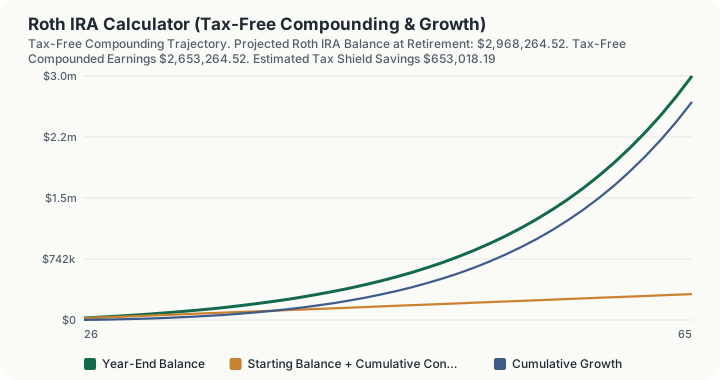
- Final Roth balance at age 65: $2,968,264.52
- Total contributions over 40 years: $15,000 starting balance + ($7,500 × 40 years) = $15,000 + $300,000 = $315,000
- Total tax-free growth earned: $2,968,264.52 − $315,000 = $2,653,264.52
- Equivalent Traditional IRA net value (same balance, taxed at 22% on withdrawal): $2,968,264.52 × (1 − 0.22) = $2,315,246.32
- Roth tax advantage: $2,968,264.52 − $2,315,246.32 = $653,018.19
That $653,018.19 figure measures one specific thing: the tax that never comes due on this balance if it sits in a Roth rather than a Traditional account, at a 22% withdrawal rate. It is not the net benefit of choosing Roth over Traditional. A strict like-for-like comparison would also credit the Traditional contributor with the deduction they receive in each contribution year and the growth on investing it, which narrows the gap considerably and can close it entirely if your tax rate in retirement matches your rate today. Treat the number as the size of the tax exposure a Roth removes, not as free money. For a second reference point, this calculator's own test suite shows the pure compounding effect in isolation: a single $20,000 lump-sum contribution with zero future additions, growing at 8.0% monthly-compounded over 30 years, reaches $218,714.59, an 11-fold increase driven entirely by compound growth on the original contribution.
Carrying Into the Second Year, and to the Crossover
Step 10 -- The first schedule row, age 26. Year-end balance $24,125.06, of which $22,500.00 is the starting balance plus the first contribution and $1,625.06 is growth.
Step 11 -- Age 27. Balance $34,056.69, contributions to date $30,000.00, cumulative growth $4,056.69
Step 12 -- The year growth first overtakes contributions. At age 39 cumulative growth reaches $129,687.01 against $120,000.00 contributed. The year before, at 38, growth of $109,743.51 was still behind the $112,500.00 paid in.
Step 13 -- Age 55, thirty years in. Balance $1,222,078.55: $240,000.00 of contributions carrying $982,078.55 of growth.
Step 14 -- The last row, age 65. Balance $2,968,264.52, contributions $315,000.00, cumulative growth $2,653,264.52
Age 39 is the row that matters. Up to it, the account is mostly your own money; after it, the account is mostly what the money earned, and every further year widens that ratio. Nothing about the contribution changes at 39. The only thing that changed is that fourteen years of prior contributions had accumulated enough to out-earn the next one.
What This Does Not Account For
- Income eligibility phase-outs. Roth IRA contribution eligibility phases out over $153,000-$168,000 MAGI for single filers and $242,000-$252,000 for married filing jointly in 2026; high earners may be ineligible to contribute directly and may need to use a "backdoor Roth" conversion strategy instead. This calculator assumes full eligibility.
- The apples-to-apples contribution comparison with Traditional accounts. This calculator compares equal dollar contributions to both account types. In reality, a Traditional IRA contribution reduces your current-year taxable income, meaning the same take-home pay allows for a larger pre-tax contribution than an equivalent after-tax Roth contribution; some analyses account for this by assuming the Traditional contributor invests their upfront tax savings separately.
- Early withdrawal penalties and ordering rules. Roth IRA contributions (though generally not earnings) can be withdrawn tax- and penalty-free at any time; this calculator does not model early withdrawal scenarios or the five-year holding period rule that applies separately to converted funds and to earnings.
- Required Minimum Distributions. Roth IRAs are not subject to RMDs during the original owner's lifetime, unlike Traditional IRAs; this calculator does not model any forced distribution schedule for either account type.
- Variable future tax rates. The comparison uses a single flat assumed retirement tax bracket; actual future tax rates depend on legislation, your total taxable income in retirement, and the tax bracket structure in effect decades from now, none of which can be known with certainty today.
Common Pitfalls
- Assuming Roth and Traditional accounts always produce different total balances. If your tax rate is identical at contribution and at withdrawal, and contribution amounts are treated as directly equivalent, the pre-tax value of both accounts is mathematically the same; the Roth's advantage in this model comes specifically from comparing equal after-tax contribution amounts against a taxable withdrawal.
- Overlooking the $7,500 (or $8,600 with catch-up) annual contribution limit. Entering an annual contribution above the 2026 statutory limit produces a projection you cannot actually replicate under current IRS rules.
- Ignoring income phase-out limits. High earners who contribute directly to a Roth IRA despite exceeding the income limit can trigger a 6% excess contribution penalty for every year the excess stays in the account; check your MAGI against the 2026 ranges ($153,000-$168,000 single, $242,000-$252,000 joint) before assuming you are eligible.
- Using an unrealistically high or low return assumption. Equity-heavy portfolios have historically returned somewhere in the high single digits nominally over multi-decade periods with substantial year-to-year variance; test a range of return assumptions rather than relying on one point estimate.
- Forgetting that monthly compounding produces a higher effective annual yield than the stated annual rate. Because this calculator compounds monthly, the effective annual growth rate is slightly higher than the nominal annual return entered, an important distinction when comparing this projection against annually-compounded illustrations elsewhere.
Frequently Asked Questions
What is the 2026 Roth IRA contribution limit used in this calculator?
What are the 2026 Roth IRA income (MAGI) limits?
How is a Roth IRA different from a Traditional IRA?
Can I withdraw my Roth IRA contributions before retirement without penalty?
Is there an income limit to contribute to a Roth IRA?
Why does the calculator compound monthly instead of annually?
What tax rate should I use for the "retirement tax bracket" input?
Sources
- Internal Revenue Service, "401(k) limit increases to $24,500 for 2026, IRA limit increases to $7,500," irs.gov/newsroom, IRS Notice 2025-67 (2026 contribution limits and Roth IRA MAGI phase-out ranges). irs.gov
- IRS Publication 590-A, Contributions to Individual Retirement Arrangements (IRAs), irs.gov/publications/p590a
- IRS Publication 590-B, Distributions from Individual Retirement Arrangements (IRAs), irs.gov/publications/p590b
- Internal Revenue Code Section 408A, Roth IRA statutory provisions. law.cornell.edu/uscode/text/26/408A
- U.S. Securities and Exchange Commission, Investor.gov Roth IRA guide, investor.gov/introduction-investing/investing-basics/investment-products/roth-iras