Quick Answer: Your maximum affordable home price is the largest loan a lender will approve under standard debt-to-income underwriting, plus your available cash down payment.
Overview
Mortgage lenders do not ask "how much house do you want," they ask "how much monthly payment can your income support without exceeding standard debt ratios." That question is answered with the back-end debt-to-income (DTI) ratio, a figure most conventional underwriting caps at 36% of gross monthly income, sometimes stretched higher for well-qualified borrowers with compensating factors like strong reserves or a low loan-to-value ratio. This calculator applies that same 36% back-end standard, subtracts your existing monthly debt obligations, and solves backward through the mortgage payment formula to find the maximum loan a lender would likely approve, then adds your cash down payment to arrive at a maximum home price.
The 36% figure comes from the housing finance industry's long-running qualified mortgage conventions, echoed by Fannie Mae and Freddie Mac underwriting guidelines and referenced across CFPB consumer education materials. It sits alongside a companion 28% "front-end" ratio some lenders apply specifically to the housing payment (principal, interest, taxes, and insurance, or PITI) alone. This calculator uses the back-end 36% ceiling as the binding constraint, which is the more common gatekeeping ratio in practice, and then estimates a 20% carve-out of that housing budget for property taxes and insurance to isolate the portion available for principal and interest.
Affordability is not the same question as "what payment am I comfortable with." Lenders qualify you on gross income and standard ratios; your own comfortable, sustainable payment, after accounting for savings goals, other financial priorities, and the reality of variable expenses, is frequently lower than the maximum the math allows. Treat this calculator's output as a ceiling, not a target.
How This Is Calculated
Step 1: Maximum total monthly housing budget. Gross annual income is converted to a monthly figure, multiplied by the 36% back-end DTI ceiling, and reduced by existing non-housing monthly debt obligations (car payments, student loans, minimum credit card payments):
Step 2: Set up the budget identity. Property tax is charged on the home's price, not on the loan, and homeowners insurance is a flat dollar amount, so the split between principal/interest and taxes/insurance cannot be assumed as a fixed share of the budget. It has to be solved at the same time as the loan itself. The identity the calculator solves is:
where $f$ is the monthly principal-and-interest payment per $1 of loan over a 30-year (360-month) term, and $t$ is the monthly property tax rate (your annual rate divided by 12).
Step 3: Solve that identity for maximum loan principal. Rearranging for the loan term gives a single closed-form answer, with the down payment's own share of the property tax and the full insurance premium stripped out of the budget before dividing:
If that numerator comes out at or below zero, taxes and insurance alone have already exhausted the housing budget, and the calculator returns a maximum loan of $0 rather than a negative figure.
Step 4: Add cash down payment. The maximum home price is the maximum loan plus your available cash down payment:
Worked Example
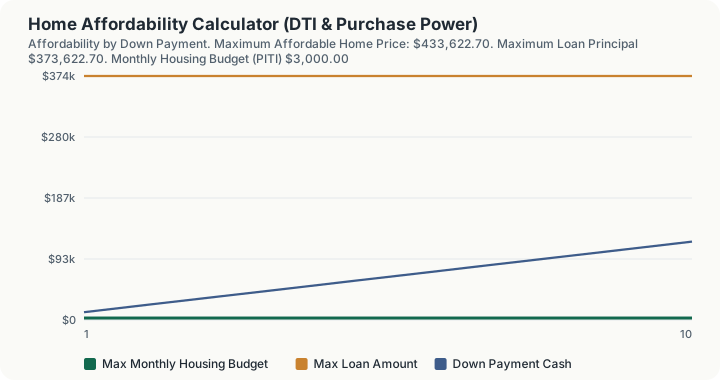
Using this calculator's baseline inputs: $120,000 gross annual income, $600 in existing monthly debt, a $60,000 cash down payment, a 6.75% interest rate, a 1.25% property tax rate, and $1,500 in annual homeowners insurance.
- Gross monthly income: $120,000 ÷ 12 = $10,000
- Maximum total monthly housing budget: ($10,000 × 0.36) − $600 = $3,600 − $600 = $3,000
- Monthly periodic rate: 6.75% ÷ 12 = 0.5625% = 0.005625, giving a payment factor $f$ of about $0.0064861 of monthly P&I per $1 of loan over 360 payments
- Monthly property tax rate: 1.25% ÷ 12 = 0.1041667% = 0.001041667 of home price per month
- Budget left after the fixed costs: $3,000 − ($60,000 × 0.001041667) − ($1,500 ÷ 12) = $3,000 − $62.50 − $125 = $2,812.50
- Maximum loan amount: $2,812.50 ÷ (0.0064861 + 0.001041667) = $373,622.70
- Maximum affordable home price: $373,622.70 + $60,000 down payment = $433,622.70
The resulting monthly breakdown sums back to the budget exactly: $2,423.31 in principal and interest, $451.69 in property tax on the full $433,622.70 price, and $125 in insurance, totalling $3,000.
A second data point from the calculator's own verified test suite confirms the direction of the model: dropping monthly debt to $0 while raising income to $150,000 and a $100,000 down payment (at a slightly lower 6.5% rate) pushes the maximum affordable home price above $500,000, since eliminating the $600 monthly debt obligation alone frees up $600 more per month for housing, which compounds into tens of thousands of dollars of additional borrowing capacity over a 30-year term.
What This Does Not Account For
- Private mortgage insurance (PMI). If your down payment is below 20% of the purchase price, PMI adds a real monthly cost that is not modeled here and would reduce your true affordable price.
- HOA dues. Condominiums and many planned communities carry monthly association fees that lenders count against your DTI ratio but this calculator does not include.
- Actual lender-specific DTI limits. Some loan programs allow back-end DTI ratios well above 36%, including certain FHA and VA products, while others are stricter; your true qualifying ceiling depends on the specific loan program and lender overlays.
- Credit score-driven rate variation. The interest rate you actually qualify for depends on your credit profile, loan-to-value ratio, and loan type, and can differ meaningfully from the rate you enter here.
- Closing costs and cash reserves required at closing. This calculator assumes your entire stated down payment goes toward the purchase price; it does not reserve funds for closing costs, moving expenses, or post-closing cash reserves lenders often require.
Common Pitfalls
- Confusing "approved for" with "comfortable paying." The maximum a lender will approve is calculated purely from ratios; it says nothing about your other financial goals, emergency fund needs, or lifestyle spending.
- Forgetting that property taxes vary enormously by location. This calculator uses a general estimate for the tax-and-insurance carve-out; a property in a high-tax jurisdiction can have a materially smaller principal-and-interest budget than the same purchase price implies elsewhere.
- Ignoring existing debt that will be paid off soon. If a car loan is 3 months from payoff, some lenders will exclude it from DTI calculations, which can meaningfully change your qualifying picture in ways this static calculator cannot capture.
- Using a teaser or promotional rate instead of your expected locked rate. Affordability calculations are highly sensitive to the interest rate assumption; a 1% rate difference can move your maximum loan amount by tens of thousands of dollars.
- Overlooking that a bigger down payment does double duty. Additional cash reduces the loan amount needed and, above the 20% threshold, eliminates PMI, both of which increase true affordability beyond what a simple dollar-for-dollar addition suggests.
Frequently Asked Questions
What is the 28/36 rule?
How does the calculator handle property taxes and insurance?
Can I qualify for a higher DTI than 36%?
Does a larger down payment always increase my maximum home price dollar for dollar?
How sensitive is affordability to interest rates?
Should I borrow the maximum amount this calculator shows?
Sources
- Consumer Financial Protection Bureau, "Buying a House" consumer guide and DTI explainer, consumerfinance.gov/consumer-tools/buy-a-home
- Fannie Mae Selling Guide, Debt-to-Income Ratio Requirements, selling-guide.fanniemae.com
- U.S. Department of Housing and Urban Development, FHA mortgage program guidelines, hud.gov
- U.S. Department of Veterans Affairs, VA Home Loan program requirements, va.gov/housing-assistance/home-loans