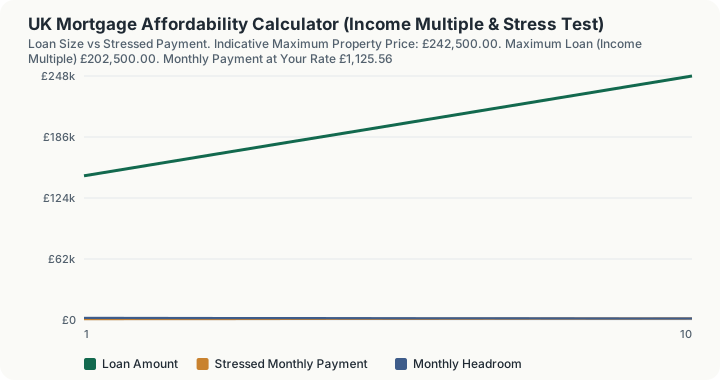
Quick Answer: On a £45,000 income with a £40,000 deposit, a 4.5 times income multiple supports a £202,500 loan and an indicative property price of £242,500.00. The monthly payment at 4.5% over 25 years is £1,125.56, rising to £1,243.53 if stress-tested at 5.5%. Against £2,993.30 of monthly take-home pay, that leaves £1,749.77 of headroom.
What does this calculator do?
UK mortgage lending is constrained by two separate tests, and applications usually fail on the second.
The first is the income multiple, capped for most lenders at around 4.5 times income. This is the number people know, and it sets the ceiling.
The second is the affordability stress test. Lenders must check you could still pay if rates rose, and they do this at a rate above the one you are offered. This is where borrowing capacity is genuinely decided, particularly for applicants with existing credit commitments.
An important caveat about the stress rate. There is no statutory figure. FCA rules require lenders to stress-test affordability, but each firm sets its own rate and they vary widely. The uplift here is an input you should set to match your lender, not an official number, and this calculator does not claim otherwise.
How is this calculated?
Step 1: Maximum loan from the income multiple:
Max loan = income × multiple
Step 2: Indicative property price is that loan plus your deposit.
Step 3: Monthly payment on a repayment basis, using the standard annuity formula at your product rate:
PMT = (P × i)/(1 − (1 + i)⁻ⁿ)
where i is the monthly rate and n the number of months.
Step 4: The stressed payment is the same calculation at your rate plus the uplift you set.
Step 5: Headroom. Your take-home pay is computed from Income Tax and Class 1 National Insurance on the income entered, then the stressed payment and any monthly commitments are deducted. What remains is the disposable income a lender would assess.
Worked Example
£45,000 income, £40,000 deposit, 4.5x, 4.5% over 25 years:
- Maximum loan: £45,000 × 4.5 = £202,500
- Indicative price: £202,500 + £40,000 = £242,500
- Monthly payment at 4.5%: £1,125.56
- Stressed at 5.5%: £1,243.53
- Take-home pay: £2,993.30 a month, after £6,486 of Income Tax and £2,594.40 of NI
- Headroom after the stressed payment: £1,749.77
- Loan to value 83.5%; the stressed payment is 41.5% of take-home pay
With a harsher +3 point stress test: the stressed payment rises to £1,496.46. The loan is unchanged, but many lenders would decline at this level of assessed payment relative to income.
Over a 35-year term: the stressed payment falls to £1,087.46. Extending the term is the most common way an application that fails affordability is made to pass, at the cost of substantially more total interest.
With £400 of monthly commitments: headroom falls to £1,349.77, and lenders would reduce the loan offered accordingly.
What does this calculator not account for?
- The lender's own affordability model. Every firm uses its own income multiples, stress rates, and expenditure assumptions drawn from ONS data. This is an indication, not a decision in principle.
- The stress rate itself, which is an assumption. FCA MCOB requires a stress test but sets no rate. Firms typically stress at the reversion rate plus a margin, or a floor of around 6% to 8%, and the figure here is whatever you enter.
- Loan-to-value limits. Most lenders cap at 95% LTV, and rates worsen sharply above 85%. This does not check whether your deposit is sufficient for the price produced.
- Credit history, which can prevent an offer regardless of affordability.
- Stamp duty, legal fees, survey and moving costs, none of which come out of the deposit figure here but all of which need cash.
- Interest-only mortgages, which are assessed differently and require a credible repayment vehicle.
- Self-employed income, usually assessed on two or three years of accounts and often averaged.
- Joint applications where incomes differ, and how lenders weight a second income.
- Help to Buy, shared ownership and other schemes.
What mistakes do people make with this?
- Treating the income multiple as the answer. It is the ceiling, not the outcome. The stress test and your existing commitments usually bind first.
- Assuming a single official stress rate exists. It does not. Lenders set their own, and the difference between a one point and a three point uplift is over £250 a month on this example.
- Forgetting the deposit is not all available for the deposit. Stamp duty, legal fees and a survey all come out of the same cash, and on a second property the surcharge alone can be tens of thousands.
- Extending the term without counting the cost. Moving from 25 to 35 years cuts the monthly payment meaningfully but adds ten more years of interest.
- Ignoring monthly commitments. A car finance agreement or a credit card balance directly reduces the assessed headroom, often by more than borrowers expect.
- Using gross income to judge affordability. Lenders assess net disposable income, which is why the take-home figure matters more than the salary.
Frequently Asked Questions
How much can I borrow on my salary?
What is the mortgage stress test?
Why do different lenders offer me different amounts?
Does a longer term let me borrow more?
Do my credit commitments really matter that much?
Is this an agreement in principle?
Sources
- HM Revenue and Customs (HMRC), the official authority for the national tax authority this calculator relates to. gov.uk/government/organisations/hm-revenue-customs
Also consulted: FCA Handbook MCOB 11.6, the requirement to assess affordability against a plausible increase in interest rates. The Handbook mandates the test but prescribes no single stress rate, which is why it is an input here; GOV.UK: "Income Tax rates and Personal Allowances", used to compute take-home pay; GOV.UK: "National Insurance rates and categories", Class 1 employee rates of 8% and 2%; Tax and National Insurance figures verified on 30 August 2026 and mirrored in engine/tables/2026/uk-2026-27.json.