Quick Answer: A $1,500,000 commercial loan at 7.25%, amortized over 25 years but due in 7 years, costs $10,842.10 a month, produces a 1.38x Debt Service Coverage Ratio against $180,000 of annual NOI, and leaves a $1,306,006.80 balloon payment due at maturity.
Overview
Commercial real estate loans behave differently from a residential mortgage in two important ways. First, they almost always come with a mismatch between the amortization period and the actual loan term. A lender might calculate your monthly payment as if the loan paid off over 25 or 30 years, but the loan itself matures in 5 to 10 years, at which point whatever balance is left comes due in one balloon payment. Borrowers then refinance, sell, or negotiate an extension.
Second, commercial lenders underwrite the loan around the property's income, not the borrower's personal income the way a residential mortgage does. The key metric is the Debt Service Coverage Ratio, or DSCR: the property's annual Net Operating Income (NOI) divided by the annual debt service (principal and interest payments). A DSCR of 1.00x means the property's income exactly covers the loan payment with nothing left over. Most commercial lenders want to see meaningfully more cushion than that, commonly requiring 1.20x to 1.35x depending on property type, market, and loan program.
This structure exists because commercial properties, unlike owner-occupied homes, are underwritten as income-producing assets. The lender cares less about your W-2 and more about whether the tenants' rent checks reliably cover the mortgage with room to spare for vacancy, maintenance, and market swings.
How This Is Calculated
- Monthly payment. The payment is computed using the full amortization period you select (commonly 25 years), even though the loan itself is due sooner. This is the standard mortgage-style payment formula applied to the amortization period, not the shorter loan term.
- Annual debt service. The monthly payment is multiplied by 12 to get the total yearly principal and interest obligation.
- DSCR. Net Operating Income is divided by annual debt service. A ratio above 1.00x means the property covers its own debt payment; below 1.00x means it doesn't, and the owner would need to cover the shortfall from other sources.
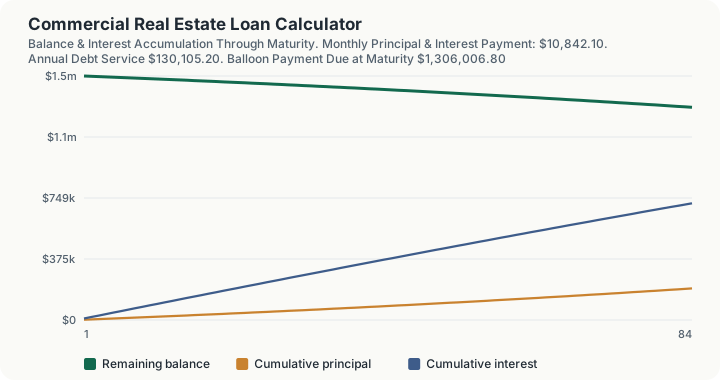
- Balloon payment. The amortization schedule runs out to the full amortization period, but only the months up through your selected loan term are shown. The remaining balance at that final displayed month is the balloon payment due at maturity, since the loan hasn't fully amortized within that shorter window.
Worked Example
A $1,500,000 loan at 7.25% APR, amortized over 25 years, due in 7 years, secured by a property producing $180,000 in annual NOI:
- Monthly rate: 7.25% ÷ 12 = 0.6041667%
- Monthly payment (25-year amortization, 300 months): $10,842.10
- Annual debt service: $10,842.10 × 12 = $130,105.20
- DSCR: $180,000 ÷ $130,105.20 = 1.38x, which clears a typical 1.25x underwriting minimum
- Balance remaining after 84 months (7 years): $1,306,006.80, the balloon due at maturity
- Cumulative interest paid over those 7 years: $716,743.13
Now suppose the property underperforms and NOI drops 20% to $144,000. Debt service doesn't change, so DSCR falls to $144,000 ÷ $130,105.20 = 1.11x, below the 1.25x minimum most lenders would require to approve or refinance the loan at maturity. This is exactly the scenario CRE lenders stress-test for: a loan that qualified comfortably at origination can fail to qualify for refinancing years later if the property's income softens.
What This Does Not Account For
- Origination fees, appraisal, and legal costs. Commercial closings carry meaningfully higher transaction costs than residential ones, often 1% to 3% of the loan amount plus third-party report fees.
- Recourse vs. non-recourse structuring. Whether the loan is personally guaranteed changes the lender's pricing and underwriting posture in ways this calculator doesn't reflect.
- Interest rate resets or floating-rate structures. Many CRE loans reprice at a spread over an index like SOFR; this calculator assumes a fixed rate for the displayed period.
- Reserve and escrow requirements. Lenders frequently require tax, insurance, and capital expenditure reserves that add to the borrower's effective monthly outlay beyond principal and interest.
- Refinance risk at balloon maturity. This calculator tells you the balance due; it doesn't model whether market conditions, interest rates, or the property's performance will support a successful refinance when that date arrives.
Common Pitfalls
- Confusing the amortization period with the loan term. The payment is based on a long amortization schedule, but the loan is due much sooner. Borrowers sometimes assume the loan simply continues at that payment for the full 25 or 30 years; it doesn't.
- Ignoring balloon risk. A large balloon payment coming due in a rising-rate environment, or when the property's income has softened, can force a distressed sale or a costly refinance. Plan the exit well before maturity.
- Underestimating how DSCR moves with small NOI changes. Because DSCR is a ratio, a modest drop in rental income or a modest rise in operating expenses can push a comfortably qualifying property below a lender's minimum.
- Treating DSCR as the only underwriting factor. Lenders also look at Loan-to-Value ratio, property type, tenant quality and lease terms, and the borrower's net worth and liquidity.
Frequently Asked Questions
Why is the amortization period longer than the loan term?
What DSCR do I need to qualify for a commercial loan?
What happens if I can't refinance the balloon payment when it's due?
Does a higher DSCR always mean a better loan?
Can I use this calculator for an SBA 504 or 7(a) commercial loan?
Sources
- Board of Governors of the Federal Reserve System: commercial real estate lending standards and underwriting practice guidance. federalreserve.gov
- U.S. Small Business Administration (SBA): 504 and 7(a) commercial loan program structures, referenced for contrast with conventional balloon-structured CRE debt. sba.gov
- Internal Revenue Service, the official authority for the tax rules this calculator relates to. irs.gov
Also consulted: Mortgage Bankers Association (MBA): commercial/multifamily mortgage debt outstanding and underwriting benchmark reporting.