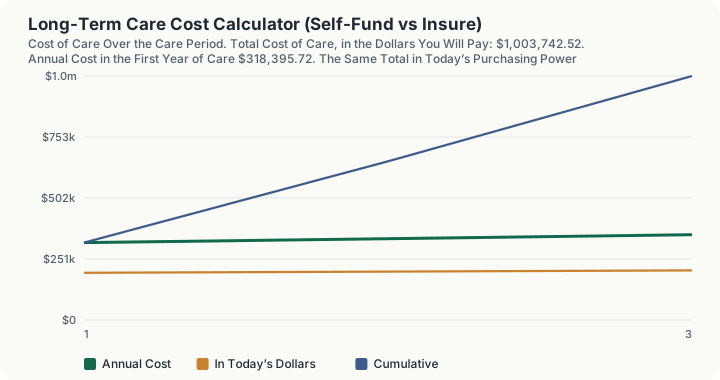
Quick Answer: Three years of care beginning in 20 years, costing $120,000 a year at present prices and inflating at 5%, comes to $1,003,742.52 in the dollars you will actually pay, or $597,256.20 in present purchasing power. Nearly $399,000 of the nominal total exists purely because care inflation outruns general inflation.
Read this before the insurance comparison. Both the insure path and the self-fund path are priced assuming the care is actually needed, for the full duration entered. This is not weighted by the probability of ever claiming. That structurally flatters the policy: a contract that pays out whenever benefits exceed premiums will always look advantageous under a certain claim. Every price, inflation rate and premium on this page is a figure you supplied, with no statutory or published authority behind it.
What does this calculator do?
Nothing on this page is set by law. Care prices, care-cost inflation and long-term care insurance premiums are market figures that vary enormously by facility, by state and by underwriting, so every one of them is an input you control rather than a table lookup. The defaults are placeholders. Replace them with quotes for your own area before relying on any output.
What makes long-term care different from every other retirement expense is that its price index runs above general inflation, and has done persistently. A plan built on a single blended inflation rate understates the bill, and understates it by more the further away the care is, because the two rates compound apart. This calculator therefore carries two rates separately: one compounds the price of care, and the other is used only to restate future dollars in today's purchasing power. Set them equal and the model collapses to an ordinary inflation projection, which is a useful way to see exactly what the excess is worth.
The second half of the page compares paying the bill from assets against buying a policy. Read that comparison with the assumption above firmly in mind. It answers the question "if I definitely need three years of care, which path costs less?" It does not answer "should I buy this policy?", because that question requires a probability of claiming that this model does not carry.
How is this calculated?
Care costs compound from today at the care inflation rate, and are restated at the general rate:
cost (t) = Cost Today × (1 + i_care)ᵗ; today’s dollars = (cost (t))/((1 + i_gen)ᵗ)
where t counts years from today, so the first year of care is at t = 20. A duration that is not a whole number of years bills the final year in proportion: 2.5 years of care is two full years plus half of the third year's price, and the policy's benefit cap for that final year is halved the same way.
Step 1: Compound the cost of care to the year care begins. $120,000 x 1.05^20 = $318,395.72 in the first year of care
Step 2: Compound the second year. $318,395.72 x 1.05 = $334,315.51
Step 3: Compound the third year. $334,315.51 x 1.05 = $351,031.29
Step 4: Sum the three. This is the headline. $318,395.72 + $334,315.51 + $351,031.29 = $1,003,742.52
Step 5: Restate each year at general inflation and sum. Each year's cost is divided by 1.025 raised to the same t. $597,256.20 in today's purchasing power
Step 6: Re-run the same three years as if care inflated at the general rate only. $604,772.36
Step 7: Difference the two nominal totals to isolate the excess. $1,003,742.52 - $604,772.36 = $398,970.16 created purely by the inflation gap
The insurance comparison then prices both paths in nominal dollars.
Step 8: Total the premiums paid. $4,200 x 20 years = $84,000
Step 9: Charge the elimination period to you, at the first year's price. 90 / 365 = 0.246575 of a year 0.246575 x $318,395.72 = $78,508.53 out of pocket before any benefit
Step 10: Cap the first year's benefit at the inflated policy benefit and at the actual cost, then deduct the elimination period. Benefit cap: $75,000 x 1.03^20 = $135,458.34 min($135,458.34, $318,395.72) - $78,508.53 = $56,949.81 paid in year one
Step 11: Cap the second year. min($75,000 x 1.03^21, $334,315.51) = $139,522.09
Step 12: Cap the third year. min($75,000 x 1.03^22, $351,031.29) = $143,707.76
Step 13: Total the benefits. $56,949.81 + $139,522.09 + $143,707.76 = $340,179.66
Step 14: Find the care cost the policy never reaches. $1,003,742.52 - $340,179.66 = $663,562.86
Step 15: Net cost if you insure: premiums plus everything the policy does not pay. $84,000 + $663,562.86 = $747,562.86
Step 16: Net cost if you self-fund: the whole bill. $1,003,742.52
Step 17: The advantage of insuring, under the certainty assumption. $1,003,742.52 - $747,562.86 = $256,179.66
Step 18: Benefits paid per dollar of premium. $340,179.66 / $84,000 = $4.05
Step 19: The premium at which the two paths tie. $340,179.66 / 20 years = $17,008.98 a year
Worked Example
A 65-year-old is planning for assisted living costing $120,000 a year today, which she expects might be needed around age 85 for about three years. She has a policy quote at $4,200 a year with a $75,000 annual benefit, a 3% inflation rider, a three-year benefit period and a 90-day elimination period.
Step 1: What the care will cost her. $318,395.72 in the first year, rising to $351,031.29 in the third, for $1,003,742.52 in total.
Step 2: What that means in money she understands. $597,256.20 in today's purchasing power.
Step 3: How much of the bill is the inflation gap. Had care inflated at 2.5% like everything else, the same three years would cost $604,772.36. The 5% assumption adds $398,970.16.
Step 4: What the policy pays. $340,179.66, after the elimination period takes $78,508.53 out of year one and the annual cap stops the benefit well short of the actual cost every single year.
Step 5: What she still pays despite being insured. $663,562.86 of uncovered care, plus $84,000 of premiums, for $747,562.86.
Step 6: The comparison. Insuring costs $256,179.66 less than self-funding, and the policy returns $4.05 of benefit for every dollar of premium: if the claim happens. That conditional is doing all the work in this comparison, and it is not a small one. A policy she pays for and never claims on returns nothing at all.
Step 7: The break-even. She could pay up to $17,008.98 a year in premiums before the two paths tie, again assuming the claim occurs.
Two variations are worth running. Setting care inflation equal to general inflation removes the excess entirely and shows what that single assumption was worth. Extending the stay to five years is more instructive still: the care keeps running but the three-year benefit period stops paying, so the policy's share of a longer bill falls sharply just when it is most needed.
Carrying The Care Bill Across The Three Years
Step 8: Care year one. $318,395.72, which is $194,307.66 in today's purchasing power. Cumulative: $318,395.72.
Step 9: Care year two. $334,315.51 nominal, $199,046.87 in today's money. Cumulative: $652,711.23.
Step 10: Care year three. $351,031.29 nominal, $203,901.67 in today's money. Cumulative: $1,003,742.52.
Step 11: What the policy has covered by then. $1,003,742.52 - $340,179.66 of benefits = $663,562.86 still paid from her own assets
The nominal figures nearly double across twenty years of deferral and then rise another 10.3% across the three years of care itself, while the today's-dollars column barely moves from $194,308 to $203,902. Both columns are true. The first is what the invoice says and the second is what it costs her, and a plan built on only one of them will be wrong in a predictable direction.
What does this calculator not account for?
- The probability of ever claiming. This is the largest omission on the page and it is deliberate: both paths assume the care is needed for the full duration entered. A genuine expected-value comparison would multiply the insurance benefit by the chance of claiming, and would look considerably less favourable to the policy.
- Present value. Premiums and benefits are compared in nominal, undiscounted dollars. Premiums are paid decades before benefits are received, and no time value is applied to either.
- Premium increases. Long-term care premiums are not guaranteed level. Insurers have repeatedly obtained large rate increases on in-force blocks. The calculator holds your quoted premium constant for the whole period.
- Policy triggers and exclusions. Benefits typically require certification of inability to perform activities of daily living, or cognitive impairment. Nothing here tests whether a claim would be approved.
- Medicaid, Medicare, and veterans' benefits. Medicare pays for limited skilled nursing after a qualifying hospital stay and not for custodial care. Medicaid pays only after assets are spent down. Neither is modelled.
- The tax treatment of qualified long-term care premiums and benefits, and of hybrid life or annuity contracts with care riders.
- Informal care. Most long-term care in practice is provided unpaid by family. The financial model assumes every hour is purchased.
What mistakes do people make with this?
- Reading the insurance advantage as advice. It is a conditional figure. It says what happens if you claim, not whether you should buy.
- Using one inflation rate for everything. Care inflation is the input that dominates the total on a long horizon. At the defaults it accounts for roughly 40% of the nominal bill.
- Underestimating duration. Duration is the single largest source of uncertainty in the total and it moves the answer more than any price assumption. Test it in both directions.
- Assuming the policy covers the cost of care. Most policies pay well under it. At the defaults the benefit cap is $135,458.34 against a $318,395.72 bill in the first year of care.
- Buying without an inflation rider. Without a rider the benefit is fixed in nominal dollars for decades while the cost of care is not, and the gap widens every year. Set the rider to zero in the calculator to see the effect.
- Forgetting the elimination period. Ninety days of care at the price prevailing when care begins is a real out-of-pocket cost. Here it is $78,508.53, most of a year's premium payments for twenty years.
- Treating the defaults as data. They are placeholders. Get local quotes for the care setting you actually have in mind.
Frequently Asked Questions
How much does long-term care cost?
Why does this calculator use two different inflation rates?
Is long-term care insurance worth it?
Does Medicare pay for long-term care?
What does the elimination period actually cost me?
Why does the policy pay so much less than the cost of care?
Sources
- U.S. Bureau of Labor Statistics, Consumer Expenditure Surveys. bls.gov/cex
Also consulted: No statutory or published data source underlies this page. Care prices, care-cost inflation, general inflation, policy premiums, benefit amounts, riders, benefit periods and elimination periods are all user inputs with no authority behind their defaults, as documented in engine/primitives/long-term-care.ts; The insure-versus-self-fund comparison assumes the claim occurs with certainty and is not probability-weighted. This limitation is stated in the primitive's header and is surfaced on the calculator itself as the "What This Comparison Assumes" output; For the cost of care in your own area, obtain direct quotes from local providers and from the insurer whose policy you are considering.