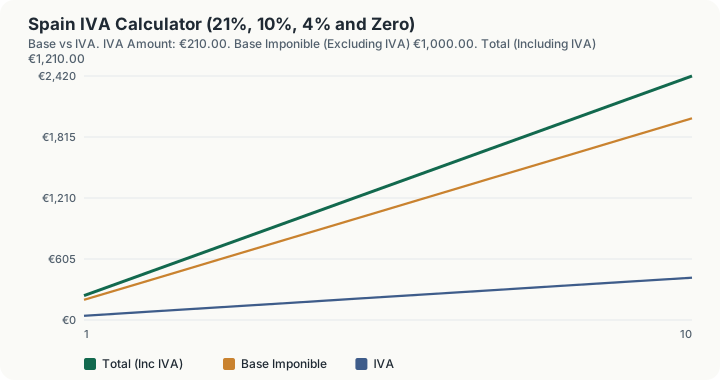
Quick Answer: Adding the general 21% rate to a €1,000 net price adds €210.00, giving €1,210 total. Removing IVA from a €1,000 gross price gives €173.55, not €210, because the tax is 21/121 of the gross. Spain also has a 4% super-reduced rate on staples such as bread, milk, eggs, fruit, books and medicines: one of the lowest in the EU.
What does this calculator do?
Spanish IVA has four rates. The general 21% covers most goods and services. The reduced 10% covers food generally, housing, hospitality, passenger transport and glasses. The super-reduced 4% covers staples: bread, milk, eggs, fruit, vegetables, cereals, cheese, books, newspapers and medicines. A 0% rate applies to certain operations.
One temporary measure is in force: electricity, natural gas, biomass briquettes and pellets, firewood and fuels are charged at 10% rather than 21% until 30 June 2026.
How is this calculated?
Adding IVA:
IVA = Base × rate; Total = Base × (1 + rate)
Removing IVA uses the VAT fraction, because the tax is a share of the gross:
IVA = Total × rate/(1 + rate)
At 21% that is 21/121, at 10% it is 10/110, and at 4% it is 4/104.
Worked Example
Adding the general rate to a quoted net price
An autónomo quotes €1,000 for a piece of work and has to issue the factura.
Step 1: The rate. Tipo general, so r = 21%
Step 2: The IVA repercutido. €1,000 x 21% = €210.00
Step 3: The invoice total. €1,000.00 + €210.00 = €1,210.00
Working backwards from a gross price
Now the reverse: a €1,000 receipt that already includes IVA, and the base imponible has to be extracted for the Modelo 303.
Step 4: The VAT fraction at 21%. 21 / 121 = 17.36% of gross
Step 5: Extract the IVA. €1,000 x (21 / 121) = €173.55
Step 6: The base imponible. €1,000.00 - €173.55 = €826.45
Step 7: The error the shortcut produces. €1,000 x 21% = €210.00, which overstates the IVA by €210.00 - €173.55 = €36.45
Step 7 is the single most common mistake on a Spanish return. Twenty-one percent of the gross is not the tax, because the tax is not charged on the gross. The check is that step 5 and step 2 must round-trip: €826.45 x 21% comes back to €173.55, whereas €790.00 x 21% would give €165.90, not the €210.00 the shortcut assumed.
The other three rates on the same €1,000
Step 8: Reduced rate, adding. €1,000 x 10% = €100.00, total €1,100.00
Step 9: Reduced rate, removing. €1,000 x (10 / 110) = €90.91, base €909.09
Step 10: Super-reduced rate, adding. €1,000 x 4% = €40.00, total €1,040.00
Step 11: Super-reduced rate, removing. €1,000 x (4 / 104) = €38.46, base €961.54
Notice how the gap between the add and remove figures narrows as the rate falls: €36.45 at 21%, €9.09 at 10%, €1.54 at 4%. The fraction and the percentage converge as the rate approaches zero, which is why the shortcut error goes unnoticed on low-rate items and becomes material on general-rate invoices. The zero rate makes both identical at €0.00.
Scaling the same rate
The computed table steps the amount in fifths. Two rows, at the general rate on a net price:
Step 12: A €200 net line. IVA €42.00, total €242.00
Step 13: A €400 net line. IVA €84.00, total €484.00
IVA is strictly proportional: there are no bands, thresholds or allowances inside the rate itself. Everything that makes a Spanish IVA return complicated happens in deciding which of the four rates applies to a given supply, not in the arithmetic once that is settled.
The Marginal Euro, and Where Cent Rounding Shows
Sweeping the amount from €900 to €1,300 in €100 steps at the general rate, in the adding direction, returns €189.00, €210.00, €231.00, €252.00 and €273.00. Every step is €21.00, exactly as a flat 21% on a net base must be.
The same sweep in the removing direction returns €156.20, €173.55, €190.91, €208.26 and €225.62, and the steps are €17.35, €17.36, €17.35, €17.36. They alternate. The engine rounds each result to the cent, and 21/121 of €100 is €17.3553, which lands either side of half a cent depending on where the previous row fell. That alternation is a property of this implementation's cent rounding, not of Spanish law, and it is the only place on this page where the arithmetic is not perfectly proportional.
The gap between the two directions is the whole point of the page, and it widens with the invoice. On a €10,000 net quote the general rate adds €2,100.00 for a €12,100.00 total. On a €10,000 gross receipt it extracts €1,735.54, leaving a base imponible of €8,264.46. The shortcut of deducting 21% from that same gross would claim €2,100.00 of input IVA against the €1,735.54 actually embedded in it, an overstatement of €364.46 on one document. At €1,000 that same error was €36.45; it scales linearly with the amount.
The reduced rate gives the cleanest confirmation that the fraction is right rather than approximately right. A €1,100 gross receipt at 10% removes exactly €100.00 of IVA and leaves a base of exactly €1,000.00, which is where the adding direction put it: €1,000 net at 10% produces €100.00 and a €1,100.00 total. The loop closes to the cent with no residue.
Two limitations bear on all of the above. The rate is chosen from the four options in the input, not derived from what is being supplied, so the engine cannot tell you that a given item belongs at 10% rather than 21% and will apply whichever rate is selected. And the computed table's fourth series reports zero on every row, because a base-and-IVA split has no running balance to carry: the chart's "Balance" series is structurally empty on this calculator rather than showing something meaningful.
What does this calculator not account for?
- Which rate applies to which supply. Classification is the difficult part; the Agencia Tributaria publishes the definitive lists.
- IGIC and IPSI, the separate indirect taxes applying in the Canary Islands, Ceuta and Melilla instead of IVA.
- Recargo de equivalencia, the surcharge applying to retailers in that special regime.
- Exempt operations such as healthcare, education and certain financial services, which differ from zero-rated in that input IVA cannot be recovered.
- The reverse charge (inversión del sujeto pasivo) in construction and certain cross-border supplies.
- The One Stop Shop and the EU distance selling threshold.
- Modelo 303 and 390 filing mechanics, and the SII real-time reporting regime.
- Whether the temporary energy rate has been extended beyond 30 June 2026.
What mistakes do people make with this?
- Deducting 21% from a gross price. €1,000 minus 21% is €790, wrong by €36.45. The correct base is €826.45.
- Assuming all food is 4%. Only specified staples get the super-reduced rate; food generally sits at 10%.
- Applying peninsular IVA in the Canaries. The Canary Islands use IGIC at different rates entirely, and Ceuta and Melilla use IPSI.
- Using 21% on energy bills before July 2026. The temporary 10% rate applies until 30 June 2026.
- Confusing exempt with zero-rated. Only the latter preserves the right to reclaim input IVA.
- Forgetting the recargo de equivalencia. Retailers in that regime pay an additional surcharge on top of the IVA charged by their suppliers.
Frequently Asked Questions
Why is removing 21% not the same as adding it?
What qualifies for the 4% rate?
Is energy still at 10%?
Does IVA apply in the Canary Islands?
What is the recargo de equivalencia?
Can I reclaim IVA on exempt sales?
Sources
- Agencia Tributaria: "Tipos impositivos de IVA" and the Tipos IVA 2026 schedule, 21% general (art. 90.Uno, Ley 37/1992), 10% reduced, 4% super-reduced. sede.agenciatributaria.gob.es/Sede/iva/calculo-iva-repercutido-clientes/tipos-impositivos-iva.html
All figures verified on 30 August 2026
Also consulted: Agencia Tributaria: temporary reduction of energy supplies from 21% to 10% until 30 June 2026.