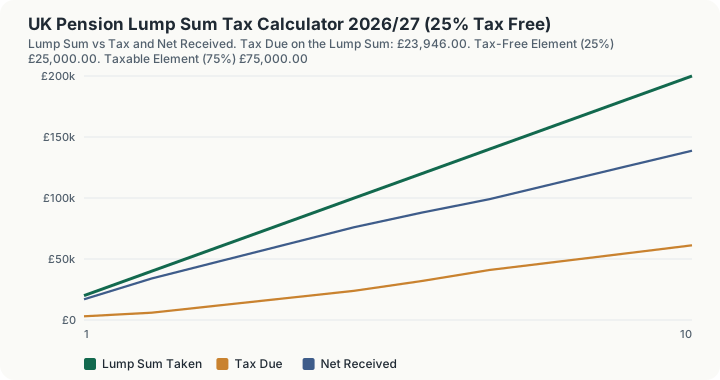
Quick Answer: Taking £100,000 from a pension alongside £20,000 of other income costs £23,946.00 in tax. £25,000 is tax free and £75,000 is taxed as income, most of it at 40% because the withdrawal stacks on top of your existing income. You would receive £76,054, but HMRC will probably withhold around £32,600 on an emergency code first, leaving roughly £8,654 to reclaim.
What does this calculator do?
Since the 2015 pension freedoms, you can take money out of a defined contribution pension from age 55, rising to 57 in April 2028. Each withdrawal is normally 25% tax free and 75% taxed as income.
Two things determine the bill, and neither is obvious.
The first is that the taxable 75% stacks on top of your other income. A £100,000 withdrawal does not get its own set of tax bands. It sits on your salary or pension, so most of it can land in the 40% band even if your ordinary income is modest.
The second is emergency tax. HMRC normally applies a month-1 emergency code to a first withdrawal, taxing it as though you were going to take the same amount every month for a year. The over-withholding is often substantial, and reclaiming it requires a form.
How is this calculated?
Step 1: Split the withdrawal. 25% is tax free, capped by whatever remains of the Lump Sum Allowance of £268,275:
Tax free = min(0.25 × lump sum, 268,275 − already used)
Step 2: The remainder is taxable income. It is added to your other income for the year and taxed at the bands for your region, so 20%, 40% and 45% in England, Wales and Northern Ireland, or the six Scottish bands.
Step 3: The tax attributable to the lump sum is the difference between your total tax with the withdrawal and the tax you would have paid without it.
Step 4: Emergency tax. The calculator also shows what a month-1 emergency code would withhold, computed by taxing twelve times the taxable element and dividing by twelve. The difference between that and the tax actually due is what you would need to reclaim.
Worked Example
£100,000 withdrawal, £20,000 other income:
- Tax free: £25,000. Taxable: £75,000
- Total income becomes £95,000; taxable income £82,430 after the allowance
- £37,700 × 20% = £7,540, plus £44,730 × 40% = £17,892 → £25,432
- Tax on the £20,000 alone would have been £1,486
- Tax on the lump sum: £23,946, an effective rate of 23.95% on the whole £100,000
- Net received: £76,054
The same withdrawal with no other income:
- The full Personal Allowance is available against the taxable element
- Tax: £17,432, £6,514 less for taking it in a year with no other income
A £25,000 withdrawal instead:
- Taxable element £18,750, which mostly stays inside the basic rate band
- Tax: £3,750, an effective rate of 15% rather than 23.95%
Spreading withdrawals across tax years is the single most effective way to reduce the total tax paid.
What does this calculator not account for?
- Defined benefit pensions, where the tax-free lump sum is calculated by scheme rules and commutation factors rather than as 25% of a pot.
- The Money Purchase Annual Allowance. Taking taxable income from a pension normally reduces your future annual allowance to £10,000, which can be costly if you are still working.
- Protected tax-free cash, where an individual holds a right to more than 25% under transitional protections.
- The Lump Sum and Death Benefit Allowance of £1,073,100, which applies to serious ill-health and death benefit lump sums.
- Scheme charges and exit penalties.
- The State Pension, which is taxable and should be included in other income if you are receiving it.
- Whether taking the money is a good idea. Withdrawn funds leave a tax-advantaged wrapper and become part of your estate.
- Age eligibility. Access is from 55, rising to 57 from 6 April 2028.
What mistakes do people make with this?
- Assuming the withdrawal has its own tax bands. It does not. The taxable 75% stacks on your other income, which is why a large withdrawal is mostly taxed at 40% even on a modest salary.
- Being surprised by emergency tax. A first withdrawal is normally taxed on a month-1 code as though repeated monthly. On £100,000 that withholds roughly £32,600 against £23,946 actually due.
- Not reclaiming the overpayment. It is recovered with form P55, P53Z or P50Z depending on circumstances. If you do nothing, HMRC corrects it after the tax year ends, which can mean waiting months.
- Taking it all in one year. Splitting a withdrawal across two tax years uses two sets of bands and can save thousands.
- Triggering the Money Purchase Annual Allowance unnecessarily. Taking only tax-free cash does not trigger it; taking taxable income does, cutting future contributions to £10,000 a year.
- Forgetting the Lump Sum Allowance. The 25% is capped at £268,275 across your lifetime, so very large pots do not get 25% of everything tax free.
Frequently Asked Questions
Is 25% of my pension always tax free?
Why is so much of my withdrawal taxed at 40%?
What is emergency tax on a pension withdrawal?
How do I get the overpaid tax back?
Should I take it in stages?
Does taking a lump sum affect what I can pay in?
Sources
- HM Revenue and Customs (HMRC), the official authority for the national tax authority this calculator relates to. gov.uk/government/organisations/hm-revenue-customs
All figures verified on 30 August 2026 and mirrored in engine/tables/2026/uk-2026-27.json
Also consulted: HMRC Pensions Tax Manual PTM171000, Lump Sum Allowance of £268,275; HMRC Pensions Tax Manual PTM172000, Lump Sum and Death Benefit Allowance of £1,073,100; GOV.UK: "Tax when you get a pension", the 25% tax-free element and taxation of the balance as income; GOV.UK: "Claim back tax on a flexibly accessed pension overpayment", forms P55, P53Z and P50Z.