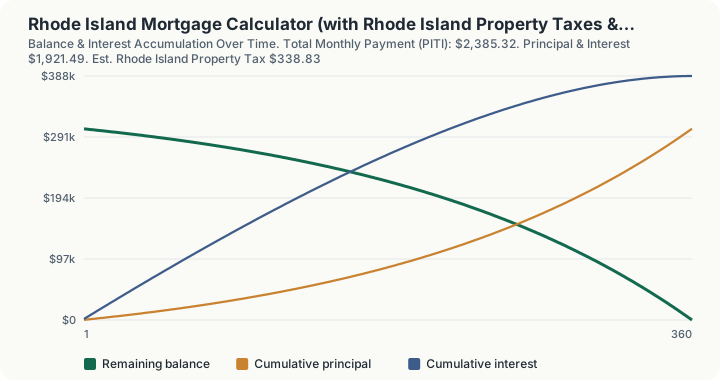
Quick Answer: A $380,000 Rhode Island home bought with 20% down at a 6.5% rate runs about $2,385.32 a month, with roughly $338.83 of that going toward Rhode Island's above-average property tax bill.
Overview
Rhode Island is the smallest state by land area, but its property tax bills are consistently among the highest in the country relative to home value, generally landing around 1.07% of market value on a statewide average, tied closely with Pennsylvania's average and well above lower-tax states like Oklahoma. Unlike states with a uniform assessment system, Rhode Island's 39 cities and towns each conduct their own property revaluations on independent cycles (state law requires a full revaluation at least every nine years, with statistical updates in between), so a home's assessed value and effective tax rate can shift noticeably depending on how recently the local municipality last reassessed.
Providence, in particular, carries one of the more complex tax structures in the state, with different mill rates for residential owner-occupied homes, non-owner-occupied residential property, and commercial property, plus a homestead exemption for owner-occupants. Statewide, though, most Rhode Island cities and towns use a single mill rate applied against assessed value. This calculator uses a 1.07% statewide average effective rate as its baseline, applies it to the purchase price, and combines it with a full 360-month loan amortization and a flat monthly insurance estimate to produce a complete PITI figure.
How This Is Calculated
- Loan principal. The down payment percentage reduces the home price to determine the financed balance. At the defaults, 20% down on $380,000 leaves a $304,000 loan.
- Principal and interest. The $304,000 balance amortizes over 360 monthly periods at the entered annual rate, using the periodic rate
i = APR / 12and the fixed payment formulaM = P × i × (1 + i)^n / ((1 + i)^n − 1), calculated period by period rather than estimated from a shortcut. - Escrow stack. Monthly property tax equals home price times 1.07% divided by 12, and a flat $125 monthly insurance estimate is added on top.
- Total PITI. Principal and interest, tax, and insurance sum into the single monthly figure.
Worked Example
Using the platform defaults ($380,000 home price, 20% down, 6.5% APR), the engine produces:
- Loan principal: $304,000.00
- Monthly principal & interest: $1,921.49
- Monthly Rhode Island property tax (1.07% of price, over 12 months): $338.83
- Monthly insurance estimate: $125.00
- Total monthly PITI: $2,385.32
- Total interest paid over 30 years: $387,735.24
The property tax line comes from $380,000 × 0.0107 = $4,066.00 per year, divided by 12 months to reach $338.83, which is meaningfully higher than the equivalent line item on an identical purchase in a lower-tax state like Oklahoma at 0.9%. Add the $1,921.49 principal and interest payment and $125.00 for insurance, and the monthly total lands at $2,385.32. Over the full 30-year loan term, the borrower repays $304,000 of principal alongside $387,735.24 of interest, on top of an estimated $121,980 of cumulative property tax at a static 1.07% rate over that same 30 years.
What This Does Not Account For
- City and town-specific mill rates. Rhode Island's 39 municipalities each set independent tax rates, and Providence in particular uses separate rates for owner-occupied versus non-owner-occupied residential property, so the actual bill for a specific address can differ meaningfully from the 1.07% statewide average used here.
- The homestead exemption available in some municipalities. Cities including Providence offer a reduced effective rate for owner-occupied primary residences, which lowers the real bill below what a flat statewide average would suggest.
- Revaluation timing effects. Because state law only requires full revaluations every nine years (with statistical updates in between), a home in a municipality that recently revalued can show a different assessed-to-market-value ratio than one that has not been reassessed in years.
- PMI for low down payment loans. Below roughly 20% equity, conventional loans typically require private mortgage insurance, which is not modeled in the flat $125 insurance line used here.
- Coastal flood insurance premiums. Rhode Island's extensive coastline means flood insurance costs in shoreline communities can run well above the flat insurance estimate used in this calculator.
Common Pitfalls
- Assuming one statewide rate applies everywhere. Rhode Island's 39 cities and towns set independent mill rates, and Providence layers on separate rates by property type, so the 1.07% figure here is a planning average, not a specific-address quote.
- Missing the owner-occupied homestead exemption. Buyers who qualify for a municipal homestead exemption but never file the paperwork pay more in tax than necessary, sometimes significantly more in cities that offer a large owner-occupied discount.
- Confusing this property tax with the old vehicle excise tax. Rhode Island phased out its separate annual motor vehicle excise tax starting with 2024 registrations; that has no bearing on real property tax, which remains fully in force and is what this calculator models.
- Comparing raw mill rates across towns without adjusting for revaluation timing. A town that revalued recently and a town several years overdue for revaluation can have very different relationships between assessed value and true market value, making mill-rate-only comparisons unreliable.
- Skipping PMI in a low-down-payment scenario. Buyers modeling 5% or 10% down should budget an additional PMI line on top of the numbers shown here until reaching 20% equity.
Frequently Asked Questions
Why does Rhode Island's property tax rate match Pennsylvania's in this calculator series?
Does every Rhode Island city and town charge the same rate?
Is there a homestead exemption in Rhode Island?
How often does Rhode Island reassess property values?
Can I model a smaller down payment or a higher purchase price?
Sources
- Consumer Financial Protection Bureau: Regulation Z disclosure requirements for fixed-rate mortgage APR and finance charges. ecfr.gov/current/title-12/chapter-X/part-1026
Also consulted: Rhode Island Division of Municipal Finance: city and town tax rate reports; Rhode Island General Laws Title 44, Chapter 5: property tax assessment and revaluation cycle requirements; City of Providence Tax Assessor: residential, owner-occupied, and commercial mill rate schedule.