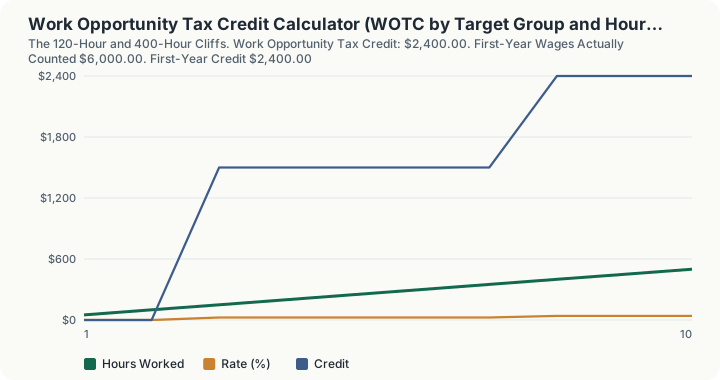
Quick Answer: A general target group hire who began work in 2025, worked 400 hours and was paid $18,000 of first-year wages earns a Work Opportunity Tax Credit of $2,400, being 40% of the $6,000 statutory wage cap. The credit has lapsed: section 51(c)(4) excludes anyone who begins work after 31 December 2025, so a 2026 hire produces zero.
What does this calculator do?
The Work Opportunity Tax Credit rewards employers for hiring from certified target groups: SNAP recipients, ex-felons, SSI recipients, vocational rehabilitation referrals, the long-term unemployed, designated community residents, several veteran categories, summer youth employees, and long-term family assistance recipients.
Two features determine almost every WOTC outcome, and both are cliffs rather than curves.
The hours test in section 51(i)(3) is stepped. Fewer than 120 hours and no wages count at all, whatever was paid. From 120 to 399 hours the rate is 25% rather than 40%. At 400 hours it steps to the full 40%. One hour either side of a threshold changes the credit by hundreds or thousands of dollars.
The wage cap is applied before the rate, and it is per target group. A general hire's qualified first-year wages stop at $6,000, so the credit can never exceed $2,400 no matter how much the employee earns. The veteran categories carry caps of $12,000, $14,000 and $24,000, and summer youth employees $3,000. Only long-term family assistance recipients generate a second-year credit at all.
The most important thing on this page is the lapse. The credit was available for individuals who began work on or before 31 December 2025. It is not available for a 2026 hire. Congress has revived WOTC retroactively after previous lapses, but had not done so as at 30 August 2026, and no employer should plan a 2026 hiring decision around a credit that does not currently exist.
How is this calculated?
Credit = [ min(W₁, C₁) × r] + [ min(W₂, C₂) × 50%], r ∈ {0%, 25%, 40%}
with the whole expression gated to zero for anyone beginning work after 31 December 2025.
Step 1: Test the hire against section 51(c)(4). The employee began work in 2025, on or before 31 December 2025: Within the statutory window Had the year been 2026 or later, every figure below would collapse to zero. The gate is applied to the credit itself, not flagged after the fact.
Step 2: Select the wage cap from the target group. General target group, 26 U.S.C. 51(b)(3): $6,000
Step 3: Apply the cap to first-year wages. (\18{,}000,\ \$6{,}000) = $ $6,000 counted $18,000 − $6,000 = $12,000 of wages ignored
Step 4: Determine the rate from hours worked. 400 hours is at or above the 400-hour threshold: 40%
Step 5: Compute the first-year credit. $6,000 x 40% = $2,400
Step 6: Compute the second-year credit. The general target group has no second-year credit, so second-year wages are disregarded entirely: $0
Step 7: Total the credit. $2,400 + $0 = $2,400
Step 8: Measure what the hours shortfall cost. The credit at the full 40% rate would be $2,400, which is what was achieved: $0 lost to the hours test
Step 9: Express the credit against wages actually paid. $2,400 ÷ $18,000 = 13.33%
Step 10: Compare against the ceiling for this group. $6,000 x 40% = $2,400 maximum possible The hire is already at the ceiling; paying more wages would add nothing.
Worked Example
A warehouse operator hires a certified SNAP recipient in October 2025. The employee works 400 hours by the end of the first year of employment and is paid $18,000.
Step 1: The hire is inside the window. Work began in 2025, before the 31 December 2025 cut-off in section 51(c)(4).
Step 2: The cap bites first. The general target group cap is $6,000, so of the $18,000 paid, only $6,000 is qualified first-year wages and $12,000 is ignored.
Step 3: The hours give the full rate. 400 hours reaches the threshold exactly, so the rate is 40%, not 25%.
Step 4: The credit. $6,000 x 40% = $2,400
Step 5: What it is worth in context. $2,400 against $18,000 of wages is 13.33% of what was paid, and it is the maximum this target group can produce.
Now move the hours by one. At 399 hours the rate drops to 25%, and the credit falls to $6,000 x 25% = $1,500: $900 lost for a single hour. At 100 hours, section 51(i)(3) disallows every dollar of wages and the credit is zero, whatever was paid.
The target group matters just as much. A disabled veteran unemployed six months or more carries a $24,000 cap, so 40% of $24,000 gives $9,600, the largest single-year credit in the statute. A long-term family assistance recipient is the only group with a second year: 40% of $10,000 in year one plus 50% of $10,000 in year two gives $9,000 across two years.
And a hire who begins work in 2026 produces $0, regardless of target group, hours or wages.
What does this calculator not account for?
- The credit has lapsed and this calculator will show a credit for a pre-2026 hire only. Section 51(c)(4) is a hard gate at 31 December 2025. If Congress revives WOTC retroactively, as it has done after previous lapses, this page will need updating; as at 30 August 2026 it had not.
- Certification is asserted, never verified. The Form 8850 pre-screening notice and the 28-day deadline for filing it with the state workforce agency are not modelled. An uncertified hire earns nothing however well they fit a target group description, and missing the 28-day window is the single most common way employers lose the credit.
- The section 51(f) reduction for subsidised employment and the section 51(i)(1) related-individual disqualification are not applied. Wages funded by federally subsidised on-the-job training programmes are reduced, and hiring a relative or a dependent generally disqualifies the credit entirely.
- The section 38 general business credit limitation and its 20-year carryforward are out of scope. The credit computed here is the gross credit, not the amount usable against this year's tax.
- The section 280C(a) wage deduction disallowance is not modelled. The employer must reduce its wage deduction by the credit claimed, which reduces the after-tax value materially.
- The section 3111(e) variant for tax-exempt employers hiring qualified veterans is not covered. It uses different percentages and offsets payroll tax rather than income tax.
- This models one hire. There is no aggregation across a workforce, and no handling of an employee who moves between target groups.
What mistakes do people make with this?
- Assuming a 2026 hire qualifies. It does not. The authority lapsed on 1 January 2026 and no extension existed as at 30 August 2026. Do not build a hiring plan or a job offer around it.
- Missing the 28-day certification deadline. Form 8850 must reach the state workforce agency within 28 days of the employee's start date. The credit is lost outright otherwise, and no amount of eligibility cures it.
- Believing more wages mean more credit. The cap is applied before the rate. Paying a general target group hire $60,000 rather than $18,000 produces exactly the same $2,400.
- Treating the hours test as a proportional ramp. It is two cliffs. 119 hours earns nothing; 120 hours earns 25% of the capped wages; 399 hours earns 25%; 400 hours earns 40%. Employers who track hours for this reason routinely find the 400th hour is the cheapest money in the payroll.
- Assuming every veteran category is the same. The four veteran caps run $6,000, $12,000, $14,000 and $24,000, and the certification requirements differ for each.
- Expecting a second-year credit. Only long-term family assistance recipients have one. For every other group, second-year wages are irrelevant and the calculator disregards them.
- Forgetting the wage deduction reduction. Section 280C(a) requires the employer's deduction for wages to be cut by the credit claimed, so the net benefit is smaller than the credit figure.
Frequently Asked Questions
Is the Work Opportunity Tax Credit still available in 2026?
How much is the credit worth per employee?
What happens if the employee works fewer than 400 hours?
Do I get more credit if I pay the employee more?
What is Form 8850 and when is it due?
Which target group gives the biggest credit?
Sources
- 26 U.S.C. 51(a): the credit is 40 percent of qualified first-year wages. law.cornell.edu/uscode/text/26/51
- Internal Revenue Service, "The Work Opportunity Tax Credit is available until the end of 2025." irs.gov/newsroom/the-work-opportunity-tax-credit-is-available-until-the-end-of-2025
Also consulted: 26 U.S.C. 51(b)(3): the $6,000 general cap on qualified first-year wages, and the $12,000, $14,000 and $24,000 caps for the three qualified veteran categories; 26 U.S.C. 51(d)(7)(B): the $3,000 cap for summer youth employees; 26 U.S.C. 51(e), long-term family assistance recipients: 40 percent of qualified first-year wages plus 50 percent of qualified second-year wages, each capped at $10,000; 26 U.S.C. 51(i)(3): no wages are taken into account where fewer than 120 hours are performed; 25 percent applies in lieu of 40 percent between 120 and 400 hours; 26 U.S.C. 51(c)(4), termination: wages do not include any amount paid to an individual who begins work for the employer after 31 December 2025.
Statutory text verified 2026-08-30. Authority lapsed on 1 January 2026 and had not been extended as at that date.