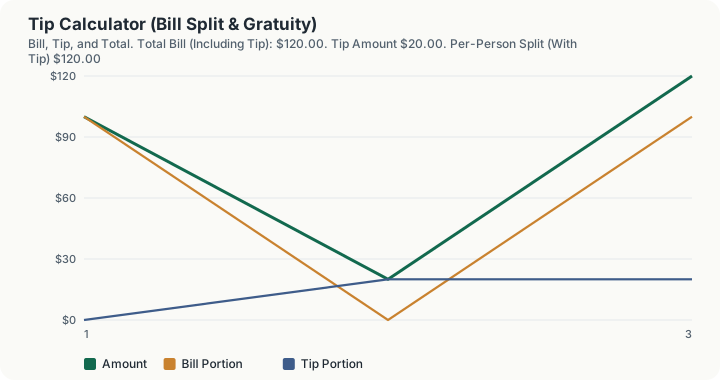
Quick Answer: On a $100.00 bill with a 20% tip split one way, the tip is $20.00 and the total comes to $120.00. Split that same bill four ways with an 18% tip on $87.50, and each person owes $25.81 including tip, or $21.88 if the group is splitting the pre-tip bill only.
Overview
This calculator does the two things a group at a table actually needs at the end of a meal: it turns a bill amount and a tip percentage into a dollar tip and a grand total, and it splits that total evenly across however many people are paying. It reports the per-person share both with the tip included and without it, since some groups tip individually on top of an even split of the food and drink.
Tipping norms vary by service type and region, but in most of the United States, full-service restaurant tipping runs from around 15% at the low end to 20% or more for excellent service, with 18% commonly cited as a typical middle ground. Counter service, delivery, and other non-full-service settings often run lower, while exceptional service, large parties, or special occasions sometimes justify 25% or higher. None of these are legal requirements. They are social conventions that shifted meaningfully over the twentieth century and continue to shift today.
How This Is Calculated
- Tip amount. The bill amount is multiplied by the tip percentage.
- Total bill. The tip is added to the original bill.
- Per-person split. The total (or, separately, the bill alone) is divided evenly by the number of people splitting.
All dollar figures are rounded to the nearest cent using standard rounding (round-half-up), the same convention a cash register or point-of-sale terminal uses.
Worked Example
Using the calculator's default inputs:
- Bill Amount: $100.00
- Tip Percentage: 20%
- Number of People: 1
Step by step:
- Tip: $100.00 × 20% = $20.00.
- Total: $100.00 + $20.00 = $120.00.
- Since only one person is paying, the per-person amount with tip equals the total: $120.00. Without tip, it is the original bill: $100.00.
Now a four-way split example: an $87.50 bill with an 18% tip, split among four people.
- Tip: $87.50 × 18% = $15.75.
- Total: $87.50 + $15.75 = $103.25.
- Per person with tip: $103.25 ÷ 4 = $25.81 (rounded to the nearest cent).
- Per person without tip: $87.50 ÷ 4 = $21.88.
- Tip per person alone: $15.75 ÷ 4 = $3.94.
Note that $25.81 × 4 = $103.24, one cent short of $103.25, and $21.88 × 4 = $87.52, two cents over $87.50. Per-cent rounding on an even split will occasionally leave the group a cent or two short or over; in practice, one person usually covers the odd cent or the difference is left on the table as part of the tip.
Choosing a Tip Percentage
- 15%: Often treated as a floor for adequate full-service dining, and a common default for counter service or takeout in places where tipping is customary at all.
- 18%: A frequently cited middle-of-the-road rate for standard, competent full-service restaurant dining in the United States.
- 20%: Commonly treated as the rate for good-to-very-good service, and increasingly the default suggested option on point-of-sale tip screens.
- 25%: Reserved for exceptional service, small intimate venues, or situations like large parties, holidays, or difficult service conditions (bad weather delivery, a very complicated order) where a higher tip is customary.
These are conventions, not fixed rules, and they vary by country, region, and service category. Bar tabs, delivery, salons, and taxis/rideshare each have their own norms that can differ from full-service restaurant dining.
What This Does Not Account For
- Tax. This calculator does not compute or add sales tax. If your bill amount is the pre-tax subtotal and you intend to tip on the post-tax total, add tax to the bill amount first, or use your point-of-sale receipt's post-tax subtotal as the bill amount.
- Uneven splits. This calculator divides the bill evenly across all people. It does not itemize who ordered what, which is a different, more detailed way to split a shared check.
- Service charges and auto-gratuity. Many restaurants add an automatic service charge or gratuity for large parties (commonly 18-20% for parties of 6 or more). If your bill already includes an auto-gratuity line, do not add a separate tip percentage on top of it unless that is your explicit intent.
- Delivery fees and platform fees. Food delivery apps often separate a delivery fee, a service fee, and a tip to the driver. This calculator treats "bill amount" as a single number; add or exclude fees before entering the amount depending on what you intend to tip on.
- Currency. All figures are treated as a single currency with two decimal places (cents). International tipping conventions and currency-specific rounding are not modeled here.
Common Pitfalls
- Tipping on the post-tax total by habit without deciding to. Whether to tip on the pre-tax or post-tax amount is a personal choice; the difference is usually small, but decide deliberately rather than by default, and enter the bill amount you actually intend to tip on.
- Double-tipping on an auto-gratuity. Check the receipt for an already-included service charge before adding a separate tip percentage; adding both can mean tipping 35-40% or more without intending to.
- Forgetting that uneven per-person splits round to the cent, not exactly. A four-way split of an odd total will not divide perfectly; expect the sum of the rounded per-person shares to be off from the total by a cent or two.
- Using the same tip percentage regardless of context. Delivery, counter service, bartending, and full-service sit-down dining often carry different customary tip ranges; applying one flat percentage everywhere can mean over- or under-tipping relative to local norms.
- Splitting a bill evenly when orders were very uneven. An even split works well for similar-priced orders, but if one person ordered significantly more or less, an even split may not reflect what each person actually consumed; this calculator does not do itemized splitting.
Frequently Asked Questions
Should I tip on the pre-tax or post-tax bill amount?
Is 20% still the standard tip in the United States?
What if the bill already includes a service charge or auto-gratuity?
Why doesn't the sum of the per-person amounts exactly equal the total?
Does this calculator handle different currencies?
Sources
- U.S. Bureau of Labor Statistics: Consumer Expenditure Survey, for context on typical household dining-out spending. bls.gov/cex
Also consulted: Emily Post Institute: guidance on standard U.S. tipping percentages and etiquette by service category; Restaurant industry associations (e.g., National Restaurant Association): commentary on customary gratuity ranges and automatic service charge practices for large parties.