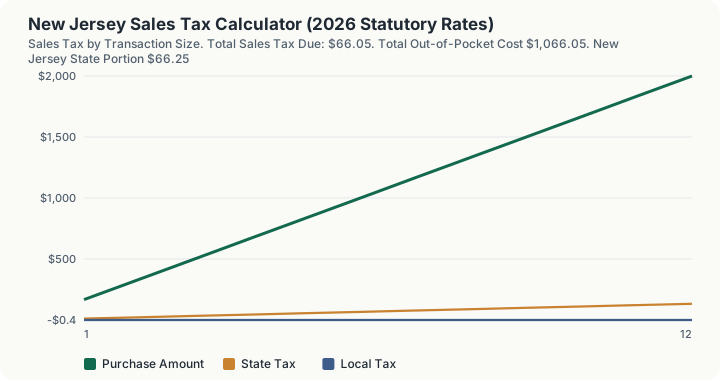
Quick Answer: A $1,000 taxable purchase in New Jersey costs $66.05 in combined state and local sales tax, for a total of $1,066.05 out the door.
6.625% Statewide, With a Local Average Below Zero
Ring up a purchase almost anywhere in New Jersey and the receipt starts with the state's 6.63% statutory sales tax rate before anything local gets added on. Local rates are allowed in principle, but in practice New Jersey's statewide average local add-on works out to roughly 0.02% in the state's favor, a slight net reduction rather than an addition, so the average combined rate of 6.61% actually lands a hair below the 6.63% state rate itself.
That leaves New Jersey a bit below the roughly 7.3% average combined rate seen across the states that levy a general sales tax. Retailers operating storefronts in multiple New Jersey jurisdictions have to track which local rate applies at each location, since the state does not collect a single uniform combined rate. It sets the 6.63% floor and lets local governments decide what, if anything, to add above it. Point-of-sale systems configured for New Jersey generally pull the applicable rate by ZIP code or street address rather than applying one number statewide, which is the same logic this calculator uses when it defaults to the statewide average.
How This Is Calculated
New Jersey charges 6.625% statewide and is the one state whose average local rate is negative, at -0.02%. That is not an error. New Jersey has no ordinary local sales taxes, but it does have Urban Enterprise Zones where qualifying retailers charge half the state rate, and Salem County operates under a similar reduced rate. Averaging those below-rate zones against the rest of the state pulls the local component slightly below zero, giving a combined 6.605% and $66.05 on a $1,000 purchase, marginally less than the $66.25 the state rate alone would produce.
The reduced-rate zones enter the calculation as a negative local term in the same combined-rate formula:
The calculator runs:
- Establish the taxable base. The calculator uses the pre-tax price exactly as entered.
- No item-level exemption filtering. New Jersey exempts groceries, prescription drugs and most clothing. None of those exemptions are applied to the entered amount.
- Apply the state rate to the base. That gives the state share of the tax.
- Apply the local adjustment. Turning the local component off raises the New Jersey result rather than lowering it, because the adjustment is a discount rather than a surcharge.
- Combine into a total. State and local tax are added, then the combined tax is added to the purchase price for the final transaction amount.
Worked Example
For a $1,000 taxable purchase in New Jersey:
- Starting purchase price. The buyer rings up a $1,000.00 taxable retail purchase in New Jersey, the baseline amount before any tax is applied.
- State portion. New Jersey's statutory state sales tax rate of 6.63% applies to the full purchase amount: $1,000.00 × 6.63% = $66.25 owed to the state.
- Local portion. Local municipal, county, and special-district surcharges add an average of -0.02% on top of that: $1,000.00 × -0.02% = -$0.20, which is actually a small net reduction rather than an addition.
- Combined tax due. Summing the two pieces, $66.25 in state tax plus -$0.20 in local surcharge comes to $66.05 in total sales tax owed on the transaction.
- Total out-of-pocket cost. Adding that $66.05 in tax to the $1,000.00 purchase price brings the buyer's total out-of-pocket cost to $1,066.05.
This example uses New Jersey's statewide average local rate of -0.02%; actual combined rates vary by city and county, so a real receipt could show a combined rate above or below the 6.61% average used here.
The Only Negative Local Rate in the Table
New Jersey is the one state in this family where the stored average local rate is below zero. The state rate is 6.625% and the average local adjustment is -0.02%, giving a combined 6.605%. That is not a data error: New Jersey's Urban Enterprise Zones charge a reduced rate on qualifying sales, and averaged across the state that pulls the effective local component slightly negative.
It shows up directly in the output, and it looks alarming until you know why. On a $1,000 purchase the state portion is $66.25, the local portion is -$0.20, and the total is $66.05. On $30,000 the local line reads -$6.00 against $1,987.50 of state tax, for $1,981.50 total.
The local toggle therefore moves the number the wrong way, which is unique to this page. Switch the surcharge off and the tax rises from $66.05 to $66.25, and the cost from $1,066.05 to $1,066.25. Every other state in this family gets cheaper when the local layer is removed. New Jersey gets $0.20 more expensive on $1,000, and $6.00 more expensive on $30,000.
Each additional $100 of purchase costs $6.61 with the local adjustment applied and $6.63 without. Raising the entry from $1,000 to $1,100 moves the tax from $66.05 to $72.66.
A rounding trap in the displayed rate. The "New Jersey State Portion" is computed at the full 6.625%, but the state rate output is rounded for display to 6.63%. Multiplying $1,000 by the displayed 6.63% gives $66.30, five cents more than the $66.25 the engine computed. On $30,000 that rounding gap is $1.50. Always take the dollar figure rather than re-deriving it from the displayed percentage.
The reverse question: how much can be spent before the tax reaches $100? At $1,513 the tax is $99.94 and at $1,514 it is exactly $100.00.
Right method against wrong method, priced. A receipt total of $1,066.05 does not contain 6.605% of itself in tax. Deducting 6.605% of the gross gives $70.41 and a net of $995.64, overstating the tax by $4.36 against the correct $66.05. Dividing the gross by 1.06605 returns the $1,000.00 the calculator started from.
What This Does Not Account For
- The -0.02% local figure is a statewide average reflecting Urban Enterprise Zone reduced rates, not a rate anyone actually pays. No UEZ eligibility is tested and there is no address input.
- The displayed state rate is rounded to 6.63% while the computation uses 6.625%, so re-deriving the tax from the displayed percentage overstates it by $0.05 on $1,000.
- The calculator does not extract tax from a tax-inclusive total.
- Statutory exemptions on unprepared groceries, prescription medications, or manufacturing equipment.
- Special industry excise taxes (lodging hotel taxes, vehicle rental fees, alcohol/tobacco excise).
- Use tax compliance on out-of-state untaxed online purchases.
- B2B resale certificate exemptions or direct pay permit programs.
Common Pitfalls
- Confusing State and Combined Rates: Quoting the state base rate without factoring in local city and county add-on taxes.
- Overlooking Consumer Use Tax: Failing to self-report and remit use tax on untaxed out-of-state purchases on your state income tax return.
- Missing Annual Sales Tax Holidays: Many states offer annual tax-free weekends for back-to-school items, severe weather supplies, or energy-efficient appliances.
- Failing to Collect Resale Certificates: Selling wholesale without collecting valid exemption certificates exposes sellers to full sales tax liability upon audit.
Frequently Asked Questions
What is the sales tax rate in New Jersey?
Are groceries taxed in New Jersey?
How does use tax differ from sales tax?
Are digital goods and SaaS taxable in New Jersey?
Sources
- New Jersey Division of Taxation: 2026 Sales and Use Tax Rate Schedules. nj.gov/treasury/taxation
- Streamlined Sales Tax Governing Board (SSTGB): State Taxability Matrix. streamlinedsalestax.org/for-businesses/taxability-matrix