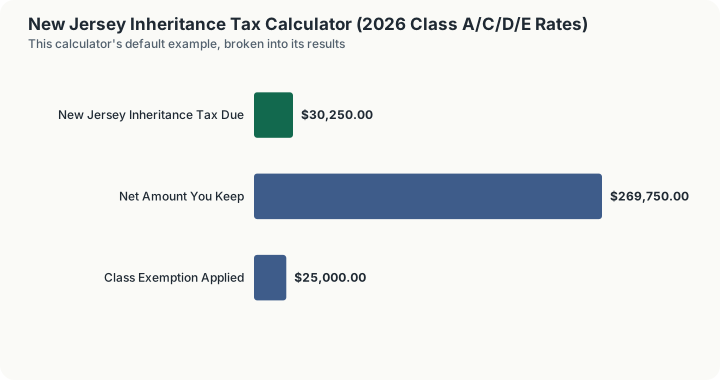
Quick Answer: On the calculator's $300,000 baseline bequest, a sibling (Class C) owes $30,250, which is 11% of the $275,000 left after the $25,000 exemption. Scaling the same class up, a sibling inheriting $500,000 from a New Jersey resident owes $52,250 after the $25,000 exemption (11% on the remaining $475,000). A friend or cousin (Class D) inheriting $500,000 owes $75,000, with no exemption at all (flat 15% under $700,000). A spouse, parent, child, or grandchild (Class A) owes $0.
Overview
New Jersey is one of only five states that still tax the individual beneficiary on what they personally receive, rather than taxing the total estate the way an estate tax does. New Jersey repealed its separate state estate tax for deaths on or after January 1, 2018 -- so the inheritance tax computed here, which predates that repeal by over a century, is now the only New Jersey-level death tax that applies to any bequest.
New Jersey sorts beneficiaries into four active classes -- A, C, D, and E (Class B was eliminated by statute back in 1963, and the letter was never reused). Class A and Class E are fully exempt. Class C gets a real exemption before a mid-range progressive schedule. Class D -- everyone not otherwise classified -- gets no exemption at all and the highest rates in the entire five-state group at the low end of the scale. New Jersey's rates have been unchanged since 2002, making it one of the most stable -- and, for Class D beneficiaries, one of the most expensive -- inheritance tax regimes among the five states.
How This Is Calculated
Class C and Class D use progressive brackets applied to the gross amount inherited, with Class C's $25,000 exemption chargeable against its lowest bracket the same way Kentucky's exemptions work.
New Jersey's Four Active Classes
| Class | Who's Included | Exemption | Rates |
|---|---|---|---|
| A | Spouse, civil union/domestic partner, parent, grandparent, child (incl. adopted/mutually acknowledged), grandchild, great-grandchild, stepchild | Unlimited | 0% |
| C | Sibling; son/daughter-in-law or civil union partner of a child | $25,000 | 11%-16% |
| D | All other beneficiaries (cousins, friends, unrelated individuals) | $0 | 15%-16% |
| E | Qualified charities, religious/educational/medical institutions, government | Unlimited | 0% |
Class C Bracket Schedule
| Amount Inherited | Rate |
|---|---|
| First $25,000 | Exempt |
| Next $1,075,000 (up to $1,100,000) | 11% |
| Next $300,000 (up to $1,400,000) | 13% |
| Next $300,000 (up to $1,700,000) | 14% |
| Over $1,700,000 | 16% |
Class D Bracket Schedule
| Amount Inherited | Rate |
|---|---|
| First $700,000 | 15% |
| Over $700,000 | 16% |
Worked Example
- Start with the amount inherited. This example uses a $500,000 bequest to a sibling -- Class C.
- Apply the $25,000 exemption. $500,000 − $25,000 = $475,000 taxable, all within the 11% first tier (up to $1,100,000 of taxable amount).
- Apply the rate. $475,000 × 11% = $52,250 in New Jersey inheritance tax.
- Net to the sibling. $500,000 − $52,250 = $447,750.
- Compare to a friend (Class D). The identical $500,000 to a friend has no exemption at all and falls entirely in the 15% first tier: $500,000 × 15% = $75,000 -- nearly $23,000 more tax on the exact same bequest, purely because of the relationship and the missing exemption.
- A larger Class D example. A $900,000 bequest to a cousin spans both Class D tiers: 15% × $700,000 = $105,000, plus 16% × ($900,000 − $700,000) = $32,000, for a total of $137,000.
Why Class D Is New Jersey's Costliest Category
New Jersey's Class D stands out among all five inheritance-tax states for two compounding reasons: it has no exemption whatsoever (every dollar is taxed from the first dollar), and its starting rate -- 15% -- is already at or above the top marginal rate that most other states' "other beneficiary" categories reach only after climbing through several brackets. A cousin, friend, or unrelated beneficiary inheriting even a modest amount in New Jersey pays more, dollar for dollar, at the low end than an equivalent Kentucky Class C or Nebraska Class 3 beneficiary would, because those states both grant a small exemption and start their bracket schedules well below 15%.
How New Jersey Compares to Pennsylvania's Simpler Model
New Jersey and Pennsylvania are geographic neighbors with very different inheritance tax architectures. Pennsylvania applies one flat rate per class from the first dollar with almost no exemptions; New Jersey applies genuine progressive brackets to Class C and D, with a real exemption for Class C but none for Class D. The practical effect is that a sibling inheriting a modest amount is treated noticeably better in New Jersey (11% after a $25,000 exemption) than in Pennsylvania (12% flat, no exemption) -- but an unrelated beneficiary inheriting a modest amount fares worse in New Jersey (15% from dollar one) than in Pennsylvania (also 15%, but at least matching rather than exceeding it). Executors and families with property or beneficiaries spanning both states should never assume one state's class-and-rate logic transfers to the other.
What This Does Not Account For
- Federal estate tax, assessed separately against estates above the federal exemption ($15 million per decedent in 2026).
- New Jersey's repealed state estate tax, which no longer applies to deaths on or after January 1, 2018 -- inheritance tax is the only state-level death tax remaining.
- Life insurance proceeds paid to a named beneficiary, which are generally exempt from New Jersey inheritance tax regardless of class.
- Qualifying charitable remainder trust interests and other split-interest transfers, which have their own valuation rules under the New Jersey inheritance tax regulations.
- Real property New Jersey decedents owned in other states, which may be subject to that state's own estate or inheritance tax rules instead.
- The 2025 regulatory update that expressly added non-biological children conceived through assisted reproductive technology to Class A, which does not change any rate or exemption but does affect who qualifies as a Class A "child."
Common Pitfalls
- Assuming Class B still exists. New Jersey eliminated Class B by statute in 1963; using an old five-tier A/B/C/D/E mental model instead of the current four-tier A/C/D/E structure leads to misclassifying beneficiaries.
- Forgetting Class D has zero exemption. Executors sometimes assume every class gets some baseline exemption the way Class C does; Class D beneficiaries owe tax on the very first dollar.
- Confusing New Jersey's repealed estate tax with its still-active inheritance tax. New Jersey stopped taxing estates in 2018 but never stopped taxing individual beneficiaries -- the two are easy to conflate in older financial planning content.
- Treating siblings and in-laws identically to unrelated beneficiaries. Siblings and a child's spouse get the meaningfully better Class C treatment (an exemption plus a lower starting rate); a friend or cousin does not.
- Missing the eight-month filing deadline. New Jersey requires Form IT-R within eight months of the decedent's death for non-exempt beneficiaries -- shorter than Pennsylvania's nine months and far shorter than Kentucky's 18 months.
Frequently Asked Questions
Does New Jersey still have an estate tax?
What happened to New Jersey's Class B?
What is the New Jersey inheritance tax rate for a sibling?
What is the New Jersey inheritance tax rate for a friend or cousin?
Are stepchildren exempt from New Jersey inheritance tax?
When is the New Jersey inheritance tax return due?
Sources
- New Jersey Division of Taxation, Inheritance and Estate Tax Branch -- Tax Rates: nj.gov/treasury/taxation/inheritance-estate/tax-rates.shtml.
- New Jersey Division of Taxation -- Beneficiary Classes: nj.gov/treasury/taxation/inheritance-estate.
Also consulted: N.J.S.A. 54:34-1 et seq. and 54:34-2: Inheritance tax statute and rate schedule; estate tax calculator: For the federal estate tax computation; New Jersey's own state estate tax was repealed effective January 1, 2018.