Quick Answer: The IRS generally will not accept an Offer in Compromise below your Reasonable Collection Potential, which equals your net realizable equity in assets plus your monthly disposable income multiplied by 12 (lump-sum offers) or 24 (periodic-payment offers).
Overview
An Offer in Compromise, commonly called an OIC, lets a taxpayer settle a tax debt for less than the full amount owed. Most OICs are filed under a basis called "doubt as to collectibility," meaning the taxpayer does not dispute owing the tax, but does not have and will not realistically have, within the collection statute period, the ability to pay it in full. The IRS does not accept these offers based on a taxpayer's opinion of what they can afford. It runs a specific formula, called Reasonable Collection Potential, or RCP, and as a general rule will not accept an offer for less than that number.
This calculator reproduces the core arithmetic of that formula so you can see, before you file Form 656, roughly where your offer needs to land to have a realistic chance of acceptance. It is not a substitute for the full Form 433-A (OIC) or Form 433-B (OIC) Collection Information Statement, which walks through every asset, account, and expense line by line, but it captures the same two building blocks the IRS formula is built from: what you could realistically raise by liquidating what you own, and what you could realistically pay out of future income.
How This Is Calculated
Reasonable Collection Potential has two components that get added together.
Net realizable equity in assets. For each asset (bank accounts, real estate, vehicles, investments, and so on), the IRS does not use full fair market value. It applies a "quick sale value," generally 80% of fair market value, to reflect what you would actually net from a forced, rapid sale rather than a leisurely market-rate sale. It then subtracts any loans or liens against that asset. This calculator asks for that net number directly as a single input, since the underlying asset-by-asset worksheet is beyond what a single page can walk through, but the arithmetic behind it is exactly quick-sale value minus what you owe against each asset, summed across everything you own.
Future income value. The IRS does not look at your actual monthly budget. It looks at your gross monthly income minus a set of IRS-defined allowable living expenses, published in the Collection Financial Standards, which cover necessities like housing, transportation, food, and healthcare up to set caps by location and household size, not your discretionary spending. What is left over is your monthly disposable income. That figure is then multiplied by a fixed number of months, which depends entirely on how you plan to pay if the offer is accepted: 12 months for a lump-sum cash offer, paid in five or fewer installments within five months of acceptance, or 24 months for a periodic-payment offer, paid in installments over six to twenty-four months. Choosing the periodic-payment structure roughly doubles the income component of your RCP, which is why most taxpayers with any meaningful monthly disposable income prefer the lump-sum route even though it requires more cash up front.
Add the two components together and you have the Reasonable Collection Potential, the number the IRS will generally hold as the floor for what it will accept.
Worked Example
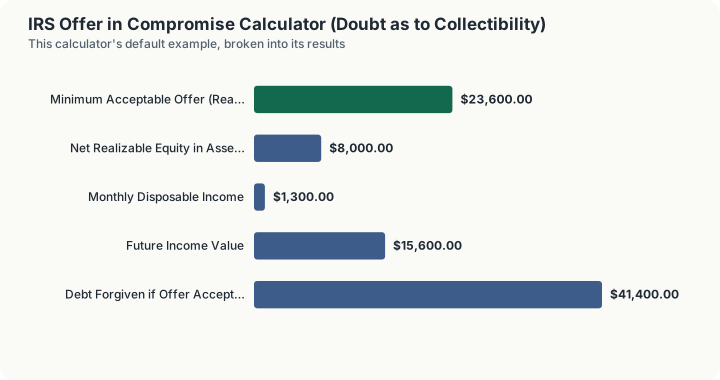
Assume you owe $65,000 in back taxes, penalties, and interest. Your Form 433-A(OIC) shows $8,000 of net realizable equity in assets after applying the quick-sale discount and subtracting loan balances. Your gross monthly household income is $4,500, and the IRS's allowable living expense standards for your household size and location total $3,200 per month.
Step 1: Monthly disposable income. $4,500 − $3,200 = $1,300.
Step 2: Future income value, lump-sum offer. $1,300 × 12 = $15,600.
Step 3: Reasonable Collection Potential. $8,000 + $15,600 = $23,600.
That $23,600 is roughly the floor for an acceptable lump-sum offer, well below the full $65,000 owed, since the RCP formula only counts what the IRS believes it could realistically collect, not the full assessed balance. If you instead structured the same offer as a periodic payment plan over 24 months, the future income component doubles to $31,200, pushing the RCP up to $39,200, which is why the payment structure you choose materially changes the size of a competitive offer.
What This Does Not Account For
This calculator does not replace the full Form 433-A(OIC) or 433-B(OIC) worksheets, which require itemizing every bank account, retirement account, vehicle, and piece of real estate, and comparing your actual expenses against the IRS's published allowable expense tables by category and location, not just a single net "allowable expenses" figure. It does not model "dissipated assets," meaning property you sold, transferred, or spent down in the period before applying, which the IRS can still add back into your RCP if it believes you gave away collectible value. It does not check basic eligibility requirements, such as being current on all required tax filings and estimated payments, not being in an open bankruptcy, and not already having every avenue of the RCP formula give a $0 result before an offer even makes sense to file. It does not calculate the $205 application fee (waived for eligible low-income taxpayers) or the 20% non-refundable initial payment required with most lump-sum offers. Finally, RCP is a floor the IRS applies as general policy, not a guarantee; individual Offer Specialists retain judgment, and special circumstances, economic hardship, or effective tax administration arguments can sometimes support an offer below RCP.
Common Pitfalls
- Using your actual expenses instead of IRS-allowable expenses. Many taxpayers plug in their real monthly budget, including debt payments, private school tuition, or above-standard housing costs, none of which the IRS necessarily allows. The IRS substitutes its own published caps for many categories.
- Forgetting the quick-sale discount on assets. Valuing a home or vehicle at full market value rather than the roughly 80% quick-sale value overstates the asset-equity component of RCP and can lead to filing an offer higher than necessary.
- Choosing periodic payments without realizing the income multiplier doubles. A periodic-payment structure can feel more manageable month to month, but it roughly doubles the future income component of RCP compared to a lump-sum offer for the same disposable income.
- Filing while behind on current tax filings or estimated payments. The IRS will return an OIC application outright, without ever evaluating RCP, if you are not current on required filings.
- Assuming a low offer will simply be negotiated up. The IRS does not typically counter-negotiate an offer significantly below RCP; it more often rejects it outright, so a realistic RCP calculation up front saves months of processing time.
Frequently Asked Questions
What is the difference between the 12-month and 24-month multiplier?
Can my offer be accepted for less than the Reasonable Collection Potential?
What counts as an "allowable" living expense?
Does filing an Offer in Compromise stop IRS collection activity?
What happens to the equity in my home if I file an OIC?
Sources
- Internal Revenue Service, Form 656 Booklet, Offer in Compromise, irs.gov/pub/irs-pdf/f656b.pdf
- Internal Revenue Service, Offer in Compromise program overview, irs.gov/payments/offer-in-compromise
- Internal Revenue Service, Collection Financial Standards, irs.gov/businesses/small-businesses-self-employed/collection-financial-standards
- Internal Revenue Service, Form 433-A (OIC) and Form 433-B (OIC), Collection Information Statements. irs.gov