Quick Answer: Most pass-through owners can deduct 20% of qualified business income, but above a 2026 taxable-income threshold of $201,750 (single) or $403,500 (joint) the deduction phases out entirely for specified service businesses and is capped by W-2 wages and property basis for everyone else. On the baseline, a single filer with $150,000 of QBI and $180,000 of taxable income takes the full $30,000 deduction.
Overview
The Qualified Business Income deduction, created by Section 199A of the tax code, is one of the largest and most misunderstood tax breaks available to owners of sole proprietorships, partnerships, S corporations, and other pass-through entities. In its simplest form, it lets a business owner deduct 20% of their qualified business income directly on their personal return, without spending a dollar or making any special election. For a taxpayer with modest income, that is the entire calculation. For a taxpayer above the income threshold, the rules get considerably more complicated, and the outcome depends heavily on what kind of business you run.
The complexity exists because Congress built two separate guardrails into the deduction once income rises above a threshold that adjusts for inflation each year. The first guardrail targets specified service trades or businesses, commonly called SSTBs, which include law, health, accounting, consulting, financial services, performing arts, and similar fields where the business is essentially built around the reputation or skill of its owners. Above the threshold, SSTB owners lose the deduction entirely, on the theory that this is really disguised wage income for personal services rather than a return on business capital. The second guardrail applies to every other kind of business and limits the deduction to the greater of 50% of the W-2 wages the business pays, or a blend of 25% of wages plus 2.5% of the original cost of qualified depreciable property still in use. This guardrail exists to keep the deduction tied to businesses that actually employ people or invest in equipment, rather than businesses with high profit and few employees.
How This Is Calculated
The calculator works through three possible zones, based on where your taxable income before the QBI deduction falls relative to the 2026 threshold and the phase-in range above it. Every run follows the same nine steps; which of them binds is what changes.
Step 1 -- Floor every input at zero. Negative QBI, taxable income, capital gains, wages or UBIA are treated as zero. Loss carryforwards are not modelled.
Step 2 -- Compute 20% of QBI. Qualified business income times 0.20. This is the ceiling on everything that follows.
Step 3 -- Compute the overall taxable-income limit. (Taxable income before QBI minus net capital gain) times 0.20, floored at zero.
Step 4 -- Take the lesser of steps 2 and 3. That is the tentative deduction, before any SSTB or wage test.
Step 5 -- Compute the wage and property limit. The greater of 50% of W-2 wages, or 25% of W-2 wages plus 2.5% of UBIA.
Step 6 -- Compute the fully limited amount. Zero if the business is an SSTB. Otherwise the lesser of step 5 and step 4.
Step 7 -- Locate the taxable income against the threshold. The 2026 threshold is $201,750 single and $403,500 married filing jointly; the phase-in range above it is $75,000 and $150,000 respectively, so the upper edge is $276,750 and $553,500.
Step 8 -- Select the answer for the zone. At or below the threshold, the deduction is step 4 and neither the SSTB status nor the wage figure is consulted at all. At or above the upper edge, it is step 6. Between them, the calculator takes the gap between step 4 and step 6 and restores the fraction of it that corresponds to how far through the range the income sits, then adds that to step 6.
Step 9 -- Cap the result at the tentative deduction. The phase-in can never produce more than step 4 allowed.
Below the threshold. If your taxable income before the QBI deduction is at or under $201,750 (single) or $403,500 (married filing jointly) for 2026, none of the SSTB or wage/property limitations apply. Your deduction is simply the smaller of 20% of your qualified business income, or 20% of your taxable income minus any net capital gain, since the deduction cannot exceed a share of your overall taxable income.
Fully above the threshold and phase-in range. For 2026, the phase-in range is $75,000 for single filers and $150,000 for joint filers, so the guardrails are fully in effect once taxable income reaches $276,750 (single) or $553,500 (joint). If your business is an SSTB, your deduction is $0. If it is not an SSTB, your deduction is capped at the greater of 50% of W-2 wages paid, or 25% of W-2 wages plus 2.5% of the unadjusted basis of qualified property, still bounded by the base 20%-of-QBI figure.
Inside the phase-in range. Between the threshold and the threshold plus the phase-in range, the limitations apply gradually rather than all at once. This calculator models that transition as a straight-line interpolation between the uncapped deduction amount at the threshold and the fully-limited amount at the end of the phase-in range, using the platform's shared phase-out primitive. This is a standard simplified approximation of the statutory mechanics, which technically phase in a reduction to the SSTB percentage, or a reduction applied to the gap between the tentative deduction and the wage/UBIA-limited amount, and produces results very close to the precise statutory calculation for most taxpayers.
The calculator also shows two informational figures beyond the deduction itself: the estimated federal income tax dollars the deduction actually saves you, computed by comparing your tax bill with and without the deduction using the 2026 federal brackets, and the self-employment tax you would still owe on the same business income. That second figure exists because of a detail that trips up a lot of business owners: the QBI deduction reduces your income tax, but it does absolutely nothing to reduce self-employment tax, which is calculated on your full net business profit regardless of what you deduct on the income tax side.
Worked Example
Below the threshold, where the rules are simple
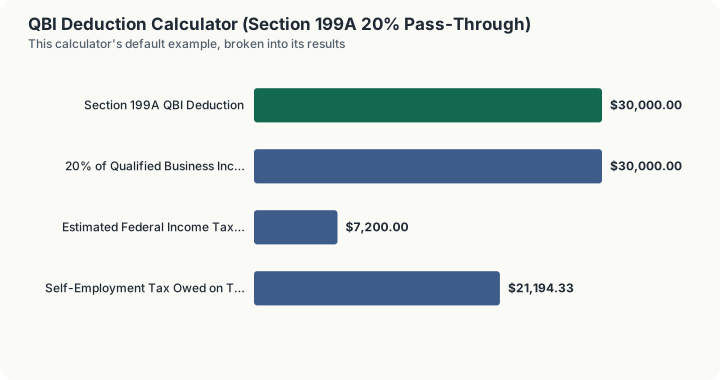
A single-filer consultant reports $150,000 of qualified business income and $180,000 of taxable income before the deduction.
Step 1 -- Twenty percent of QBI. $150,000 x 20% = $30,000.00
Step 2 -- The overall taxable-income limit. ($180,000 - $0 of capital gain) x 20% = $36,000.00
Step 3 -- The tentative deduction. The lesser of the two = $30,000.00
Step 4 -- Locate the income. $180,000 is below the $201,750 threshold, so the zone is below threshold
Step 5 -- The deduction. $30,000.00, the tentative amount, unmodified
Note what steps 4 and 5 skipped. This taxpayer is a consultant, which is an SSTB, and the business pays no W-2 wages at all. Below the threshold neither fact is consulted. The same person $100,000 higher up would get nothing.
Step 6 -- What the deduction is worth in tax. The whole $30,000 comes off income sitting in the 24% bracket, so $7,200.00 of federal income tax
Step 7 -- What it does not touch. Self-employment tax on the same $150,000 of profit remains $21,194.33, calculated on the full profit before any of the steps above
Step 7 is the misunderstanding worth $21,194.33. The QBI deduction is an income tax deduction only.
Inside the phase-in range, where the limits arrive gradually
The same consultant, now with $240,000 of taxable income. That is $38,250 above the threshold, on a $75,000 range.
Step 8 -- The tentative deduction, unchanged. $30,000.00
Step 9 -- The fully limited amount. SSTB, so $0.00
Step 10 -- How far through the range the income sits. $240,000 - $201,750 = $38,250, and $38,250 / $75,000 = 51% of the way through
Step 11 -- The share of the tentative deduction that survives. 1 - 0.51 = 49%, so $30,000.00 x 49% = $14,700.00
Step 12 -- The deduction. $0.00 + $14,700.00 = $14,700.00, worth $4,704.00 in federal income tax
The cliff people expect at $201,750 is not a cliff. It is a ramp $75,000 wide, and the taxpayer in step 12 keeps just under half the deduction.
Non-SSTB inside the range, where two limits interact
A shop owner with $200,000 of QBI, $240,000 of taxable income and $40,000 of W-2 wages.
Step 13 -- Twenty percent of QBI. $200,000 x 20% = $40,000.00
Step 14 -- The overall limit. $240,000 x 20% = $48,000.00, so the tentative deduction stays at $40,000.00
Step 15 -- The wage and property limit. The greater of 50% of $40,000 = $20,000.00, or 25% of $40,000 plus 2.5% of $0 = $10,000.00, so $20,000.00
Step 16 -- The fully limited amount. Not an SSTB, so the lesser of $20,000.00 and $40,000.00 = $20,000.00
Step 17 -- The gap the phase-in works on. $40,000.00 - $20,000.00 = $20,000.00
Step 18 -- The surviving share of that gap. $20,000.00 x 49% = $9,800.00
Step 19 -- The deduction. $20,000.00 + $9,800.00 = $29,800.00, worth $9,536.00 in tax
Compare step 19 with step 12. Identical taxable income, identical position in the range, and the non-SSTB owner keeps $29,800 against the consultant's $14,700, because a non-SSTB never phases below its wage limit while an SSTB phases to nothing.
Fully above the range, where the guardrails bind completely
A manufacturing shop with $400,000 of QBI, $500,000 of taxable income, $80,000 of W-2 wages and $200,000 of UBIA in equipment.
Step 20 -- The tentative deduction. $400,000 x 20% = $80,000.00, below the $100,000.00 overall limit
Step 21 -- The 50%-of-wages test. $80,000 x 50% = $40,000.00
Step 22 -- The wages-plus-property test. ($80,000 x 25%) + ($200,000 x 2.5%) = $20,000.00 + $5,000.00 = $25,000.00
Step 23 -- The wage and property limit. The greater of the two = $40,000.00
Step 24 -- The zone. $500,000 is above $276,750, so the limit applies in full with no phase-in relief
Step 25 -- The deduction. $40,000.00, exactly half the uncapped amount, worth $14,000.00 in tax
Step 22 is worth noticing. The equipment route adds $5,000 to a $25,000 total and still loses to the simple wage test, which is typical: UBIA only wins for genuinely property-heavy businesses, since 2.5% of basis is a small number next to 50% of payroll.
Step 26 -- The same $500,000 income earned by a law firm. An SSTB above the upper edge of the range, so the deduction is $0.00 and the tax saving is $0.00, no matter how large its payroll
Steps 25 and 26 are the whole design of Section 199A in two lines. Above the range, a capital-and-payroll business keeps a deduction sized by its payroll, and a business built on its owners' professional skill keeps nothing.
What This Does Not Account For
This calculator does not replace a full Form 8995 or Form 8995-A calculation, which requires aggregating income and limitations across every qualified trade or business you own separately, then combining them, and which applies special ordering rules when some businesses have losses and others have income. It does not model the REIT dividend and publicly traded partnership income component of QBI, which gets its own 20% deduction outside the wage/UBIA limitation entirely. It does not model aggregation elections, which let related businesses under common ownership sometimes combine their wages and property to help a smaller entity qualify for a larger deduction. It does not calculate state tax treatment, since many states do not conform to the federal QBI deduction at all. It does not precisely replicate the statutory phase-in formula for the SSTB "applicable percentage," using a straight-line approximation instead, which is very close but not certified identical to an IRS worksheet calculation. Finally, the $400 minimum deduction floor added for 2026 under OBBBA, guaranteeing at least a $400 deduction when QBI is $1,000 or more even in edge cases, is not separately modeled here.
Common Pitfalls
- Assuming the QBI deduction reduces self-employment tax. It does not. Self-employment tax is calculated on net profit before any QBI deduction is applied; the two calculations are completely independent.
- Not knowing whether your business is an SSTB. The SSTB category is broader than people expect and includes not just doctors and lawyers but also financial advisors, consultants of many kinds, and businesses where the principal asset is the reputation or skill of an owner or employee.
- Forgetting the phase-in range exists. Many taxpayers assume the SSTB and wage limits are an all-or-nothing cliff at the threshold. In reality there is a wide dollar range, $75,000 for single filers and $150,000 for joint filers in 2026, where the limitations phase in gradually.
- Using taxable income instead of QBI, or vice versa, for the wrong limit. The deduction is capped both by 20% of QBI and separately by 20% of taxable income minus net capital gain; missing the second limit can overstate a deduction for taxpayers with modest overall income relative to a large QBI figure.
- Not tracking UBIA for real estate and equipment-heavy businesses. Owners often underestimate this figure, which can materially raise the wage/UBIA limitation and increase an otherwise-capped deduction.
Frequently Asked Questions
What counts as a Specified Service Trade or Business (SSTB)?
Does the QBI deduction reduce my adjusted gross income?
What happens if my business has a loss?
Can I do anything to increase my QBI deduction if I am above the threshold?
Why does the calculator show a separate self-employment tax figure?
Sources
- Internal Revenue Service, Revenue Procedure 2025-32 (2026 inflation-adjusted Section 199A threshold and phase-in range), irs.gov/pub/irs-drop/rp-25-32.pdf
- Internal Revenue Service, Section 199A Qualified Business Income Deduction FAQ and final regulations (T.D. 9847), irs.gov/newsroom/section-199a-qualified-business-income-deduction
- 26 U.S.C. Section 199A, Internal Revenue Code. law.cornell.edu/uscode/text/26/199A
- Internal Revenue Service, Forms 8995 and 8995-A instructions, Qualified Business Income Deduction. irs.gov