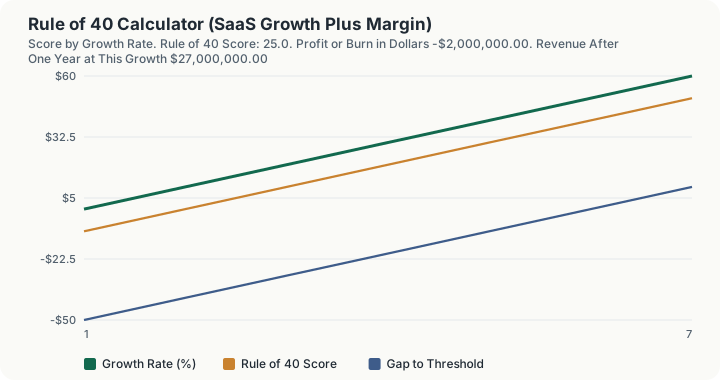
Quick Answer: $20 million of revenue growing 35% at a -10% margin scores 25.0 on the Rule of 40, failing the 40 threshold by 15.0 points. Growth contributes +35.0 points and margin subtracts 10.0. Passing would take either a +5.0% margin at the current growth rate, or 50.0% growth at the current margin. The company is burning $0.29 for every $1 of new revenue it adds.
What does this calculator do?
The Rule of 40 is a screen, not a valuation. It says a software business should have its revenue growth rate plus its profitability margin sum to at least 40, on the reasoning that early on you buy growth with losses and later you convert growth into profit, but you should always be doing one of the two well enough to compensate for the other.
It is not an accounting identity, and it is important to be clear about why. The two percentages are measured on different bases. Growth is a year-over-year change in revenue; margin is a share of current revenue. Adding them produces a number with no economic units at all. That is a real objection, and it is why the rule survives as a first-pass filter rather than as a model.
What makes it useful anyway is that it is hard to game. A company can flatter growth by spending, or flatter margin by cutting spend, but not both at once. The sum tends to expose the trade.
This calculator computes the score, splits it into its two contributions, solves for what each side would have to reach for the company to pass, and converts the percentages into the dollars they represent.
How is this calculated?
score = growth % + margin %
Step 1: Add the two percentages. 35.0 + (-10.0) = 25.0
Step 2: Compare against the threshold. 25.0 - 40 = -15.0 points
Short of the bar, so the company fails.
Step 3: Split the score into contributions. From growth: +35.0 points From margin: -10.0 points
Step 4: Measure how lopsided the score is. The composition uses absolute values, so that an offsetting positive and negative do not disguise how much work each side is doing. 35.0 / (35.0 + 10.0) = 0.7778 = 77.8% of the score comes from growth
Step 5: Solve for the margin that would pass at the current growth rate. 40 - 35.0 = +5.0%
Step 6: Solve for the growth rate that would pass at the current margin. 40 - (-10.0) = +50.0%
Those two figures are the practical content of the rule: the company is 15 points short, and it can close the gap from either direction.
Step 7: Convert the margin into dollars. $20,000,000 x -10.0% = -$2,000,000 of profit, a $2.0 million burn.
Step 8: Convert the growth rate into dollars. $20,000,000 x (1 + 0.35) = $27,000,000 next year
Step 9: Take the incremental revenue. $27,000,000 - $20,000,000 = $7,000,000
Step 10: Divide the burn by the revenue it bought. $2,000,000 / $7,000,000 = $0.29 burned per $1 of new revenue
This last figure is the one that survives the criticism of the rule, because it is a ratio of two dollar amounts rather than a sum of two incompatible percentages. It answers a real question: what is this company paying for growth?
The banding label on the page uses fixed boundaries: 60 and above is exceptional, 40 and above passes, 30 and above is a near miss, 20 and above is below the bar, and a negative score means shrinking and unprofitable. Those boundaries are conventional and do not move when you change the threshold input; the pass or fail verdict does.
Worked Example
A software company at $20 million of annual recurring revenue, growing 35%, with a free cash flow margin of -10%.
Step 1: The score. 35.0 + (-10.0) = 25.0
Step 2: The verdict. Fails. 15.0 points short of 40.
Step 3: What each side is doing. Growth is carrying 77.8% of the score. This is a growth story with a profitability problem, not a balanced business.
Step 4: The two ways out. Either reach a +5.0% margin while holding 35% growth, or reach 50.0% growth while still burning 10%. The first is a 15-point swing in profitability, and the second is a 15-point acceleration in growth from an already fast base. Neither is small, but the first is the one most companies at this stage actually attempt.
Step 5: The dollars behind the percentages. The company burns $2.0 million and adds $7.0 million of revenue.
Step 6: The efficiency ratio. $0.29 per $1 of new revenue. By the standards of venture-funded software that is efficient. A company at the same 25.0 score reached by 15% growth and a -10% margin would be burning $0.67 per dollar of new revenue, more than twice as much, for the identical Rule of 40 result. The score cannot tell the two apart. This ratio can.
Step 7: Watch the rule treat unequal things as equal. Change growth to 10% and margin to 30%. The score is exactly 40.0 and the company passes, on the same arithmetic that just failed a business growing three and a half times faster. Whether a point of growth and a point of margin are genuinely interchangeable is the central argument about the rule, and the calculator makes the substitution explicit rather than burying it.
Step 8: Raise the bar. Set the threshold to 50, as some investors do in tighter funding markets. The same company goes from a 15-point miss to a 25-point miss without changing anything about its business.
What does this calculator not account for?
- Which margin you used. Free cash flow margin, EBITDA margin and operating margin are all used in practice, and they give materially different scores for the same company. This calculator takes whatever you type. Comparisons across companies are only valid when the same definition was used on both.
- Revenue quality. Annual recurring revenue, GAAP revenue, gross bookings and annualised last-quarter revenue are not the same measure, and companies choose the flattering one. Growth computed on a different base than the margin is a common and invisible error.
- Retention and net revenue expansion. A company growing 35% through new logos while churning existing customers scores identically to one growing 35% through expansion in a loyal base. The rule cannot see the difference, and it is arguably the most important difference in software.
- Scale. The same score at $2 million of revenue and at $2 billion means completely different things. Growth is far easier from a small base.
- Capital structure and cash runway. A 10% burn is survivable with four years of cash and fatal with six months. Nothing here models the balance sheet.
- Stock-based compensation. Whether it is treated as a real cost changes the margin substantially, and the field takes your number without asking.
- Any forecasting. The next-year revenue figure is simply this year's revenue grown once at the stated rate. It is an arithmetic conversion, not a projection, and no multi-year path is modelled.
- Valuation. The rule says nothing about what the company is worth. It is a screen.
What mistakes do people make with this?
- Mixing revenue definitions between the growth rate and the margin. Growth computed on annual recurring revenue and margin computed on GAAP revenue produces a score that describes no real company.
- Switching margin definitions to pass. Moving from free cash flow margin to EBITDA margin can add ten or more points for a company with heavy capitalised costs. It is the single most common way the rule is gamed.
- Treating growth points and margin points as equivalent. They are not. Growth compounds and margin does not, so 60% growth at -20% is a very different business from 10% growth at 30%, despite both scoring 40. The composition line exists to make the imbalance visible.
- Applying the rule to early-stage companies. A company at $2 million of revenue growing 200% scores well and tells you nothing. The rule is meaningful roughly from the point where growth rates become sustainable rather than arithmetic artefacts of a small base.
- Applying it outside software. It was built around subscription businesses with high gross margins and recurring revenue. Applied to hardware, services or marketplaces it produces confident nonsense.
- Reading a passing score as a healthy business. A company can pass by cutting all growth investment and harvesting margin, which improves the score while ending the growth story.
- Ignoring the burn efficiency figure. Two companies can share a score and differ by more than twofold in what they pay for each dollar of new revenue. That ratio is on the page for a reason.
Frequently Asked Questions
Which margin should I use for the Rule of 40?
Why is my company failing despite growing 35%?
Is 40 the right threshold?
What does the burn per dollar of new revenue figure mean?
Does the score work for a shrinking company?
Can a highly profitable slow-grower pass?
Sources
- U.S. Securities and Exchange Commission, Investor.gov, the official authority for the investing this calculator relates to. investor.gov
Also consulted: The Rule of 40 is an industry convention originating in venture capital and growth equity practice around subscription software businesses. It has no statutory or standard-setting source, and no authoritative body defines the threshold or the margin measure; The engine implements it as the direct sum of the two supplied percentages, with the contribution split, the pass-thresholds solved by subtraction, and the dollar conversions applied to the supplied revenue figure. The banding labels are conventional and are fixed independently of the threshold input.