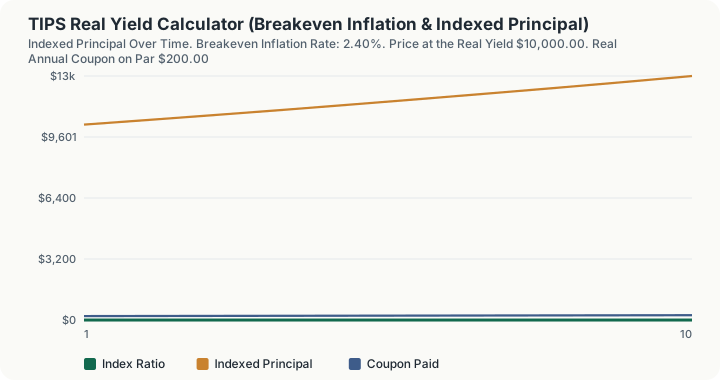
Quick Answer: With a 10-year TIPS yielding 2.00% real and the matching nominal Treasury yielding 4.40%, breakeven inflation is 2.40%. That is the inflation rate at which the two securities return the same amount. At an assumed 2.5% inflation, a $10,000 TIPS with a 2.00% real coupon accretes to $12,800.85 of principal at maturity and pays $2,268.51 in cumulative coupon cash, for total nominal proceeds of $15,069.36.
What does this calculator do?
The defining mechanic of a Treasury Inflation-Protected Security is that the principal is indexed to CPI-U, and the fixed coupon rate is applied to that indexed principal. Inflation compensation therefore arrives through the principal, not through the rate. Which is why the coupon rate and the quoted yield on a TIPS are both real numbers, and why a TIPS yield can and routinely does go negative without anything being wrong.
Two consequences follow, and this calculator computes both directly.
Pricing a TIPS is ordinary bond arithmetic done entirely in real terms: discount the real coupons and the real principal at the real yield. Your inflation assumption never touches the price. It affects only the projected nominal cash flows.
Breakeven inflation is the nominal yield less the real yield of the same maturity. It is not anyone's forecast. It is the inflation rate at which a nominal Treasury and a TIPS return the same amount, and therefore the rate the market is implicitly pricing. Realised inflation above it and the TIPS wins; below and the nominal wins.
How is this calculated?
Step 1: Compute breakeven inflation by subtraction. This is the market convention. 4.40% - 2.00% = 2.40%
Step 2: Compute it again on the exact Fisher relation, which keeps the cross term.
breakeven_exact = (1 + y_nominal)/(1 + y_real) − 1
(1.044 / 1.02) - 1 = 0.023529 = 2.35%
The simple subtraction runs about 5 basis points high here. Both are reported so the approximation is visible rather than assumed away.
Step 3: Compare your own inflation assumption against breakeven. 2.50% - 2.40% = +0.10 percentage points
Your assumption is above breakeven, so on your own view the TIPS wins.
Step 4: Price the bond in real terms. With a 2.00% real coupon and a 2.00% real yield over 10 years at semiannual compounding, the coupon equals the yield, so the bond prices at par: $10,000.00
Your 2.5% inflation assumption played no part in this figure and cannot.
Step 5: Compute the real annual coupon on unindexed par. $10,000 x 2.00% = $200.00
Step 6: Project the index ratio at maturity. 1.025¹⁰ = 1.280085
Step 7: Apply it to principal. $10,000 x 1.280085 = $12,800.85
Step 8: Isolate the inflation compensation. $12,800.85 - $10,000.00 = $2,800.85
Step 9: Project the coupon cash year by year. Coupons are paid on principal that is being indexed continuously through the year, so the engine applies the index ratio at the midpoint of each year as the fair annual approximation. Year one: $10,000 x 1.025⁰·⁵ x 2.00% = $10,000 x 1.012423 x 0.02 = $202.48
Year two: $10,000 x 1.025¹·⁵ x 0.02 = $207.55. And so on, each year's coupon larger than the last because the principal it is calculated on has grown.
Step 10: Sum the ten coupons. $2,268.51
Against $2,000 of coupon cash on an unindexed bond of the same real rate. The extra $268.51 is inflation compensation arriving through the coupon, on top of the $2,800.85 arriving through the principal.
Step 11: Total nominal proceeds. $12,800.85 + $2,268.51 = $15,069.36
Step 12: Compute the implied nominal yield your assumption produces. This is the exact Fisher combination, not a sum. (1 + 0.02) x (1 + 0.025) - 1 = 1.0455 - 1 = 4.55%
Against a nominal Treasury at 4.40%. The 15 basis point edge is the same conclusion as Step 3, restated as a yield.
Step 13: Apply the deflation floor test. At maturity, Treasury pays the greater of the inflation-adjusted principal and the original par amount. Here the indexed principal of $12,800.85 exceeds the $10,000 par, so the floor does not bind and the page reports that plainly. Coupons are never floored: they are always paid on the possibly reduced indexed principal.
Step 14: Report the real Macaulay duration. 9.11 years, computed on the real cash flows at the real yield.
Worked Example
You are choosing between a 10-year TIPS at a 2.00% real yield and a 10-year nominal Treasury at 4.40%. You expect inflation of 2.5%.
Step 1: Find the indifference point. 4.40% - 2.00% = 2.40% breakeven inflation.
This is the entire decision reduced to one number. Above 2.40% realised inflation, the TIPS wins. Below it, the nominal wins. The question is no longer "will there be inflation" but "will inflation exceed 2.40% on average for ten years".
Step 2: Place your view. You expect 2.50%, which is 10 basis points above breakeven. The TIPS wins on your view, but not by much. That is a thin margin for a ten-year commitment, and it is worth knowing that it is thin.
Step 3: See where the compensation actually arrives. Principal accretion: $2,800.85 Extra coupon cash from indexation: $2,268.51 - $2,000.00 = $268.51
More than 91% of the inflation compensation comes through principal, which is why TIPS coupon payments look so small next to a nominal bond's.
Step 4: Note the cash flow shape. You receive $202.48 in year one and $12,800.85 of principal in year ten. A nominal Treasury at 4.40% pays $440 a year on the same face. If you need current income, the TIPS is a poor instrument even when it is the better investment.
Step 5: Note the tax consequence of that shape. The principal accretion is taxable as ordinary income in the year it accrues, even though no cash arrives until maturity. This is the "phantom income" problem, and it is why TIPS are generally held in tax-deferred accounts. Nothing on this page computes it.
Step 6: Test the deflation case. Set assumed inflation to -1%. Principal shrinks each year, coupons shrink with it, and the maturity payment is floored at the original $10,000 par. The floor protects the principal you get back; it does not protect the coupons you received along the way, which were paid on the reduced indexed principal.
Carrying the Indexation Year by Year
Step 7: End of year one. Index ratio 1.025000, indexed principal $10,250.00, coupon paid $202.48
Step 8: End of year two. Index ratio 1.050625, indexed principal $10,506.25, coupon $207.55, coupons to date $410.03
Step 9: End of year five. Indexed principal $11,314.08, coupons to date $1,064.33
Step 10: End of year ten, maturity. Index ratio 1.280085, indexed principal $12,800.85, coupons to date $2,268.51
The coupon grows from $202.48 to $252.88 across ten years while the principal grows by $2,800.85. That is the asymmetry to plan around. A nominal Treasury at 4.40% would have paid $4,400.00 of coupon cash over the same decade against this bond's $2,268.51, and the TIPS makes up the difference in a single payment at the end. If the holding is in a taxable account, the tax on the accretion arrives every year and the cash to pay it does not.
What does this calculator not account for?
- Taxes, including the phantom income problem. Principal accretion is federally taxable in the year it accrues without any cash being paid. No tax of any kind is computed here.
- The published index lag. Real TIPS use a reference CPI with roughly a three-month lag, interpolated daily between monthly index values. This calculator applies a smooth annual inflation rate, and uses the midpoint index ratio to approximate coupon accrual within each year.
- A realistic inflation path. Inflation is applied as a single constant annual rate. Real CPI is volatile, and the same average delivered in a different order produces different coupon cash.
- Accrued interest and settlement. The price shown is a clean price at a coupon date. Nothing adjusts for a mid-period settlement or for the index ratio applying at purchase.
- The purchase index ratio for a seasoned issue. The projection starts from an index ratio of 1, that is, from issue. A TIPS bought years after issue already carries accreted principal, and buying that accretion is a real consideration this page does not model.
- Auction mechanics, bid-ask spread and liquidity. TIPS trade less liquidly than nominal Treasuries, and that spread is a real cost not reflected in the price.
- Any authority for the yields you enter. The 2.00% real and 4.40% nominal defaults are illustrative. Nothing here sources a live Treasury quote, and breakeven inflation computed from stale yields is stale.
- The inflation risk premium. Breakeven inflation is not a pure expectation. It contains a premium investors demand for bearing inflation uncertainty and a liquidity premium on TIPS, which push it in opposite directions. The page reports the arithmetic breakeven and does not attempt to decompose it.
What mistakes do people make with this?
- Thinking the inflation assumption affects the price. It cannot. The price is real coupons discounted at a real yield. Change the assumed inflation from 2.5% to 5% and the $10,000 price does not move by a cent, while every projected cash flow does. This surprises people and it is the most important thing to understand about TIPS pricing.
- Reading breakeven as a forecast. It is a break-even point, which is exactly what the name says. Nobody at the Treasury or the Federal Reserve is predicting 2.40% inflation; that is simply where the two securities tie.
- Adding the real yield and inflation to get the nominal. 2.00% + 2.50% = 4.50%, but the exact answer is 4.55%. The cross term is worth 5 basis points here and considerably more at higher rates. The page reports the exact figure.
- Expecting the deflation floor to protect the coupons. It does not. Only the maturity principal payment is floored at par. Coupons through a deflationary stretch are paid on reduced principal and that reduction is permanent.
- Holding TIPS in a taxable account without thinking about it. The accretion is taxed before the cash arrives.
- Comparing a TIPS yield to a nominal yield directly. A 2.00% real yield is not "worse" than a 4.40% nominal yield. They are quoted in different units. The only valid comparison runs through breakeven inflation.
- Assuming a negative real yield means an error. It is routine. A negative real yield means investors are accepting a guaranteed loss of purchasing power in exchange for the inflation protection.
Frequently Asked Questions
What does breakeven inflation actually tell me?
Why is the simple breakeven different from the exact one?
Does inflation change what I pay for the bond?
What happens to my principal in a deflation?
Why is my TIPS coupon payment so small?
Can the real yield be negative?
Is breakeven inflation the market's inflation forecast?
Sources
- The index applied to TIPS principal is the non-seasonally-adjusted Consumer Price Index for All Urban Consumers (CPI-U), published by the Bureau of Labor Statistics; real TIPS use a reference index with a lag, which this projection does not model. bls.gov/cpi
- TreasuryDirect, U.S. Department of the Treasury, the official authority for the bonds this calculator relates to. treasurydirect.gov
Also consulted: 31 CFR 356.30, the Treasury's uniform offering circular provision establishing that at maturity the inflation-adjusted principal of an inflation-protected security is paid at not less than the original par amount. This is the deflation floor applied in the engine, and it applies to the maturity principal payment only, not to coupons; Fisher, I., "The Theory of Interest," 1930. The exact relation between nominal rates, real rates and inflation used for the exact breakeven and the implied nominal yield; Pricing and duration are computed by the platform's shared bond primitive, run entirely on real inputs so that the price and the inflation assumption are structurally independent.