Quick Answer: A $500,000 purchase with 15% down and a 7% owner-carry note amortised over 30 years pays $2,827.54 a month. That is a 30-year payment on a five-year loan: only $24,941.10 of the $425,000 note is retired before the balloon, leaving $400,058.90, or 94.13% of the note, due in a single instalment in month 60.
What does this calculator do?
In an owner-carry deal the seller becomes the lender. The buyer pays a down payment and signs a promissory note secured by a deed of trust or mortgage on the property. No bank is involved, which is the appeal, and no bank is involved, which is the risk.
The structural fact that governs almost every one of these deals is a mismatch that neither party always states plainly: the note is amortised over one term and matures on another. The payment is sized on a 30-year schedule to keep it affordable. The loan comes due in three to seven years. The consequence is that the buyer repays almost nothing before the entire balance falls due at once.
That is not a defect in the structure. It is the structure. A long amortisation is exactly what makes the payment manageable, and the balloon is what compensates the seller for not waiting thirty years to be repaid. But it means the deal has a hard deadline built into it, and the buyer's real obligation is not the payment. It is refinancing, selling or extending before month 60.
This calculator prices both halves: what the long amortisation buys you each month, and what it defers to the balloon date.
How is this calculated?
PMT = N × i/(1 − (1 + i)^(−nₐ)); balloon = B_n_b
where $N$ is the note amount, $i$ the monthly rate, nₐ the amortisation months and n_b the balloon month. The balloon is read from the amortisation schedule rather than re-derived, so it reconciles to the cent.
Step 1: Find the down payment. $500,000 x 15% = $75,000
Step 2: The rest is the note the seller carries. $500,000 - $75,000 = $425,000
Step 3: Check the loan-to-value at closing. $425,000 / $500,000 = 85%
Step 4: Size the payment on the amortisation term, not the balloon term. $425,000 at 7% / 12 over 360 months = $2,827.54 a month
Step 5: Run the schedule to the balloon month. 5 years x 12 = month 60
Step 6: Interest paid over those 60 payments. $144,711.30
Step 7: Principal repaid over the same 60 payments. $24,941.10
Step 8: Total payments made before the balloon. $144,711.30 + $24,941.10 = $169,652.40
Step 9: The balance still owed, which is the balloon. $425,000 - $24,941.10 = $400,058.90
Step 10: Express the balloon as a share of the note. $400,058.90 / $425,000 = 94.13%
Step 11: And the loan-to-value on the balloon date. $400,058.90 / $500,000 = 80.01%, barely moved from the 85% at closing
Step 12: Total handed to the seller: down, payments and balloon. $75,000 + $169,652.40 + $400,058.90 = $644,711.30
Step 13: What the payment would be with no balloon at all. The same $425,000 at 7% over 60 months = $8,415.51 a month
Step 14: The monthly relief the long amortisation buys. $8,415.51 - $2,827.54 = $5,587.97 a month
Step 14 is the honest statement of the trade. The long amortisation saves the buyer $5,587.97 every month and defers $400,058.90 to a single date.
Worked Example
Three structures on the same $425,000 note, so the trade-off is visible rather than described.
Structure A: 30-year amortisation, 5-year balloon (the default).
Step 1: Payment: $2,827.54 Step 2: Principal retired by month 60: $24,941.10, which is 5.9% of the note Step 3: Balloon: $400,058.90
Structure B: interest-only, 5-year balloon.
Step 4: Payment is pure interest: $425,000 x 7% / 12 = $2,479.17 Step 5: Principal retired: $0 Step 6: Balloon: the full $425,000, and the loan-to-value on the balloon date is exactly the 85% it was at closing
Structure C: fully amortised over 15 years, no balloon.
Step 7: Payment: $3,820.02 Step 8: Balloon: none Step 9: The cost of that certainty: $992.48 a month more than Structure A
Structure B lowers the payment by $348.37 a month against Structure A and increases the balloon by $24,941.10. That is a poor trade for the buyer and an excellent one for a seller who wants the principal back intact, which is why interest-only notes are common in owner-carry deals and why buyers should read them carefully.
Structure C is the only one with no refinancing risk at all, and it costs $992.48 a month to eliminate that risk.
One more lever, and it is the cheapest of them: extending the balloon from year 5 to year 10 leaves the payment completely unchanged at $2,827.54, because the payment is sized on the same 30-year schedule. It simply lets the schedule run longer, so more principal is retired and the balloon shrinks. If you can negotiate anything in an owner-carry deal, negotiate the balloon date before you negotiate the rate.
Carrying Structure A to the Balloon Date
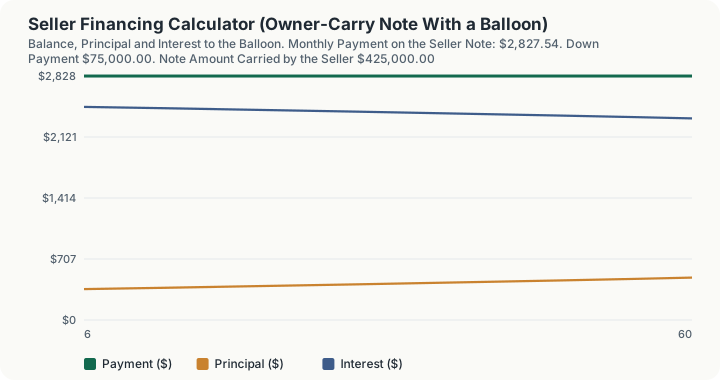
The note schedule reports every sixth month, which is enough to watch the principal barely move.
Step 10: Month 6. Of the $2,827.54 payment, $358.65 is principal and $2,468.89 is interest. Balance $422,879.04, interest paid to date $14,844.28
Step 11: Month 12. Principal $371.39, interest $2,456.15. Balance $420,682.74, interest to date $29,613.22
Step 12: Month 36. Balance $411,089.40, interest to date $87,880.84
Step 13: Month 60, the balloon. Balance $400,058.90, interest to date $144,711.30
Five years of payments come to $169,652.40. Of that, $144,711.30 was interest and $24,941.10 touched the principal, and the buyer still owes $400,058.90 on the day the note comes due. That is the number to underwrite against: not the payment, and not the rate, but the fact that sixty payments buy you an obligation to refinance almost the whole original note.
What does this calculator not account for?
- Property tax, insurance and HOA. The payment shown is principal and interest on the note only. In many owner-carry deals the buyer pays taxes and insurance directly, and the note will require proof of both.
- Closing costs, escrow, title insurance and recording fees.
- Whether the seller can legally carry the note. Owner financing of a residential property can bring the seller within mortgage originator rules depending on frequency and structure. Nothing here assesses that.
- Due-on-sale exposure. If the seller has an existing mortgage on the property, selling it typically triggers the due-on-sale clause. A wrap-around structure carries that risk and this calculator does not model it.
- The buyer's ability to refinance in month 60. This is the central risk in the structure and it depends on conditions five years out.
- Late fees, default interest, forfeiture or foreclosure terms, all of which live in the note and the security instrument.
- Tax treatment. Installment sale reporting for the seller and interest deductibility for the buyer are outside this calculation.
- Any prepayment provision. The engine assumes payments follow the schedule exactly.
What mistakes do people make with this?
- Reading the payment as the loan. The payment is a 30-year payment. The loan is a five-year loan. Those are not the same commitment and only one of them appears on the monthly statement.
- Assuming the balloon shrinks meaningfully over five years. It does not. At the defaults you retire 5.9% of the note and still owe 94.13% of it on the due date.
- Taking an interest-only note to save money. It saves $348.37 a month here and adds $24,941.10 to the balloon. The loan-to-value on the balloon date is identical to the day you closed.
- Negotiating the rate instead of the balloon date. Moving the balloon from year 5 to year 10 costs nothing per month and shrinks the balance due. A rate concession does far less.
- Underestimating the down payment's role. It is the seller's only protection against a buyer who walks, which is why owner-carry deals commonly run 10% to 20% down rather than 3%.
- Not recording the security instrument. A promissory note without a properly recorded deed of trust or mortgage leaves the seller unsecured. That is a legal matter, not a mathematical one, and it is where these deals go wrong.
Frequently Asked Questions
What is a balloon payment in seller financing?
Why is the payment based on 30 years if the loan is only 5 years?
How much principal do I actually pay off before the balloon?
Is an interest-only seller note a good idea?
What down payment do sellers usually want?
Can I extend the balloon instead of refinancing?
Sources
- Regulation Z (Truth in Lending), 12 CFR Part 1026, including the Appendix J annual percentage rate computation. ecfr.gov/current/title-12/chapter-X/part-1026
Also consulted: This calculation is pure loan mathematics and uses no statutory data. The purchase price, down payment percentage, note rate, amortisation term and balloon term are all user inputs; The payment comes from the standard annuity payment formula on the amortisation term. The balloon balance, the interest paid and the principal retired before the balloon are read directly from the amortisation schedule rather than re-derived, so the components reconcile to the note amount to the cent; For an interest-only note the engine builds the schedule explicitly rather than through the amortising path, because a self-liquidating schedule would incorrectly reconcile the final row's principal up to the full original balance on a note that repays no principal at all.