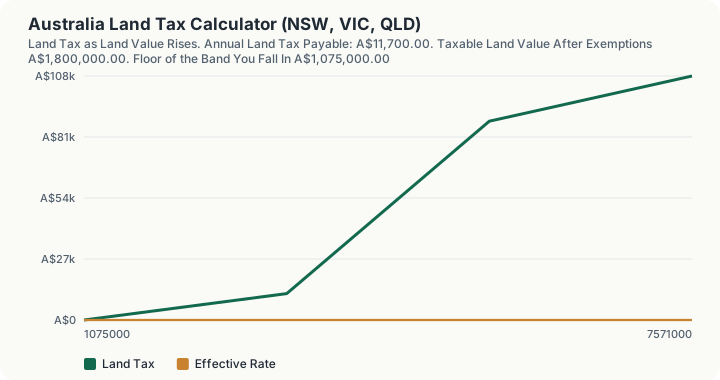
Quick Answer: A$1,800,000 of taxable land held by an individual in New South Wales owes A$11,700.00 of land tax for the 2026 land tax year: A$100 plus 1.6% of the A$725,000 above Revenue NSW's A$1,075,000 threshold. The same land owes A$11,850.00 in Victoria and A$17,700.00 in Queensland, and nothing in the Northern Territory.
What does this calculator do?
Land tax in Australia is imposed by the states and territories, never by the Commonwealth. Each state sets its own threshold and rate scale under its own Act and publishes the schedule through its own revenue office. This calculator loads the published schedule for individuals in the three largest land-tax states and the Northern Territory:
| Jurisdiction | Year loaded | Schedule source |
|---|---|---|
| NSW | 2026 land tax year (land held at midnight 31 December 2025) | Revenue NSW, land tax thresholds and rates |
| VIC | 2026 land tax year; the SRO states the scale applies for 2024 to 2033 | State Revenue Office Victoria, land tax current rates |
| QLD | 2026-27 (land held at midnight 30 June 2026) | Queensland Revenue Office, individual and absentee rates |
| NT | Any year | Northern Territory Government: there is no land tax in the NT |
South Australia, Western Australia, Tasmania and the ACT are not offered. Their schedules have not been verified from the revenue office's own table, and a placeholder presented as a state's real schedule would be worse than no answer at all.
The three schedules are genuinely different in shape, not just in level:
- New South Wales has a single general threshold of A$1,075,000 (frozen from 2024 by the 2024-25 NSW Budget). Above it you pay A$100 plus 1.6% of the excess; above the premium threshold of A$6,571,000 you pay A$88,036 plus 2%. Revenue NSW writes the bands as "more than" the threshold, so land valued exactly at A$1,075,000 pays nothing.
- Victoria taxes from A$50,000. Holdings from A$50,000 to under A$100,000 pay a flat A$500, holdings from A$100,000 to under A$300,000 pay a flat A$975, and from A$300,000 a fixed amount plus a marginal rate applies, rising through 0.3%, 0.6%, 0.9% and 1.65% to 2.65% on value above A$3,000,000.
- Queensland charges individuals nothing below A$600,000, then A$500 plus 1 cent per dollar above A$600,000, A$4,500 plus 1.65 cents above A$1,000,000, A$37,500 plus 1.25 cents above A$3,000,000, A$62,500 plus 1.75 cents above A$5,000,000, and A$150,000 plus 2.25 cents above A$10,000,000. Queensland's middle band genuinely has a lower marginal rate than the one below it.
Victoria and Queensland write their bands as "A$X to under A$Y", so a value exactly at a band floor is taxed in that band. The engine applies each state's own convention.
Foreign and absentee owners
The owner selector changes the treatment in each state, because each state does it differently:
- NSW adds surcharge land tax of 5% of the land value, from the 2025 land tax year onwards, with no tax-free threshold. It applies to residential land.
- Victoria adds an absentee owner surcharge. The SRO publishes separate absentee tables, and every band in them is exactly the general band plus 4% of total taxable value, from A$50,000.
- Queensland does not add a surcharge. A foreign individual without a permanent visa who does not usually live in Australia is assessed on a separate absentee schedule instead of the individual one: nil below A$350,000, then A$1,450 plus 1.7 cents per dollar above A$350,000, stepping to 1.5, 2.0 and 2.5 cents at A$2,250,000, A$5,000,000 and A$10,000,000.
One point people get wrong constantly: land tax is assessed on the unimproved or site value of the land, not the market value of the property standing on it. A house worth A$2,000,000 on land valued at A$1,100,000 is assessed on A$1,100,000. Your revenue office issues that valuation.
How is this calculated?
Using the defaults: New South Wales, an individual owner, total land value A$1,800,000 and no exempt residence.
- Step 1: Remove the exempt principal place of residence from the aggregate. max(0, A$1,800,000 - A$0) = A$1,800,000
- Step 2: Load the state's schedule for the owner. NSW and VIC use the general schedule for every owner; QLD uses the absentee schedule for a foreign owner and the individual schedule otherwise. NSW general: A$100 + 1.6% above A$1,075,000; A$88,036 + 2% above A$6,571,000.
- Step 3: Find the applicable band. The highest band whose floor the value exceeds (NSW) or reaches (VIC and QLD). A$1,800,000 is above A$1,075,000 and below A$6,571,000. applicable floor = A$1,075,000
- Step 4: Compute the excess over that band's floor. A$1,800,000 - A$1,075,000 = A$725,000
- Step 5: Apply the band's marginal rate to the excess. A$725,000 x 1.6% = A$11,600.00
- Step 6: Add the band's fixed amount. A$11,600.00 + A$100 = A$11,700.00
- Step 7: Add any foreign or absentee surcharge on land value. NSW 5% of value; VIC 4% of value once value reaches A$50,000; none in QLD (the absentee schedule already applied) or for an individual resident owner. A$1,800,000 x 0% = A$0.00
- Step 8: Total the annual land tax. A$11,700.00 + A$0.00 = A$11,700.00
- Step 9: Express as an effective rate on taxable land value. A$11,700.00 / A$1,800,000 = 0.65%
The table under the result lists the land tax at the floor of every band of the selected schedule, plus your own value, so you can see where the steps fall.
Worked Example
Same land, three states. A$1,800,000 of taxable land:
- NSW: A$100 + 1.6% x A$725,000 = A$11,700.00
- VIC: A$1,800,000 is exactly the floor of the A$11,850 + 1.65% band, so the tax is A$11,850.00
- QLD: A$4,500 + 1.65% x (A$1,800,000 - A$1,000,000) = A$4,500 + A$13,200 = A$17,700.00
The home exemption. In NSW, if A$900,000 of that A$1,800,000 is the land under your home, Step 1 leaves A$900,000, which is below the A$1,075,000 threshold. The tax is A$0.00: the exemption did not reduce the bill, it removed it.
A foreign owner. The same A$1,800,000 held by a foreign person:
- NSW: A$11,700 + 5% x A$1,800,000 (A$90,000) = A$101,700.00. The surcharge is almost eight times the general tax, because it is charged on the whole land value with no threshold.
- VIC: A$11,850 + 4% x A$1,800,000 (A$72,000) = A$83,850.00, which is the SRO's own absentee table figure at A$1,800,000.
- QLD: absentee schedule, A$1,450 + 1.7% x (A$1,800,000 - A$350,000) = A$1,450 + A$24,650 = A$26,100.00.
The NSW premium band. A$8,000,000: A$88,036 + 2% x (A$8,000,000 - A$6,571,000) = A$88,036 + A$28,580 = A$116,616.00. Revenue NSW's premium fixed amount is the general band carried to the premium threshold: A$100 + 1.6% x (A$6,571,000 - A$1,075,000) = A$88,036. Every published schedule loaded here reconciles that way at each band floor where a marginal rate applies, and the engine's test vectors check it.
What does this calculator not account for?
- Companies and trusts. Only the individual schedules are loaded. Queensland assesses companies and trustees on a separate schedule with a lower threshold, and Victoria applies a trust surcharge schedule to land held on trust. Use this calculator only for land held by individuals.
- South Australia, Western Australia, Tasmania and the ACT are not offered, because their schedules have not been verified from the revenue office.
- NSW surcharge land tax applies only to residential land. The calculator applies the 5% to the whole taxable value entered when the owner is foreign; enter only the residential land value for a mixed portfolio.
- Partial residence exemptions. The principal place of residence field removes whatever land value you enter. States restrict the exemption by land area, use and occupation, and grant only part of it in some cases (for example where part of the home is used for business or rented).
- Other exemptions and concessions: primary production land, charitable uses, build-to-rent, and first-year or moving-home concessions.
- Vacant residential land tax in Victoria and similar separate imposts, which have their own base and rate.
- Averaging. NSW assesses land tax on the average of the last three years' land values in most cases. Enter the taxable (averaged) value from your assessment, not the latest single valuation.
- Joint ownership. Co-owned land is assessed in a way that combines joint and individual holdings differently in each state; enter your own taxable aggregate.
What mistakes do people make with this?
- Entering market value instead of site value. This is the single most common error and inflates the result substantially. Use the unimproved or site valuation your revenue office issues.
- Assessing each property separately. Land tax aggregates all your taxable land in the state. Two blocks each below the threshold are frequently taxable when added together.
- Assuming Victoria is cheap because its threshold looks low. The Victorian scale starts at A$50,000 but its marginal rates are lower in the middle bands, so the comparison depends on the value.
- Applying a surcharge in Queensland. Queensland does not add a percentage on top; it replaces the schedule.
- Assuming the Northern Territory result is a bug. The NT levies no land tax.
Frequently Asked Questions
Which year do these schedules apply to?
Why is my state not in the list?
Is land tax charged on what my property is worth?
Does my home attract land tax?
Does the foreign owner surcharge replace the base tax?
Sources
- Revenue NSW, Land tax thresholds and rates. revenue.nsw.gov.au/taxes-duties-levies-royalties/land-tax/understanding-land-tax/thresholds-and-rates
- Revenue NSW, What is surcharge land tax? revenue.nsw.gov.au/taxes-duties-levies-royalties/land-tax/surcharge-land-tax/what-is-surcharge-land-tax
- State Revenue Office Victoria, Land tax (current rates), including the absentee owner surcharge tables. sro.vic.gov.au/land-tax-current-rates
- Queensland Revenue Office, Land tax rates for individuals. qro.qld.gov.au/land-tax/calculate/individual
- Queensland Revenue Office, Absentee land tax rates. qro.qld.gov.au/land-tax/calculate/absentee
- Northern Territory Government, Property taxes (no land tax in the NT). nt.gov.au/property/land/land-taxes