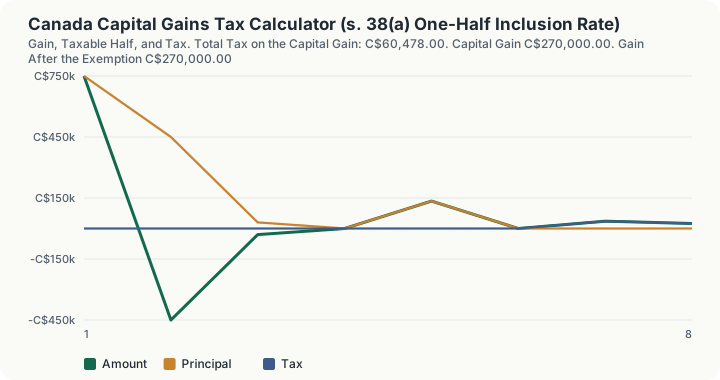
Quick Answer: C$750,000 of proceeds against a C$450,000 adjusted cost base and C$30,000 of selling costs leaves a C$270,000 capital gain. Income Tax Act s. 38(a) includes exactly half, so C$135,000 is added to income. Stacked on C$100,000 of other taxable income in Ontario, that adds C$60,478.00 of 2026 tax: C$35,927.28 federal and C$24,550.72 Ontario. That is an effective 22.40% on the whole gain, against C$131,872.94 if the gain were fully taxable. All figures are in Canadian dollars.
What does this calculator do?
Canada has no separate capital gains tax. There is no special rate, no separate return and no holding-period test. What exists instead is an inclusion rate: Income Tax Act s. 38(a) provides that "a taxpayer's taxable capital gain ... is 1/2 of the taxpayer's capital gain", and that taxable half is simply added to your ordinary income and taxed under the same federal and provincial brackets as salary.
So the tax on a gain depends on two things this page asks for: your province or territory, and how much other taxable income you have in the year. The calculator adds the taxable half to your other income, computes 2026 federal and provincial tax with and without it, and reports the difference. A gain that climbs through several brackets, crosses into the Ontario surtax, or pushes income into the range where the federal basic personal amount shrinks is taxed exactly as those 2026 schedules say.
That matters because the same sale can cost very different amounts. At the defaults the gain adds C$60,478.00 of tax in Ontario, C$51,540.99 in Alberta, C$63,763.49 in Quebec and C$49,184.27 in Nunavut. Sold in a year with no other income, the same gain adds only C$35,114.21 in Ontario, because the taxable half then starts at the bottom of both ladders.
Two provisions can remove the gain entirely. Section 40(2)(b) shelters a gain on a property designated as your principal residence, in proportion to the years designated. Section 38(a.1) sets the taxable capital gain at nil for a gift of publicly listed securities or an ecological gift to a qualified donee, which is why donating shares in kind beats selling them and donating the cash.
How is this calculated?
- The capital gain. Proceeds less adjusted cost base less the costs of disposing, under s. 40(1)(a).
- The principal residence exemption. The share of the gain you enter as sheltered under s. 40(2)(b) is removed.
- The s. 38(a) inclusion rate. One half, unless s. 38(a.1) applies to a qualifying gift, in which case the rate is nil.
- Allowable capital losses. Losses carried forward reduce the taxable half, never the gain itself and never other income.
- Tax without the gain. Your other taxable income runs through the 2026 federal ladder and your province's or territory's 2026 ladder, less each level's basic personal amount credit at its lowest rate, with the Quebec abatement, Ontario surtax and health premium, and Ontario and BC tax reductions where they apply.
- Tax with the gain. The same computation on your other income plus the net taxable capital gain, stacked on top so it lands in your highest brackets.
- Tax on the gain. The difference between step 6 and step 5, federal and provincial separately.
G = P − ACB − Outlays, TCG = max(0, 1/2G(1 − f) − L)
Tax on gain = T(I + TCG) − T(I)
Worked Example
Using the page defaults: C$750,000 proceeds, C$450,000 adjusted cost base, C$30,000 of commission and legal fees, no principal residence designation, and C$100,000 of other taxable income in Ontario.
Step 1: subtract the adjusted cost base from proceeds. C$750,000 less C$450,000. C$300,000
Step 2: subtract the outlays and expenses of selling. C$300,000 less C$30,000. C$270,000
Step 3: apply the s. 38(a) one-half inclusion rate. Half of C$270,000. C$135,000
Step 4: income tax without the gain. Federal and Ontario 2026 tax on C$100,000 of taxable income. C$21,520.57
Step 5: income tax with the gain. The same on C$235,000, where the top slice reaches the 29% federal bracket, the federal basic personal amount has started to phase down, and the Ontario surtax applies. C$81,998.57
Step 6: tax on the gain. C$81,998.57 less C$21,520.57, made up of C$35,927.28 federal and C$24,550.72 Ontario. C$60,478.00
Step 7: net proceeds. C$750,000 less the C$30,000 of selling costs less the tax. C$659,522.00
The effective rate on the economic gain is C$60,478 divided by C$270,000, or 22.40%. On the taxable half alone it is 44.80%, well above the 31.48% marginal rate at C$100,000, because most of the taxable half sits in higher brackets. If the whole C$270,000 were taxed like salary it would add C$131,872.94, and that gap is what s. 38(a) is worth.
What does this calculator not account for?
- Only the basic personal amount credits. Tax with and without the gain uses each level's basic personal amount and no other credit, so your other income is treated as taxable income with no further credits. Because the same credits would apply in both computations, this mostly affects tax at low other income.
- Low-income reductions outside Ontario and British Columbia are not modelled, and Quebec's own deductions and credits are not modelled.
- Net income is taken to equal taxable income for the federal, Manitoba and Yukon basic personal amount phase-outs.
- The principal residence exemption is entered as a percentage, not derived. The s. 40(2)(b) formula turns on the number of years designated plus one, over the years owned, and on facts about which property was designated in which year. That is a factual determination this page cannot make for you.
- The alternative minimum tax is not modelled. A large capital gain is one of the most common triggers for AMT, particularly where a donation of securities has also removed the regular tax.
- No superficial loss rule, no attribution rules, no deemed dispositions on emigration or death, no capital gains reserve for proceeds received over several years, and no lifetime capital gains exemption for qualified small business corporation shares or qualified farm and fishing property.
- Foreign currency gains are not separated. A gain on a foreign-currency asset has to be computed in Canadian dollars at the exchange rates on the acquisition and disposition dates.
What mistakes do people make with this?
- Guessing the adjusted cost base. This is the single most common error on a Canadian capital gain. The ACB includes the original purchase price, legal fees and land transfer tax on acquisition, and every capital improvement since.
- Forgetting the outlays and expenses. Real estate commission alone is frequently four or five percent of the sale price. At the defaults here, the C$30,000 of selling costs is worth C$7,473.68 of tax.
- Applying your usual marginal rate to the whole gain. A large taxable half climbs through the brackets above your other income, so the tax on it is usually more than your current marginal rate times the taxable half. Timing a sale into a lower-income year can cut the bill sharply.
- Thinking there is a special capital gains rate. There is not. There is an inclusion rate, and the included half is taxed like salary.
- Believing capital losses can shelter ordinary income. They cannot. An allowable capital loss offsets taxable capital gains only, though it can be carried back three years and forward indefinitely against those.
Frequently Asked Questions
What is the capital gains inclusion rate in Canada?
How much tax will I pay on a C$270,000 capital gain in Ontario?
Which province taxes capital gains the least?
Do I pay tax when I sell my home?
Is it better to donate shares or to sell them and donate the cash?
Sources
- Income Tax Act, R.S.C. 1985, c. 1 (5th Supp.), s. 38(a), the one-half inclusion rate, and s. 38(a.1), the nil inclusion for gifts of listed securities and ecological gifts to qualified donees. Justice Laws Website, read 2026-08-31; Act current to 2026-06-21, last amended 2026-06-18. laws-lois.justice.gc.ca/eng/acts/I-3.3/section-38.html
- Canada Revenue Agency, Current year tax rates and income brackets (2026), page dated 2026-06-25, read 2026-10-14. canada.ca/en/revenue-agency/services/tax/individuals/tax-rates-brackets/current-year.html
- Canada Revenue Agency, T4127 Payroll Deductions Formulas, 122nd Edition (January 1, 2026) and 123rd Edition (July 1, 2026): the 2026 basic personal amounts, Ontario surtax, health premium and tax reduction, BC tax reduction, Alberta supplemental credit, Manitoba and Yukon basic personal amount rules, and the Quebec abatement. Read 2026-10-14. canada.ca/en/revenue-agency/services/forms-publications/payroll/t4127-payroll-deductions-formulas/t4127-jan/t4127-jan-payroll-deductions-formulas-computer-programs.html
- Revenu Quebec, Income Tax Rates (2026). Read 2026-10-14. revenuquebec.ca/en/citizens/income-tax-return/completing-your-income-tax-return/income-tax-rates
- Manitoba Finance, Personal Income Taxes. Read 2026-10-14. gov.mb.ca/finance/personal/ptaxes.html