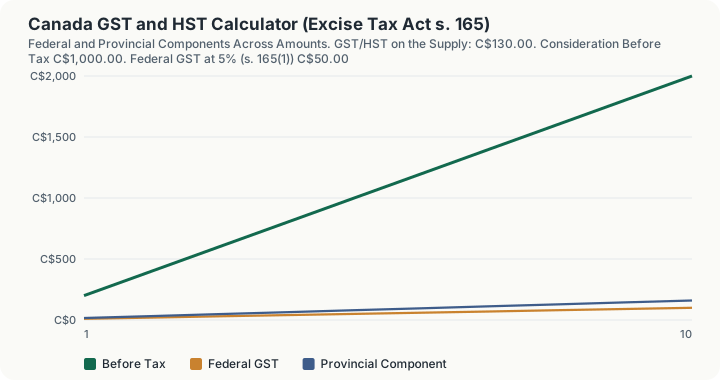
Quick Answer: C$1,000 of consideration in a participating province with an 8% provincial component carries C$130.00 of GST/HST: C$50.00 of federal GST at the statutory 5% rate under Excise Tax Act s. 165(1), plus C$80.00 of provincial component under s. 165(2), for a combined 13% rate and C$1,130.00 payable by the recipient. Set the provincial component to zero and the tax falls to C$50.00. All figures are in Canadian dollars.
What does this calculator do?
The GST and the HST are the same tax wearing two hats. Excise Tax Act s. 165(1) imposes a federal tax "calculated at the rate of 5% on the value of the consideration for the supply", and that 5% applies everywhere in Canada. Section 165(2) then adds, for a supply made in a participating province, a further tax "calculated at the tax rate for that province". Where that second layer exists, the two are administered together as a single harmonized rate, which is why an invoice shows one line rather than two.
The federal 5% is written into the section itself. The provincial component is not: s. 165(2) points at a "tax rate for a participating province" that is set out in Schedule VIII to the Act and amended as provinces join, leave or renegotiate. There is no national value for it, and the participating provinces are not all at the same rate. That is why this calculator takes the provincial component as an input and never assumes one.
The second thing worth understanding is the direction of the arithmetic. Adding tax to a price is easy. Backing it out of a tax-included total is where invoices go wrong, because you must divide by one plus the combined rate rather than subtract the rate from the total. On a C$1,130 inclusive figure at 13%, dividing gives C$1,000; subtracting 13% gives C$983.10, which is C$16.90 too high.
How is this calculated?
Step 1: establish the combined rate. The statutory federal rate plus the provincial component you supply, or nil for a zero-rated supply under s. 165(3):
r = 5% + p
Step 2: find the consideration. If the amount you entered already includes tax, back it out; otherwise it is the consideration already:
N = A/(1 + r) or N = A
Step 3: compute the federal component under s. 165(1).
GST = N × 5%
Step 4: compute the provincial component under s. 165(2).
PVAT = N × p
Step 5: total the tax and the amount payable.
T = GST + PVAT; Payable = N + T
Step 6: net input tax credits, if you are a registrant. Tax you charged less tax you paid on business inputs:
Remittable = T − ITCs
Worked Example
Using the page defaults: C$1,000 of consideration, adding tax on, with an 8% provincial component.
Step 1: find the combined rate. The statutory 5% plus the 8% provincial component. 13%
Step 2: the consideration. The amount was entered tax-exclusive, so no back-out is needed. C$1,000.00
Step 3: federal GST under s. 165(1). C$1,000 at 5%. C$50.00
Step 4: provincial component under s. 165(2). C$1,000 at 8%. C$80.00
Step 5: total tax. C$50.00 plus C$80.00. C$130.00
Step 6: amount payable by the recipient. C$1,000.00 plus C$130.00. C$1,130.00
Now run it backwards. Enter C$1,130 and choose to remove tax:
Step 7: divide by one plus the combined rate. C$1,130 divided by 1.13. C$1,000.00
Step 8: what subtracting 13% would have given instead. C$1,130 less 13% of C$1,130. C$983.10
That C$16.90 difference is the error, and on a large contract it is the difference between a correct return and an assessment.
What does this calculator not account for?
- The provincial component has no national value. Section 165(2) does not state a rate; it refers to the "tax rate for a participating province". The consolidated Schedule VIII on the Justice Laws Website still lists 8% for every participating province, but the rates actually charged have since been changed by regulation: the CRA lists 8% for Ontario, 10% for New Brunswick and 9% for Nova Scotia from 1 April 2025. The 8% default is Ontario's rate. Enter your own province's figure from the CRA's rate table.
- Provincial sales taxes outside the HST are not modelled. Several provinces levy a separate retail sales tax alongside the 5% GST rather than harmonizing, and one levies it on a base that includes the GST. None of that appears here.
- The distinction between zero-rated and exempt supplies is not modelled. Both carry no tax, and s. 165(3) covers only the zero-rated case. The difference matters enormously: a zero-rated supplier recovers input tax credits, an exempt supplier does not, and this page treats both simply as untaxed.
- Place of supply rules are not applied. Which province's rate applies to a cross-border supply depends on detailed place-of-supply rules that differ for goods, services, real property and intangibles.
- No registration threshold test. Whether you must register at all is a separate question this page does not answer.
- No quick method, no simplified input tax credit method, no housing rebates under s. 254 or s. 256.2, no point-of-sale rebates that some participating provinces apply to specific goods, and no self-assessment on imports.
What mistakes do people make with this?
- Subtracting the rate to find the pre-tax amount. This is the error the calculator deliberately surfaces. Removing tax means dividing by one plus the rate. Subtracting always leaves you too high, and the gap grows with the rate.
- Assuming one Canadian sales tax rate. The federal 5% is national; the total a customer pays is not. Quoting a single combined rate across the country will be wrong for most of your customers.
- Confusing exempt with zero-rated. Residential rent is exempt, basic groceries are zero-rated, and both look identical on the invoice. The difference shows up entirely in whether the supplier can recover input tax credits.
- Remitting tax collected without claiming input tax credits. A registrant remits output tax less input tax. Forgetting the credit side means paying tax on your turnover instead of on the value you added.
- Rounding each line separately and expecting the invoice to foot. Each component is rounded to the cent independently, so a long invoice can differ by a cent or two from tax computed on the total. That is normal.
Frequently Asked Questions
What is the GST rate in Canada?
What is the difference between GST and HST?
How do I take GST or HST out of a total that already includes it?
What does zero-rated mean?
Why does this calculator make me enter the provincial rate?
Sources
- Excise Tax Act, R.S.C. 1985, c. E-15, s. 165(1), (2) and (3): the 5% federal rate, the additional tax at the tax rate for a participating province, and the 0% rate for a zero-rated supply. Justice Laws Website, read 2026-08-31; last amended 2026-06-18. laws-lois.justice.gc.ca/eng/acts/E-15/section-165.html
- Excise Tax Act, Schedule VIII, "Participating Provinces and Applicable Tax Rates". The consolidated text lists 8% for each participating province and notes that application provisions are not included, so it does not show later regulatory rate changes. laws-lois.justice.gc.ca/eng/acts/E-15/page-123.html
- Canada Revenue Agency, "GST/HST calculator (and rates)": the combined rates in force, including 13% in Ontario, 15% in New Brunswick and 14% in Nova Scotia from 1 April 2025. canada.ca/en/revenue-agency/services/tax/businesses/topics/gst-hst-businesses/charge-collect-which-rate/calculator.html