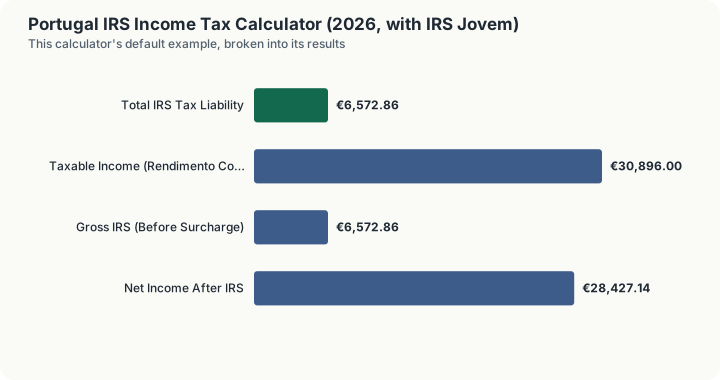
Quick Answer: €35,000 of gross employment income for a single filer, after the €4,104 Category A specific deduction, produces €30,896 of taxable income in bracket 6 (34.9% marginal), owing €6,572.86 in IRS -- an effective rate of about 18.8% -- leaving €28,427.14 net. A 30-year-old earning €28,000 in their first year under the IRS Jovem young-worker regime instead owes €0, since their entire taxable income falls under the 100%-exemption cap.
Overview
IRS (Imposto sobre o Rendimento das Pessoas Singulares) is Portugal's personal income tax, applying progressive brackets to salary, business, rental, capital, and other income categories. This calculator focuses on Category A -- employment income, the most common case -- applying the standard specific deduction, the progressive bracket schedule, an additional solidarity surcharge for very high earners, and, if applicable, the increasingly popular IRS Jovem regime aimed at retaining and attracting young workers.
IRS Jovem is a meaningful, multi-year tax break: a resident worker aged 35 or under can exempt a declining percentage of their qualifying income for up to 10 years -- 100% in year one, tapering through 75%, 50%, and finally 25% in the last three years -- subject to an overall cap tied to a multiple of the IAS (Indexante dos Apoios Sociais, Portugal's social-support reference index). For many young professionals in their first working years, this can mean paying little or no IRS at all.
How This Is Calculated
- Category A specific deduction. A flat €4,104 is subtracted from gross employment income before anything else.
- IRS Jovem exemption (if eligible). A percentage of the remaining income -- 100% in year 1, 75% in years 2-4, 50% in years 5-7, 25% in years 8-10 -- is exempted. The cap applies to the income that qualifies, not to the exemption itself: only the first 55× IAS of qualifying income enters the exemption, and anything above that is taxed in full.
- Taxable income (rendimento coletável). Gross income minus the Category A deduction minus any IRS Jovem exemption.
- Progressive brackets. Article 68 CIRS's nine marginal brackets apply to the taxable income, running from 12.5% on the first €8,342 up to 48% on income above €86,634.
- Married joint filing (quociente conjugal). If electing joint filing, combined taxable income is divided by 2, the tax is computed on that half using the single-person bracket table, and the result is doubled.
- Solidarity surcharge. An additional 2.5% applies to taxable income between €80,000 and €250,000, and 5% above €250,000, stacking on top of the ordinary bracket tax.
Worked Example
Using the calculator's default inputs (€35,000 gross, single, no IRS Jovem):
- Taxable income: 35,000 − 4,104 = €30,896 (bracket 6, 34.9% marginal rate).
- Applying the progressive brackets produces a gross tax of €6,572.86.
- No solidarity surcharge applies, since taxable income is well under the €80,000 threshold.
- Total IRS liability: €6,572.86, an effective rate of about 18.8% on gross income.
- Net income after IRS: 35,000 − 6,572.86 = €28,427.14.
Married Filing, €70,000 Combined Income
- Taxable income: 70,000 − 4,104 = €65,896.
- Under the quociente conjugal, the rate lookup uses 65,896 ÷ 2 = 32,948, still in bracket 6.
- Tax on the half, then doubled: €14,578.02 total household IRS.
- Net income after IRS: 70,000 − 14,578.02 = €55,421.98.
IRS Jovem, Year 1, €28,000 Income
- Taxable income before Jovem: 28,000 − 4,104 = 23,896, comfortably under the 55× IAS cap.
- Year 1 of IRS Jovem exempts 100% of qualifying income up to that cap -- the entire €23,896 is exempted.
- Taxable income after exemption: €0. Total IRS owed: €0. This young worker keeps their full €28,000 gross income.
What This Does Not Account For
- Per-dependent tax credits and other Category-specific deductions (health, education, housing expenses that generate additional IRS credits in Portugal's system) are not modeled -- this calculator applies only the flat Category A specific deduction.
- Income from categories other than A (employment) -- business income (Category B), rental income (Category F), capital gains (Category G), and pension income (Category H) each have their own rules not modeled here.
- Withholding (retenção na fonte) vs. final liability. Employers withhold IRS monthly using separate withholding tables; this calculator computes your actual annual liability, which reconciles against withholding at filing, not the withholding itself.
- IRS Jovem's specific eligibility conditions (this being your first time benefiting from the regime, not having been a dependent in the prior year, etc.) are assumed satisfied rather than verified.
- NHR (Non-Habitual Resident) status and its now-largely-phased-out special rates for qualifying new residents are entirely out of scope.
- Regional surtaxes or reductions that the Azores and Madeira autonomous regions may apply on top of the mainland schedule are not modeled.
Common Pitfalls
- Forgetting the Category A deduction before applying brackets. IRS brackets apply to taxable income (rendimento coletável), not raw gross salary -- always subtract the €4,104 specific deduction first.
- Assuming IRS Jovem applies automatically. It requires meeting specific eligibility conditions and is generally elected/confirmed via your annual return -- it isn't automatically factored into standard payroll withholding tables without proper registration.
- Confusing the solidarity surcharge threshold with the top bracket threshold. The 2.5%/5% surcharge kicks in at €80,000/€250,000 of taxable income, separate from (and stacking on top of) the ordinary bracket structure's own top rate.
- Not accounting for the quociente conjugal correctly. Married joint filing doesn't simply average two salaries and apply one bracket table directly -- it halves the combined taxable income for the rate lookup, then doubles the resulting tax, which can produce a different result than expected for couples with very unequal incomes.
- Ignoring IRS Jovem's declining schedule. The exemption isn't a flat rate for all 10 years -- it steps down significantly (100% → 75% → 50% → 25%) across the qualifying period, and planning finances around a flat assumption can lead to underpayment later in the schedule.
Frequently Asked Questions
Does IRS Jovem apply to all types of income?
What happens after year 10 of IRS Jovem?
Is the solidarity surcharge the same as a wealth tax?
Can married couples choose separate filing instead of the quociente conjugal?
Does this calculator include Social Security contributions?
Sources
- The €4,104 Category A specific deduction, the 2.5%/5% solidarity surcharge thresholds, and the IRS Jovem year-by-year exemption schedule (100%/75%/50%/25%, capped at 55x IAS), as detailed above. irs.gov
- Portuguese Tax and Customs Authority, the official authority for the national tax authority this calculator relates to. portaldasfinancas.gov.pt
Also consulted: Article 68 CIRS bracket table via taxsummaries.pwc.com/portugal, cross-corroborated against calculapt.pt's published 2026 table; Santander and Macedo Vitorino OE2026 (2026 State Budget) summaries, confirming the 3.51% bracket-threshold update and a 0.3-point rate cut on brackets 2-5.